What website design for musicians needs to cover
A musician's website is not a second social profile. It is the address that stays the same when a platform changes, the link printed on a poster, and the place a promoter, journalist, or new fan checks when they want to know who you are. That job decides what belongs on it.
- A home you own. Your own domain and your own account, so the site outlives any single tool.
- A direct route to your music. A featured release or track people can play without hunting through a feed.
- Your next dates. Upcoming shows in one scannable list, kept current.
- Photography that carries the mood. Live shots and a clean press photo that look like your project.
- Press material in one place. A short bio, a longer bio, photos, and the facts a writer or promoter needs.
- One obvious booking contact. A form or address that reaches the right person, with a note on what to include.
- A path to merch or a mailing list. Somewhere for a fan who is ready to buy or stay in touch.
Most people will meet your site on a phone, arriving from a link in a bio or a message, so the first screen has to do the essential work: who you are, what you sound like, when you play next, and how to reach you.
Resist the urge to fill every page at once. A short list of pages that are genuinely finished, and that you can keep finished, beats a sprawling site with sections nobody updates. If a page will not be maintained, it is usually better to leave it out of the first build and add it when there is a real reason and real content for it.
What to prepare before a build
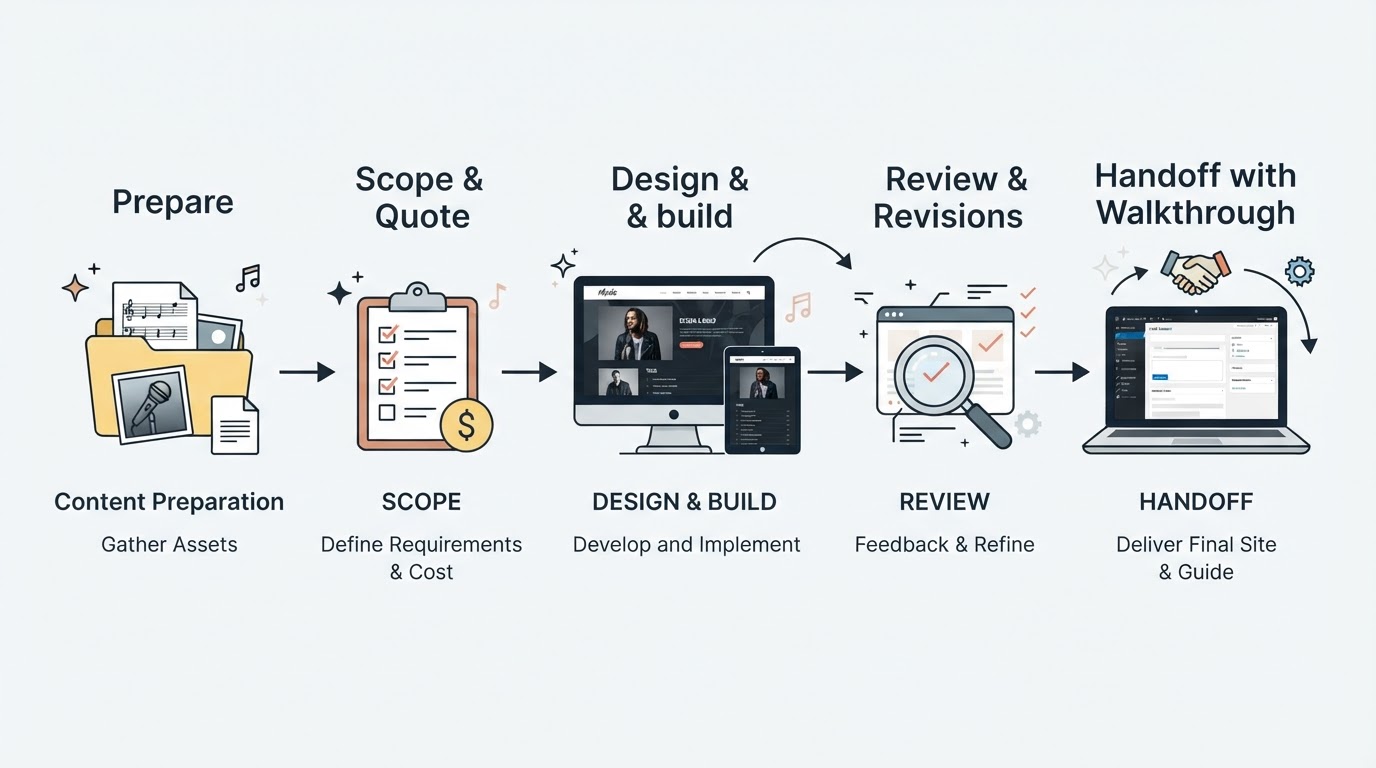
The projects that run smoothly are the ones where the content already exists. A designer can shape your material, but nobody can invent your bio, your photographs, or your release plan.
Decide what the site is for
Write one sentence describing the site's main job: supporting a release, booking a tour, presenting a press kit, or selling merch. That sentence decides which pages matter now and which can wait.
Gather the content
- A short bio for the site and a longer version for press use
- High-resolution live photographs and at least one clean press photo
- Links to your music, videos, and social profiles
- Confirmed dates with venue and city
- Product details for anything you sell, if a store is in scope
- The inbox that should receive booking and press inquiries
Collecting this in one folder before the first call saves more time than any design decision.

Settle ownership up front
Decide who owns the domain and who owns the website account. The cleanest arrangement is that you own both and the designer works inside your account, so the site, the content, and the renewal stay with you.
Bring references and a page list
Pick two or three sites you like and note what you like about them: how the photography is paced, how the navigation works, how the tone reads. Then list the pages you need. For most musicians that is a home page, a music page, dates, an about or press page, and contact.
Set the deadline around a real date
If you have a release, a tour announcement, or a grant application, work backwards from it. Plan for the build to take a few weeks once the content is in hand, and have the content ready before that window starts.
Keep content decisions and design decisions separate. Agreeing on your photos, bio, dates, and links early lets the design work move without waiting on you; reversing the content direction late is what turns a short project into a long one.
How a design engagement works
The shape of a fixed-scope project is usually the same, whether you are a solo artist or a band.
Scope and quote
The first conversation covers what the site has to do, which pages are included, who supplies the content, and when it needs to be live. A fixed-scope quote follows from that conversation, so both sides know what is included before work starts. Ask for the scope in writing: the pages, the deliverables, the revision rounds, and what counts as a change of direction rather than a revision.
Design and build
Your material becomes a site: a custom design, page structure and navigation, mobile and tablet layouts, a portfolio or gallery for your photography, contact forms and basic integrations, and basic on-page SEO such as page titles, meta descriptions, and headings.
Review and revisions
You review the work in progress and give consolidated feedback. Revision rounds are defined as part of the scope; unlimited revisions are not how fixed-scope projects stay on schedule.
Handoff and walkthrough
The project ends with a walkthrough so you can update dates, swap photos, and publish news yourself. The site is built to be editable, and you keep the account, the site, and the content. Treat the walkthrough as training rather than a formality: you should finish it knowing how to add a date, change a photo, and publish an update. If any of that is unclear, ask before the project closes.
Timelines vary with scope. For a fixed-scope build, two to four weeks is a typical range once the content is ready.
Trade-offs to accept before you start
A scoped project suits most musicians, but it is not everything. Ongoing maintenance sits outside the build: the site is handed over ready to run, and you run it. Custom web applications and heavy custom code are out of scope. So is complex or enterprise-level e-commerce, which means a large catalog with detailed inventory rules needs a different plan.
The bigger trade-off is the platform. Building only on Squarespace is deliberate: it keeps the project efficient and keeps the finished site easy to manage after handoff. If your plans depend on a custom application, a different platform, or a large store, a fixed-scope build is the wrong tool. Better to discover that before the first call than three weeks into the work.
A concrete example: Chris Sidoruk Media
Chris Sidoruk Media runs a Squarespace website design service for creatives that follows the shape described above.
Its published pricing puts most projects at $2,500, with a $1,500–$3,000 range for smaller refreshes or more involved builds, and a typical timeline of two to four weeks. Consulting is available at $150 per hour for strategy, layout feedback, audits, SEO structure, and problem-solving, with a one-hour minimum billed in 30-minute increments.
Deliverables include custom design, mobile and tablet optimization, page structure and navigation, portfolio or gallery setup, contact forms and basic integrations, and basic on-page SEO such as page titles, meta descriptions, and headings. Every build ends with a walkthrough, the sites are built to be fully editable, and the client owns the account, the site, and all content at the end. A touring musician who needs to update tour dates without calling a developer is the kind of case the service is designed around.
If a full build is premature, consulting is the smaller entry point: a layout audit, an SEO structure check, or a working session on what to fix first.
How to know you are ready
You are ready to start when you can say yes to these:
- You can describe the site's main job in one sentence.
- Your bio, photos, music links, and dates are collected in one place.
- You know who will own the domain and the website account.
- You have a real deadline rather than an aspirational one.
- You can commit to reviewing the work and giving consolidated feedback.
When most of that list is true, the next step is a short conversation about scope. Chris Sidoruk Media's Squarespace website design page for creatives is the starting point, and the inquiry path there is where a project begins: bring your deadline, the pages you need, and a link to your music.