What makes a print fine art
Three things separate a fine art photography print from a poster: who controls the file, what the print is made of, and how the individual copy is accounted for.
A poster is reproduced from a supplied file at commercial scale on coated stock. A fine art print starts with the photographer's own capture and file, gets proofed on the exact paper or metal that will be used, and is produced in a small run or to order. That chain of custody is what makes a signature, an edition number, and a permanence claim worth anything.
Materials do the rest. Pigment inks laid on acid-free paper, or dye bonded into a coated aluminum panel, are built for years of display. A print of a good file made this way keeps shadow detail and highlight separation that an office printer flattens.
Accountability is the third test. You should be able to name the photographer, read the edition terms, and find out who produced the print. When a listing answers none of those questions, treat the piece as decorative wall art and price it that way.
How to buy: the order of decisions
Buying in the wrong order is the usual reason a print ends up in a closet. Work through these in sequence.
1. Measure the wall first. Record the available width and height, the distance to the nearest window, and the light direction at the hours you use the room. A north-facing wall and a west wall with direct afternoon sun demand different surfaces.
2. Pick the subject you will still want later. A picture tied to one trip or one sofa color ages faster than a landscape or a musician you return to.
3. Set the size from the wall. Tape the outer frame dimensions on the wall with painter's tape and stand back. The right size becomes obvious when the wall is marked; it rarely does on a product page.
4. Choose the surface from the light. A glossy finish under a window becomes a mirror. Metal in a bright coastal room handles humidity. Matte paper in a dim hallway loses its texture advantage.
5. Read the edition and signature terms. Where the signature sits, whether the piece is numbered, and what paperwork travels with the print all matter more than the word "limited".
6. Confirm production and shipping before you pay. Made-to-order printing means a lead time, and a made-to-order print that ships late is a gift that misses the date.
7. Budget the frame when you buy the print. Framing often costs a meaningful share of the total, and cheap mat board can undo an archival print.
Paper and metal compared
Paper and metal react to the same room in different ways. The table is a starting point; a sample print from the maker in your own light is the reliable test.

Surface | How it reads | Suits | Watch for |
|---|---|---|---|
Cotton rag, matte | Soft texture, wide separation in bright tones, gentle blacks | Rooms with diffuse light, pictures seen up close | Surface scuffs, fingerprints, needs a mat and glazing |
Baryta or fiber gloss | Deep blacks, crisp micro-contrast, darkroom look | Bold subjects, walls without direct sun | Reflects windows and lamps, shows dust |
Luster | Middle ground: detail without a hard mirror | Hallways, mixed lighting | Reflection at steep viewing angles |
Metal, dye on aluminum | Clean detail, even surface, no glazing needed | Coastal rooms, bright interiors, kitchens | High-polish finishes mirror the room; needs a float mount or deep frame |
Acrylic face mount | Depth and clarity behind acrylic | Statement walls, large formats | Heavy, so wall hardware has to carry it |
Canvas wrap | Softer detail with wrapped edges | Casual rooms, very large sizes | Loses fine texture; the image distorts at the fold |
A matte paper can look stronger than metal in a room with one soft window. A metal print can look cleaner than paper under a ceiling full of downlights. Ask the maker about a small sample if the wall is important enough to plan around.
Editions, signatures, and paperwork
Ask these questions before you commit, whatever the listing promises.
- Open or limited? An open edition can be reprinted at any time. You are buying the image, and scarcity is not part of the purchase.
- How many, and how is it marked? A number like 3/25 means the third print of twenty-five. Ask whether numbering appears on the print, on the back, or on a separate certificate.
- Where is the signature? A signature on the print carries more weight than one on the mat, and a signature on a certificate is the weakest of the three.
- Will the file be retired? Some photographers stop printing when an edition closes; others keep printing. The answer tells you what you own.
- Are there artist proofs? Proofs outside the numbered run are normal. Their existence should be disclosed rather than discovered later.
- What happens if the print arrives damaged? A written replacement path is worth more than a friendly sentence on a contact page.
A limited edition is not automatically valuable. Value follows the photographer's body of work, exhibition record, and how the edition is administered. A signed open edition you love is a better purchase than a numbered print from a series you do not.
Sizing a print to a wall
Size mistakes are more common than surface mistakes, and they are easier to avoid.
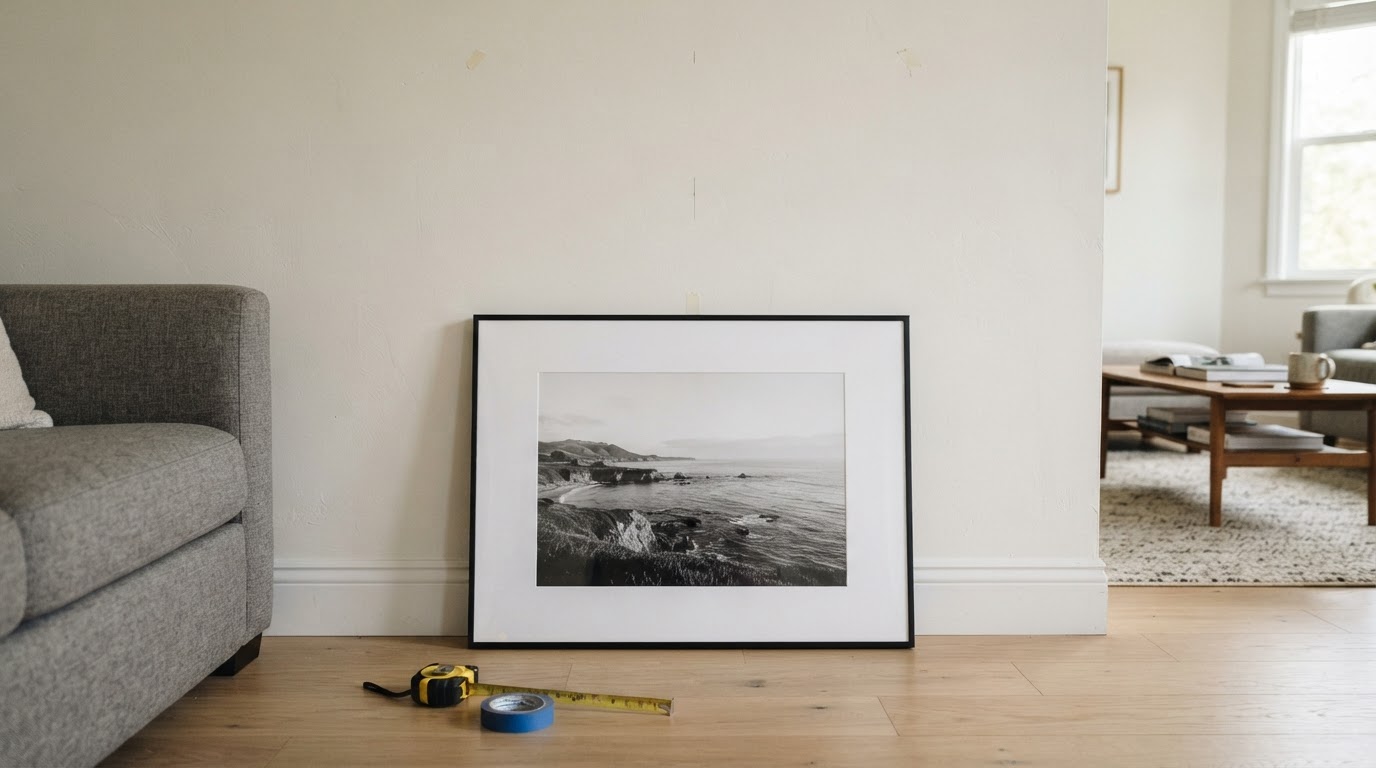
- Mark the frame, including the mat. Painter's tape on the wall shows the true footprint of frame plus mat.
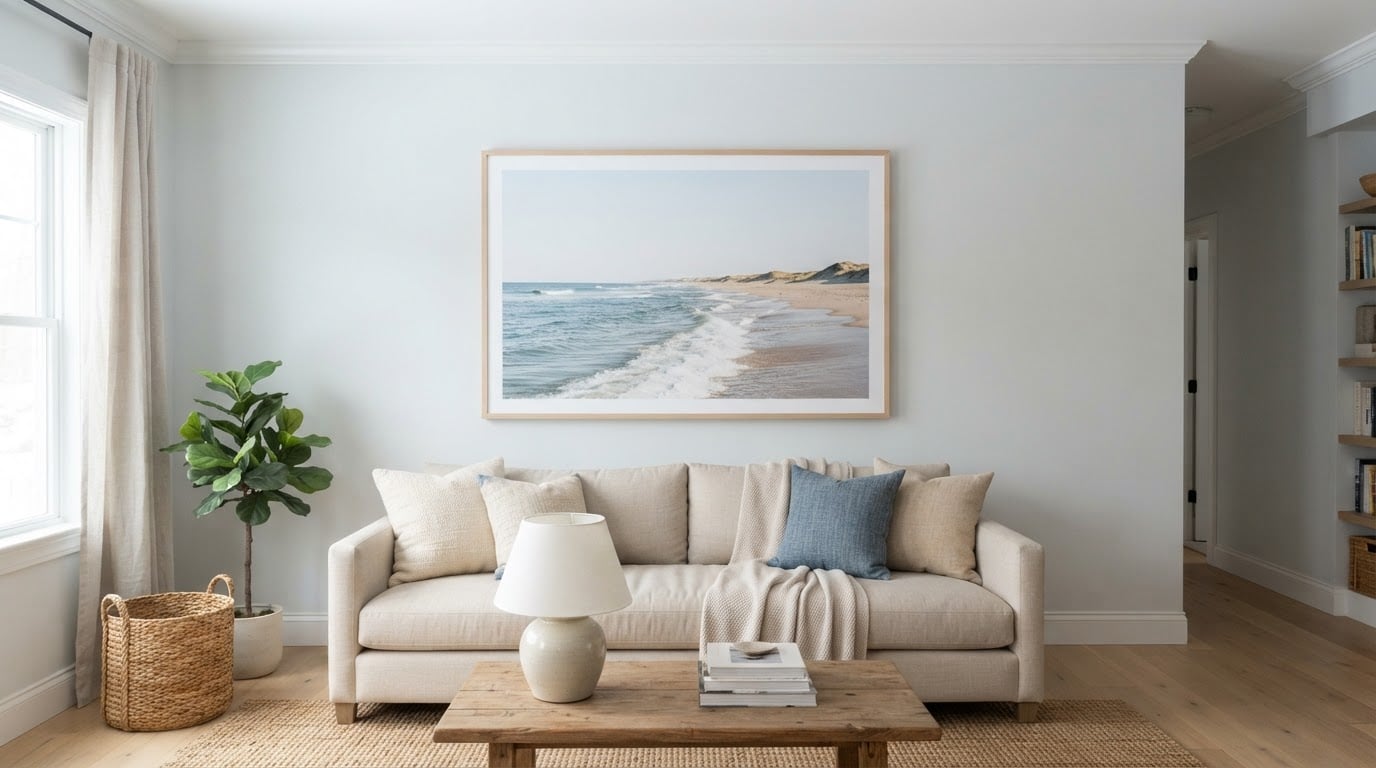
- Relate the print to the furniture below. A common proportion puts the framed width at roughly two-thirds of the width of the sofa or console under it, with wall space left at both ends.
- Hang at a viewing height. Center the piece near eye level for a standing viewer; over furniture, let the bottom edge clear the surface by a comfortable margin.
- Match size to distance. A small, dense print in a narrow hallway is seen from a few feet and can hold fine detail. A large wall across a living room needs a print that carries from across the rug.
- Check the ceiling line. A tall print can crowd a low ceiling or leave a stranded gap under a high one.
- Keep gaps consistent when grouping. Equal spacing between frames reads as a set; uneven spacing reads as an accident.
Framing and glazing decisions
The frame protects the print as much as it presents it.
A paper print needs an air gap so the surface never touches the glazing. Spacers or a mat provide it. Ordinary cardboard and acidic mat board yellow and stain over time, so specify acid-free or buffered board.
Acrylic glazing is lighter and safer above seating than glass, and easier to ship. Glass resists scratching better where hands and pets reach the frame. UV-filtering glazing slows fading and does not stop it, which is why the wall position still matters more than the glazing specification.
Metal prints often skip the frame. A float mount holds the panel off the wall and lets the surface read as an object; a frame with a deep rabbet gives the same effect with more protection.
Hanging hardware should be rated for the finished weight, fixed into studs or into anchors matched to the wall. A heavy acrylic face mount on one light hook is a repair waiting to happen.
Care after the print arrives
- Keep the print out of direct sun. If the chosen wall gets direct light, UV-filtering glazing and a rotation plan buy time.
- Hold humidity steady. Bathrooms, kitchens, attics, basements, and garages swing too much.
- Handle paper by the edges with clean dry hands or cotton gloves. Oils from fingers show up on matte surfaces permanently.
- Store unframed prints flat in an acid-free portfolio. A rolled print can take a set that shows under glazing.
- Dust with a dry microfiber cloth. Skip glass cleaners, solvents, and anything sprayed onto the surface.
- Reframe with acid-free materials. When a mount starts to yellow, replace it before the stain reaches the print.
Judging a photographer's body of work
One strong image says less about a print maker than the archive around it.
A series that holds together. Look at ten images together. Consistent framing, processing, and subject choices indicate a photographer working with intent.
Captions you can use. Place, date, and a line about what you are looking at make a print easier to live with and easier to describe to a guest.
A statement about approach. Writing about light, access, or method tells you more than a list of awards.
Processing that survives inspection. Open a large file if the site offers one, and look at shadows and highlights. Clean tonal transitions are a good sign.
Records and contact. Edition records, a signature policy, and a reply to a real question about production separate a print studio from a drop-shipping page.
Consistency across time. A body of work that has run for years, with dated captions and a visible archive, suggests the photographer will still be findable if the print needs attention.
Concert, coastal, and landscape subjects as prints
Subject type changes the practical choices more than most buyers expect.
Concert photographs carry stage light, deep shadow, and motion. Ask how the file was handled at high sensitivity: noise and color casts that vanish on a screen at small size become visible in a large print. Mid-size formats in dark frames hold the energy without magnifying grain. A frame of a hard-lit performer reads well in a room with warm lamps and no window glare.
Coastal images live or die on the horizon. A horizon that tilts by a degree is visible at a glance once the print hangs square against a wall. Metal handles salt air and bright rooms; matte paper gives softer water and sky, with glazing that will reflect a beach-facing window.
New England landscape photographs pack fine detail: tree lines, snow texture, wet rock, and the low seasonal light the region is known for. Detail-heavy scenes reward larger formats and matte or baryta paper, which preserve texture in shadow. Glossy surfaces and metal give skies depth and water clarity, with the usual reflection risk.
Whichever subject you choose, decide the wall conditions first and let the surface follow.
A next step you can finish in one sitting
Pick two walls before you browse any images. Measure both, note where the light falls, and write down the maximum width and height including the frame.
Then browse a print catalogue and shortlist two photographs, testing each against four questions: does the surface suit the light, does the size suit the wall, are the edition and signature terms clear, and does the maker answer questions about production and shipping. If a listing leaves the edition or the printer vague, ask before you buy.
Order the print once the frame is measured and the hanging hardware is in hand. A print that goes onto the wall the week it arrives gets seen every day.