Key answers
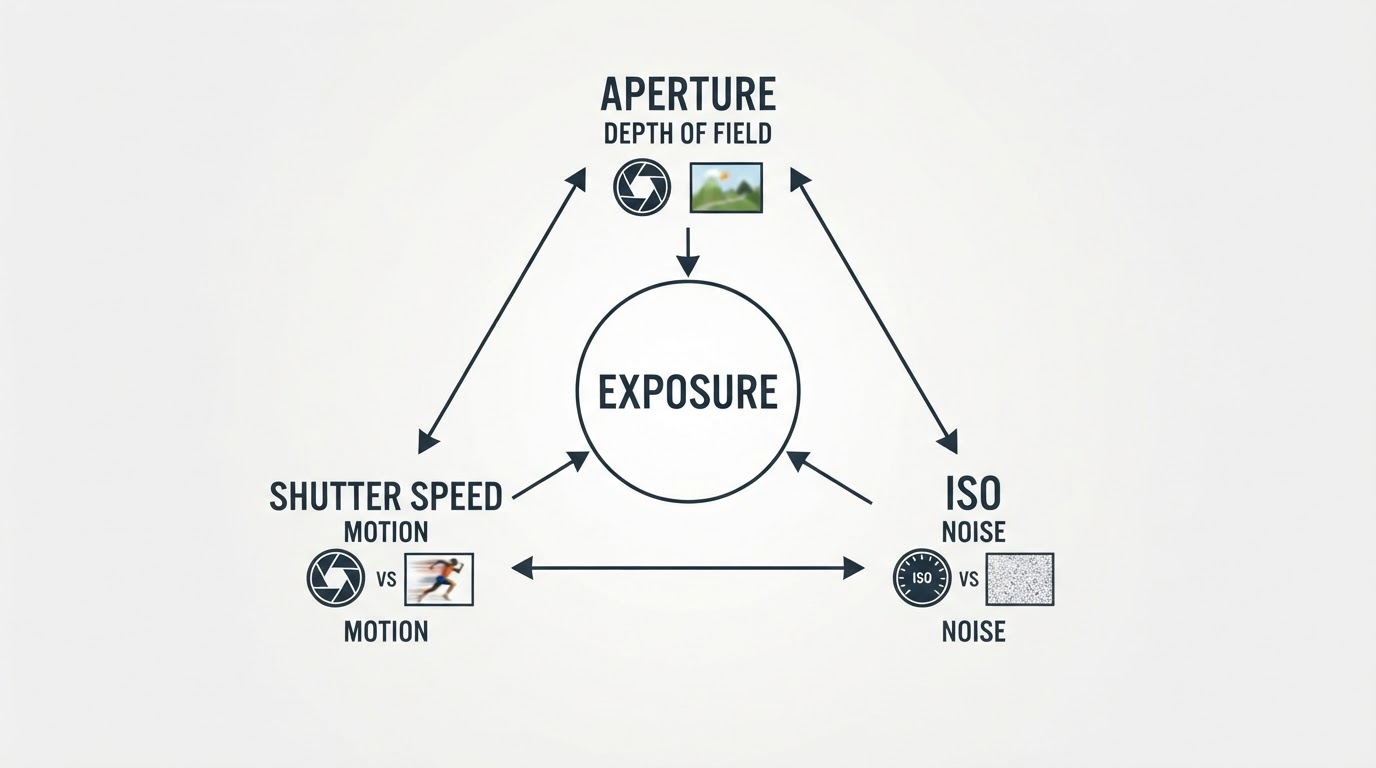
- Aperture decides whether you get the frame. f/1.4 to f/2.8 keeps the shutter near 1/250 s at an ISO you can still print; an f/5.6 kit zoom needs four stops more ISO for the same exposure.
- Pit distance decides focal length. Two to four metres from the stage suits 24–50mm, a long pit or festival barrier suits 70–200mm, and moving closer is rarely an option once the set begins.
- One lens for everything: 24–70mm f/2.8. It frames a whole stage from a shallow pit and still reaches a half-body portrait at 70mm.
- Two primes beat one zoom in the dark. A 35mm f/1.8 and an 85mm f/1.8 give roughly one and a third stops more light than an f/2.8 zoom.
- Telephoto is a distance tool. 70–200mm f/2.8 earns its place in arenas and festival fields; in a small club it isolates one face and loses the band.
- Focus speed outranks sharpness charts. A lens that locks onto a lit cheekbone at f/1.8 returns more keepers than a sharper lens that hunts.
- Two bodies beat one bag. Changing glass in a packed pit costs frames and risks a dropped lens.
- Rent before you buy. One show at your usual position answers what no specification table can.
Why aperture sets the ceiling in a dark venue
A fast aperture is the only exposure control that adds light without adding noise or motion blur.
Stage light is directional, uneven and constantly moving, so you are usually working at the edge of what the sensor can hold. The shutter has to stop the performer, the ISO has to stay low enough to print or crop, and aperture is what buys room for both.
Each full stop halves the light reaching the sensor: f/1.4, f/2, f/2.8, f/4, f/5.6. At the same shutter speed, an f/5.6 zoom needs four stops more ISO than an f/1.4 prime. If the prime holds ISO 3,200 at 1/500 s, the zoom lands near ISO 51,200 for the identical exposure.
Motion sets the shutter floor. A held note is clean at 1/125 s, a turning head wants 1/250 s, and drumsticks want 1/500 s or a strobe. Decide that number before the show and the aperture you need follows from the light on stage.
Depth of field is the trade. At three metres, an 85mm at f/1.4 gives roughly 10 cm of sharp depth, enough for one eye and not enough for a face turned slightly away; the same lens at f/2.8 gives about 21 cm. Focus on the eye nearest the camera and let the far ear go soft.
Focal length follows pit distance, not taste
Focal length is a distance decision: choose the length that fills the frame from the place the venue lets you stand.
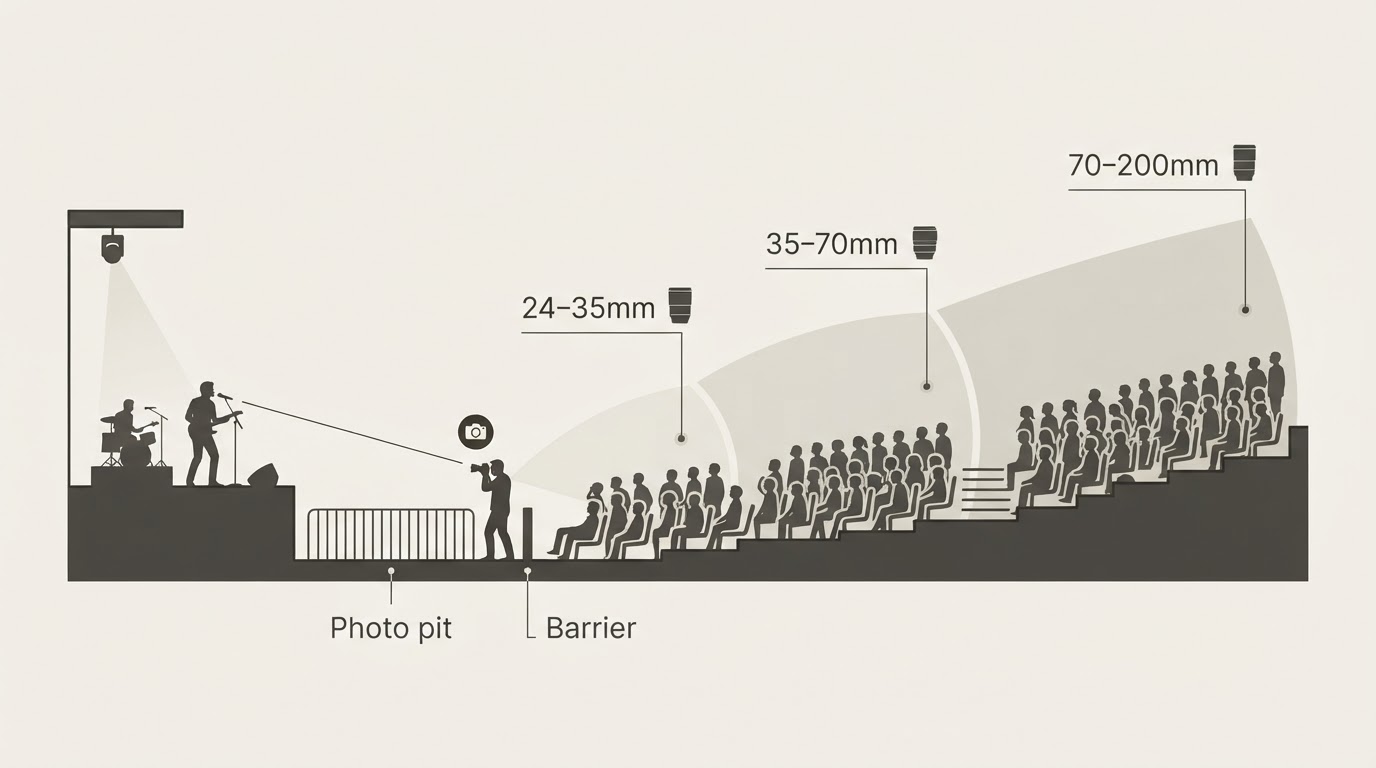
The arithmetic is worth doing once. Frame width at the subject is roughly distance times sensor width, divided by focal length. With a full-frame sensor 36mm wide, a 50mm at five metres frames about 3.6 m across, enough for a three-piece band; an 85mm at the same distance frames about 2.1 m.
Where you are standing | Distance to performer | Useful focal length | Aperture to aim for |
|---|---|---|---|
Front row, no pit, small club | 2–4 m | 24–35mm, 50mm | f/1.4–f/2 |
Shallow pit at a club show | 3–6 m | 35–70mm | f/1.8–f/2.8 |
Theatre or mid-size room, pit at the lip | 5–12 m | 50–135mm | f/1.8–f/2.8 |
Festival barrier, stage at field level | 10–25 m | 70–200mm | f/2.8 |
Arena or soundboard position | 25–40 m | 135–200mm | f/2.8 |
Those distances are working approximations, not venue specifications. Measure your own position during the opener and convert it with the formula. On an APS-C body, substitute 24mm for the sensor width, which makes a 35mm frame like a 52mm on full frame.
Wide, standard and telephoto: what each one is for
Each length answers a different question, and the room decides which question matters.
Wide from 16mm to 24mm puts the stage in its surroundings: the room, the crowd, the lighting rig, the scale of the night. It also stretches anything near the frame edge, so keep faces out of the corners and expect deep focus that hides small misses. One or two wide frames do more for a set than ten.
Standard lengths from 35mm to 70mm are the working range for pit photography. A 35mm at two to three metres fits two or three performers and a slice of crowd; a 50mm tightens to a half-body portrait without flattening the face. If you carry one prime into a club, pick this range.
Short telephoto from 85mm to 135mm does one job well: a single performer, isolated, with the background compressed into a wash of colour. From three to eight metres it crops out the kit and the monitor wedges that clutter a wide frame. It is the wrong tool for a duo standing shoulder to shoulder.
Long telephoto from 70mm to 200mm exists for distance. At 25 m, a 200mm frames a torso; a 70mm at that distance frames about 13 m of stage. If your access is a festival barrier or a soundboard platform, this is the length that decides whether the night produces usable frames.
Fast primes versus f/2.8 zooms
A prime buys light and focus speed; a zoom buys framing you cannot walk to.
In a pit, your feet are the constraint. The barrier, the security line and the crowd decide where you stand, so changing framing without moving is real value. That is why a 24–70mm f/2.8 is the default single-lens answer: full stage at 24mm, single performer at 70mm, one position.
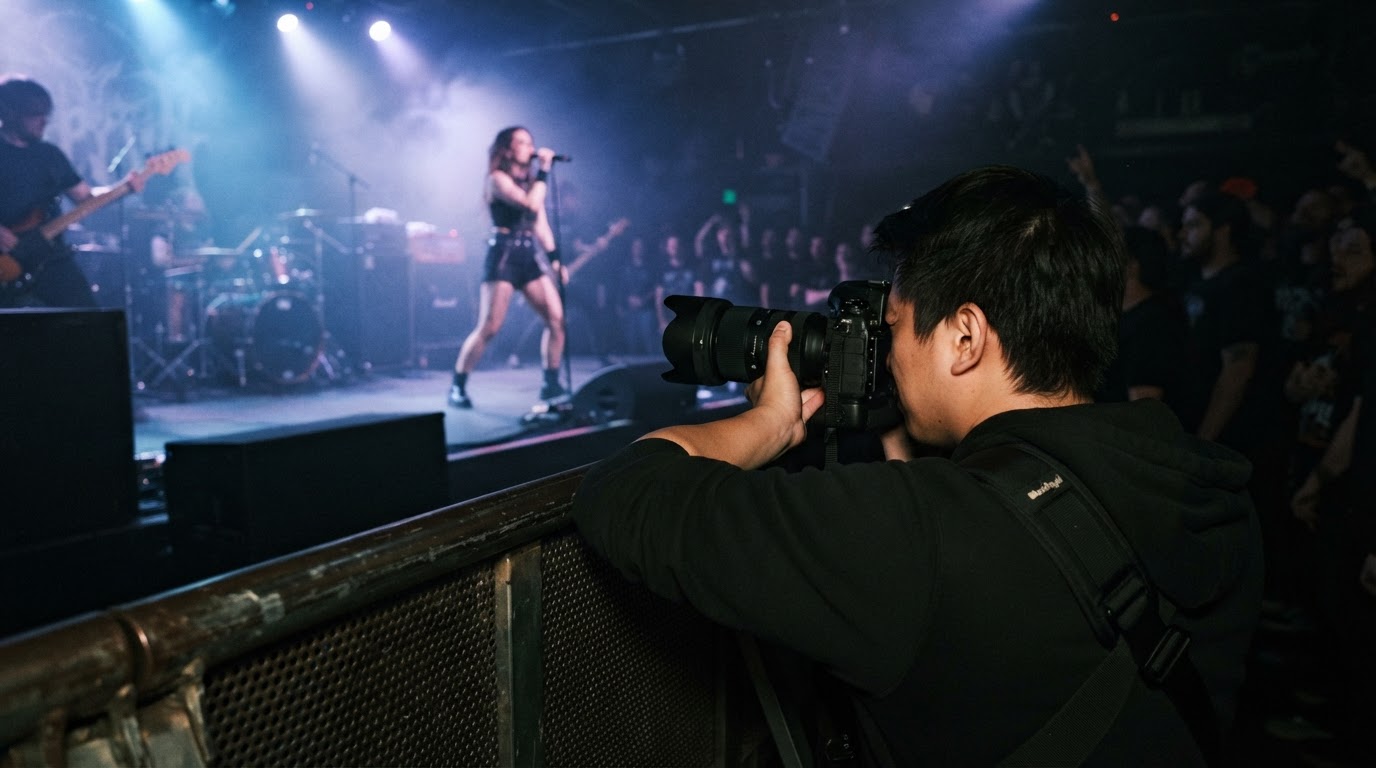
The cost is light. An f/1.8 prime at ISO 3,200 matches an f/2.8 zoom at roughly ISO 8,000 for the same shutter speed. In a dark club that is the line between a clean file and one where noise reduction erases skin texture. Wider apertures also feed more light to the autofocus system, which is why primes tend to lock faster when the stage goes blue.
Three kits cover most situations:
- Two primes: 35mm f/1.8 and 85mm f/1.8 on two bodies. Best low-light performance and the lightest bag, at the cost of fixed framings.
- Two zooms: 24–70mm f/2.8 and 70–200mm f/2.8. Best coverage from any position, and the heaviest option.
- One zoom and one prime: 24–70mm f/2.8 plus an 85mm f/1.8. Coverage for the wide and mid frames, with a fast option when the lighting drops.
Low-light autofocus: what actually fails
Autofocus fails on the dark, not on the moving.
A focus system needs contrast to measure. Black clothing, dark hair, a backlit silhouette and a deep blue wash remove the edges it needs, so the camera hunts while the performer keeps moving. Aim at something with a lit edge: a cheekbone under a spot, a collar, a mic stand, the edge of a guitar body. Then recompose.
Use a single point or a small cluster over the face rather than a wide automatic area. Set focus priority instead of release priority so a hunting lens does not fire a blurred frame. For a performer moving between marks, continuous autofocus on a lit point usually beats tracking a face that turns away from the light.
Two habits help when the light collapses. Pre-focus manually on a stage mark where the performer returns, then leave the lens there and wait. Check the camera's low-light autofocus rating in the manual, given in EV, and treat it as a floor rather than a promise, because it assumes a contrasty target. Turn off the autofocus assist lamp: it cannot reach a performer eight metres away and it draws attention in a dark room.
Stage lighting: banding, silhouettes and clipped faces
Stage light is not continuous, and the two visible failures are banded frames and blown faces.
LED fixtures and video walls switch faster than the eye can see, and an unsynchronised shutter records that switching as dark bands. Where the supply is 60 Hz, build shutter speeds on 1/60 s: 1/60, 1/120, 1/250. Where it is 50 Hz, use 1/50, 1/100, 1/200. Use the anti-flicker setting if the camera has one, and check the first frames on the back screen before the set gets going.
Metering fails in the opposite direction. A dark room with one spotlight makes an average meter expose for the darkness and blow out the face. Spot-meter the lit skin, or expose so the brightest part of the face sits just below clipping, and let the background stay black. A silhouette is a legitimate frame when you choose it deliberately.
Weight, backups and swapping lenses in a pit
Carry two bodies or one body plus one lens you can reach without opening a bag; a pit is a bad place to change glass.
Weight adds up faster than buyers expect. A 70–200mm f/2.8 is several times the weight of an 85mm f/1.8, and a full-frame body with two f/2.8 zooms becomes a load you feel by the second hour. A harness spreads that across both shoulders; a single sling strap puts it all on one side of your neck.
Backup planning is about the failure you can still work around. A second body is the only real insurance against a dead shutter or a dropped lens, and it keeps two focal lengths ready without a swap. With one body, carry two memory cards and write to both, two charged batteries because live view and cold venues drain quickly, and a cloth for haze and sweat on the front element.
Plan the set list as well. With one body and one zoom, shoot the wide opener for context, then move to the long end for the quiet song where the performer stands still. Knowing which frame you can still deliver with what remains is worth more than a lens you cannot change to.
Renting before buying
Rent the exact focal length and aperture for one show before you spend on it; a single night of keepers tells you more than any specification table.
Rental houses stock the common concert lengths, and a weekend rate is a small fraction of a purchase. Rent the lens you are considering plus the one you think you cannot justify, and shoot both from the position you normally get. Rentals also test what actually decides concert work: how fast the lens locks focus in near darkness, whether the zoom ring is usable one-handed, and how the coatings handle a direct LED wash.
Make the judgement calls during the rental. Does the framing suit your usual venue, or are you cropping every frame? Does the weight still feel acceptable after a three-hour show? At its widest aperture, is the sharpness good enough to publish, or does it only sharpen stopped down, which defeats the point? Return it if the answers are no; you have lost a rental fee instead of a purchase.
A test you can run in one set
Shoot the first three songs with the candidate lens, then grade your own keepers against a fixed standard.
Choose one focal length and one aperture, shoot 60 to 100 frames from your normal position, and review at 100 percent on a proper screen. A frame passes if the eye nearest the camera is sharp, the face is not clipped, the framing needs no crop you would be unhappy to publish, and the noise still holds at your delivery size. Count the passes and divide.
One pass in three means the lens suits that room and position. Fewer points to a real mismatch: focal length wrong for the distance, aperture too slow for the light, or a focus system that cannot handle the darkness. Repeat the test in a larger room before concluding anything about the lens, because a club and a festival field test different things. Write down the settings behind the passes; that record makes the second show easier than the first.
Choices that rarely work
Some combinations fail for structural reasons rather than operator error.
- An f/4–f/5.6 kit zoom in a dark club. It forces high ISO or slow shutter speeds exactly where neither is available.
- A slow 70–300mm at a night festival. The reach is right, the aperture is not, and the focus hunts in low contrast.
- 100mm or longer in a small club with no pit. You will crop limbs and lose the band.
- An ultra-wide as the only lens. Every frame shows the room and none shows the performer's expression.
How to choose in four steps
Choosing the best lens for concert photography comes down to four decisions: distance, focal length, aperture, then a test.
- Measure the distance. Record where the venue lets you stand at your usual shows, in metres.
- Pick the focal length from that distance. Frame width equals distance times sensor width divided by focal length.
- Buy the fastest aperture you can carry and afford. Every stop from f/2.8 to f/1.4 halves the ISO you need, and ISO is what limits the final file.
- Rent and run the set test before committing. One show at one position, graded against a fixed standard, is the only evidence that matters for your rooms.
If the answer is still unclear, a 24–70mm f/2.8 is the safest single purchase, and an 85mm f/1.8 is the most useful second lens for the frames a zoom cannot reach in low light.