Quick answers to the usual questions
Start with a budget ceiling, a lens mount, and an honest low-light requirement, because nearly every other decision follows from those three.
- What should I set first? A budget ceiling you can hold after paying for a spare battery, memory cards, a bag, and one extra lens.
- How much of the budget belongs to the body? Less than you would like. Bodies are replaced; lenses keep working across upgrades.
- Do I need a full-frame sensor? Only when you often work in low light or want very shallow focus, and only if you can afford lenses that use the advantage.
- Which lens should I buy second? A fast prime in the focal length you use most, because it teaches you more about light than a second zoom.
- Does video matter? Decide before you shop, so you do not pay for recording features you will never set.
- Is used gear a risk? It is a checkable risk: ask for the shutter count, inspect the sensor, and buy where returns are possible.
- What should I do in the shop? Bring your own card, shoot in the darkest corner, and hold the body with a long lens attached.
- When should I stop researching? When two candidates fit your budget and your mount, and one of them feels better in your hands.
Set a budget you can afford to complete
The body is one line in a longer bill, so set a ceiling below what you can spend and hold the difference for the parts that make it usable.
A working kit also needs a spare battery, memory cards, a card reader, a bag, a strap, cleaning supplies, and one additional lens. Buying the body first and improvising the rest usually produces an expensive camera with a slow zoom and a card that cannot keep up with continuous shooting.
Set the ceiling before you open any shop page, then work backwards. Choose the body last, after you have set aside enough for a lens that suits your light. Previous-generation bodies are where most of the value sits; the differences between neighbouring models rarely change what you can photograph, while the difference between one lens and another changes it immediately.
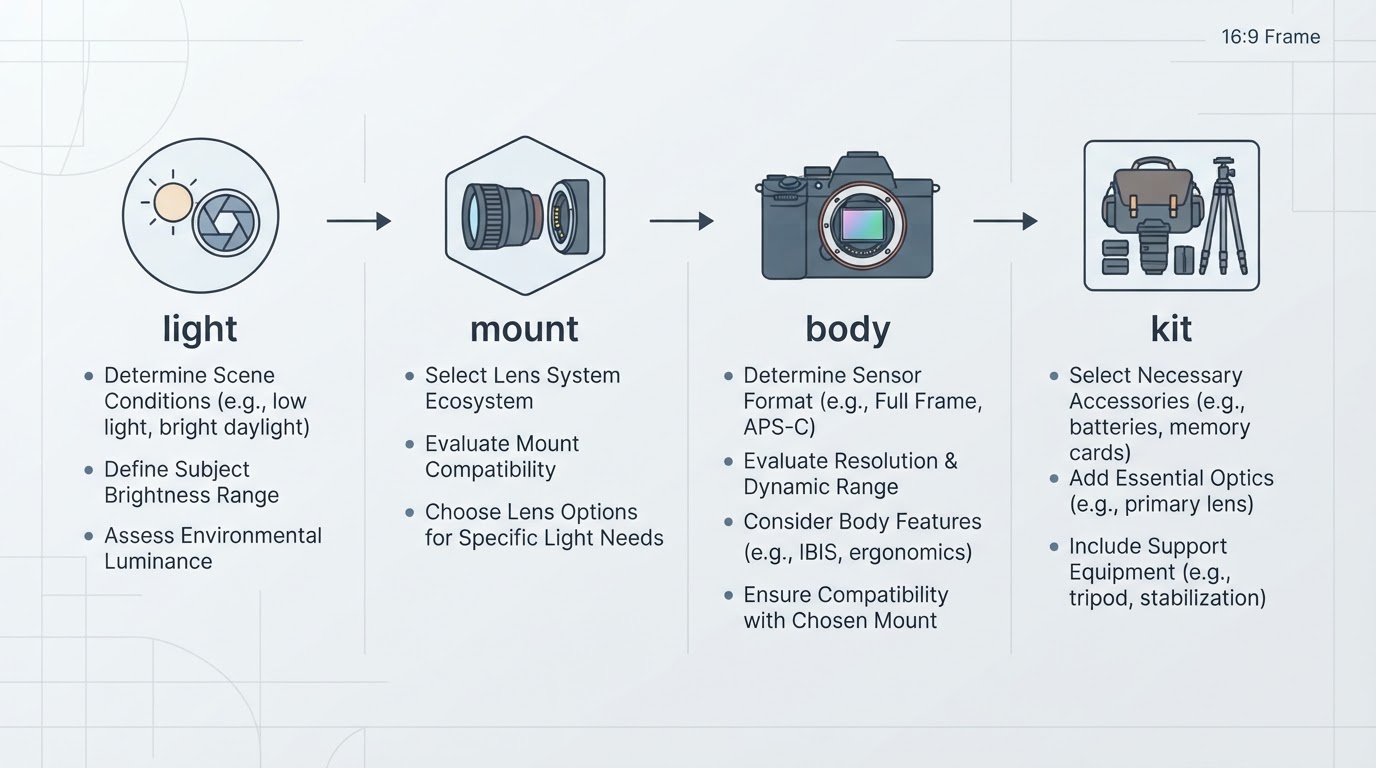
Price the whole kit before you become attached to a body. Add every item you know you need, compare the total with the ceiling, and remove the item you are least likely to use. If the total still does not fit, buy the cheaper body and the better lens.
Match the sensor to the light you work in
A larger sensor collects more light at the same aperture, and that extra room only helps when the lens in front of it can open wide.
Sensor size changes three things together: how much light is gathered, how shallow the focus can become, and how large the body and lenses grow. Full-frame cameras gather more light and separate a performer from a dark background more easily. APS-C and Micro Four Thirds cameras trade some of that headroom for smaller bodies, cheaper lenses, and longer reach from the same focal length.
Low-light work depends on the lens as much as on the sensor. A crop-sensor body with a fast prime can produce cleaner files in a dark venue than a full-frame body with a dim kit zoom, because the aperture decides how much light arrives in the first place. Stabilisation helps with still subjects and camera shake; it does not freeze a singer who is moving.
Format | What it gives you | What it asks of you |
|---|---|---|
Full-frame | More light in very dim rooms, shallower focus | Larger lenses, higher cost, more weight |
APS-C | Compact kit, longer reach, cheaper fast lenses | Less headroom in very low light |
Micro Four Thirds | Small bodies and lenses, strong stabilisation | More careful exposure in dim venues |
Read sample files from the camera you are considering in the kind of light you actually shoot. Studio samples at the lowest sensitivity tell you almost nothing about a club with a single spotlight and a smoke machine.
Buy into a lens mount you can grow with
The mount decides what you can add later, so check the lens you want in two years before you commit to a body.
Lenses hold their usefulness across body upgrades; bodies rarely do. Before choosing a body, look at the native lens line for the focal lengths you need, the fast options within those lengths, and whether third-party makers fill the gaps. A mount with a thin native selection can look cheap at the start and expensive once you need a bright lens.
One fast prime in the focal length you use most will teach you more about light and framing than a second zoom. A constant-aperture standard zoom is the flexible choice for events, portraits, and stage work where you cannot move. Ultra-wide, macro, and long telephoto work each impose their own lens requirement, so choose the body only after you know which of those you need.
Adapters can extend a mount, though autofocus behaviour varies and some lenses lose focus modes or in-camera corrections. Treat an adapter as a bridge for lenses you already own, and plan to buy native glass for the work you do most often.
Judge autofocus by behaviour in dim venues
Low-light autofocus is a behaviour you can only watch in a dark room, so test it there instead of trusting a sensitivity figure.
Manufacturers quote a low-light focus limit measured under favourable conditions, with a bright lens and a high-contrast target. In a venue the camera faces dark clothing, stage lighting that shifts colour, and performers who move between light and shadow. What matters is how quickly the camera acquires a subject and whether it stays with that subject through movement.
Phase-detection points on the sensor generally track movement better, while contrast-detection systems can hunt when light drops. Eye detection is useful in rehearsals and portraits; in a crowded pit, a single flexible point that you can move quickly is often more dependable. Manual focus with magnification and focus peaking remains a practical fallback for a still performer.
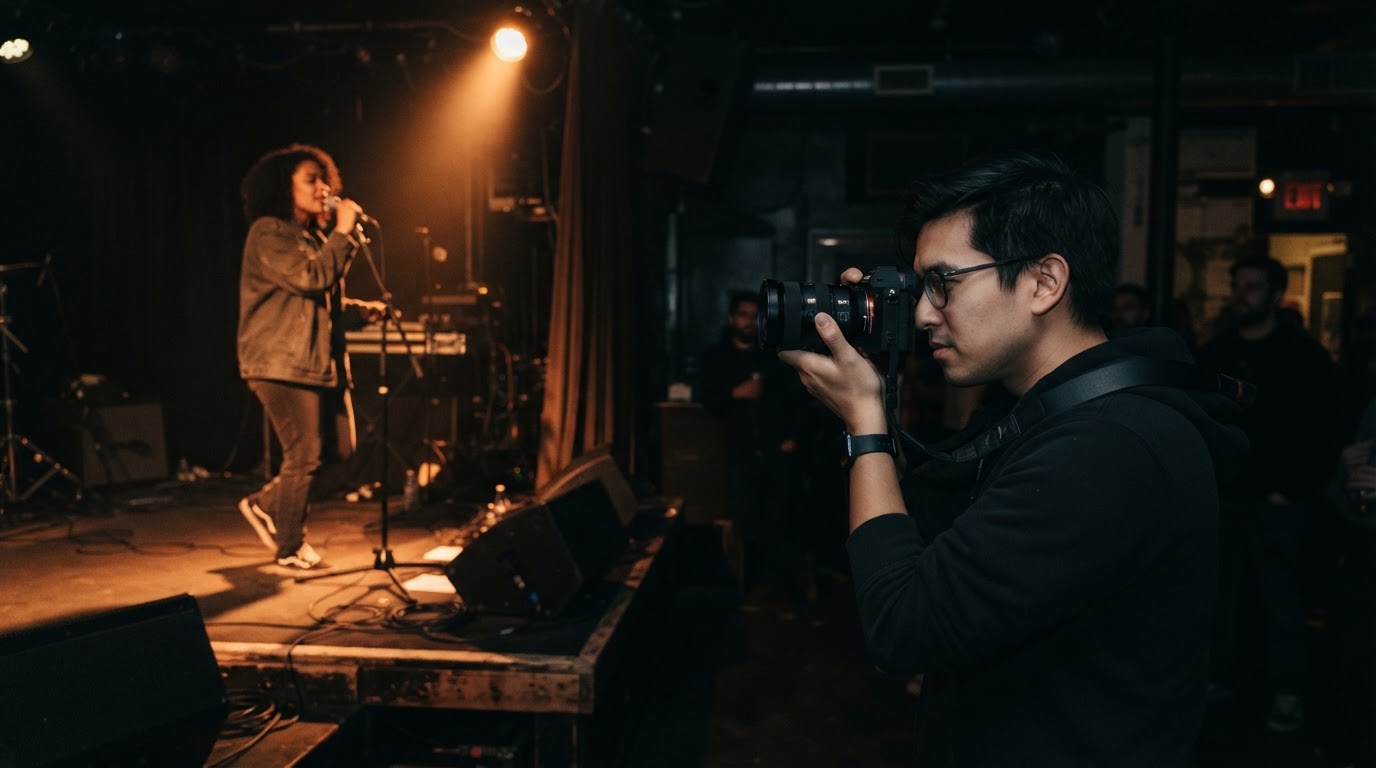
Practise before you rely on it. Set the focus mode you intend to use, point the camera at a person in a dim room, and watch whether it locks on the face or on the collar behind it. Then repeat the test with the camera in the hand you normally shoot with, because the way you hold a body changes what the focus system sees.
Weigh handling and weight with the lens attached
A camera you leave at home photographs nothing, so judge weight with the lens mounted and the grip in your own hands.
Balance matters more than the body's own weight. A compact body with a long lens feels front-heavy after an hour and is harder to hold steady at slow shutter speeds. A larger grip helps with long lenses, cold hands, and long days; a small body travels better and attracts less attention.
Check the controls you will change while shooting: exposure dials, focus point selection, drive mode, and the viewfinder. An electronic viewfinder shows the exposure you will get, which helps in a dark venue, provided the eyecup suits your eye and the refresh holds up when the light falls.
Sealing, shutter sound, and the screen hinge matter according to where you work. A quiet shutter or a silent mode helps during quiet passages. Weather sealing helps outdoors in rain and dust. A tilting screen helps when you photograph from the floor of a pit or hold the camera above a crowd.
Decide how much video you really need
Buy for the work you do most, and check these video features only when moving pictures are part of your week.
Resolution is the least useful video specification for most buyers. Stabilisation, audio inputs, recording limits, and overheating decide whether a long take is possible at all. A microphone input and a headphone output matter more than a sharper image attached to unusable sound.
Check whether the camera crops the frame while recording, how long it records before it stops, and whether it can record while charging. If you plan to grade footage, confirm the picture profiles and bit depth first, since those features cannot be added later. An articulating screen and a clean HDMI output help when the camera sits on a gimbal or a tripod.
If you take occasional clips between still jobs, most current bodies are sufficient, and the money is better spent on a lens or a second battery.
Compare used and new on total cost
Used gear buys a better body for the same money, and new gear buys a warranty, so decide which of those two you need more.
A used professional body from a previous generation often has better controls and a stronger build than a new entry-level model at the same price. The risk sits in condition and support: shutter count, sensor dust, mount wear, and whether the maker still services that model.
Buy where returns are possible, ask for the shutter count and recent service history, and inspect the sensor with a bright light and a narrow aperture. Lenses age better than bodies and are usually the safer used purchase, particularly simple primes and manual-focus glass. Confirm that batteries, cards, and repair support remain available for the model you are considering.
Compare total cost rather than the asking price. A cheap used body that needs a new battery, a fast card, and a service can end up costing more than a new body with a warranty and a current mount.
Test the camera before you pay
Bring your own memory card to the shop and spend the visit testing the details that will annoy you later.
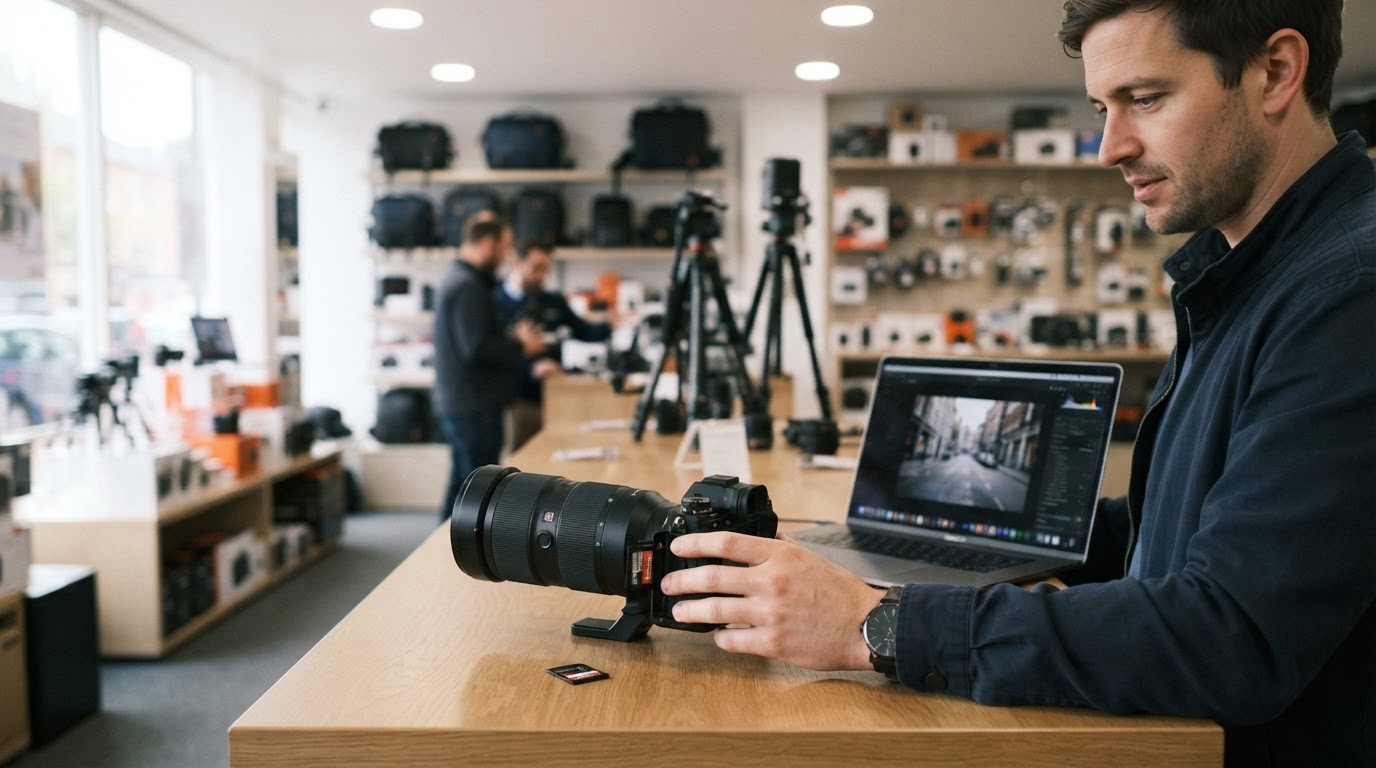
- Focus in the darkest corner of the store, in the focus mode you intend to use.
- Hold the body with the largest lens you own or plan to buy, and check where the weight sits.
- Shoot a burst and watch the buffer clear while you review the frames.
- Put the viewfinder to your eye and adjust the dioptre until the display is sharp.
- Turn the dials and press the buttons with the camera at eye level, as you would while working.
- Record a short clip and check where the microphone and headphone sockets sit.
- Review the files on a laptop rather than the rear screen.
- Ask about the return window and whether the shop lends gear for a shoot.
Shops and photography shows are the cheapest way to compare two bodies within the same hour, in the same light, with the same lens. A show also lets you handle a long lens that no shop keeps in stock, which is often the purchase that decides whether a system suits you.
Stop comparing when the answer is clear
Two candidates that clear your budget and mount requirement will separate on handling, so choose the one that fits and put the difference into practice.
The final comparison rarely changes the photographs you make. Once a body meets your light requirement, supports the lenses you need, and feels secure in your hand, further reading adds doubt rather than information. Buy it, add one fast lens, and photograph the work you bought it for. If your first shoots expose a real limitation, you will know which specification actually matters, and that is a better basis for the next purchase than any comparison table.