Answer first: name the act and the moment
A caption gets easier when you start with facts instead of adjectives. Open with the act and the moment: the artist or band, the venue, the city, and the date. In draft form that looks like "ARTIST at VENUE, CITY, STATE, on DATE." Then add one short line about what the photograph actually shows, and stop. The frame supplies mood; the caption supplies facts.
Every detail in that sentence needs a source you can point to. Assignment notes, the venue calendar, and the artist's published show listing are the usual places. If the notes say only "headliner" and you cannot confirm the name, write "the headliner" and leave the individual unidentified. Do not identify a performer from clothing, tattoos, or stage position, and do not assign feelings to someone you do not know. When verification fails, describe less rather than guessing more.
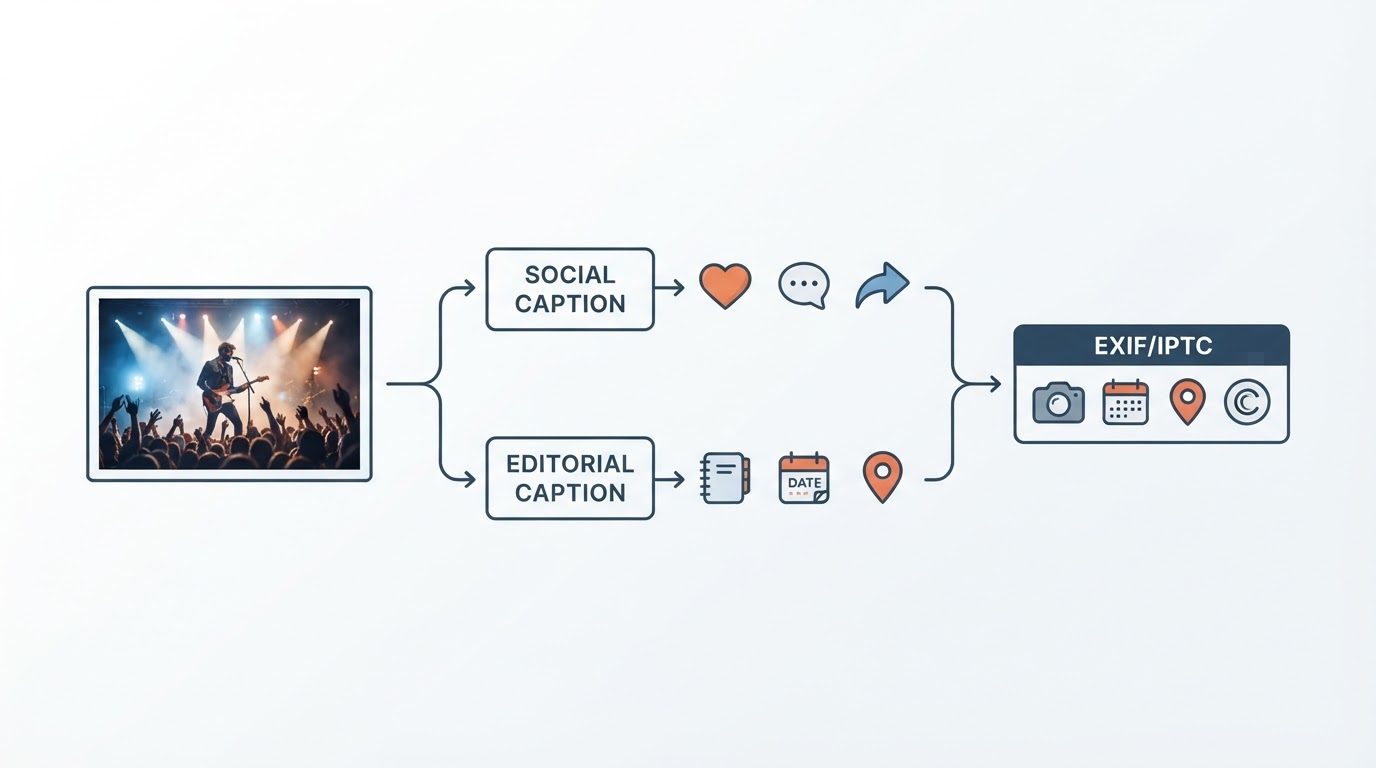
Two jobs follow from that answer. A social caption gives a viewer a reason to stop on the image. An editorial or client caption gives an editor, archivist, or client a record they can use months later. They can share a first clause, but they are not the same piece of writing.
Short social captions that stay honest
Short concert captions for Instagram are where most people start, and also where captions drift into invented detail. The patterns below use bracketed placeholders. They are templates, not reports about a real show, and none should be published until every bracket is replaced with a fact you have checked.
Factual opener. "ARTIST at VENUE, CITY — DATE." No embellishment; useful when the image is strong enough to carry the post.
Moment first. "MOMENT — ARTIST at VENUE, DATE." Lead with the visible action, then identify the act.
Visible detail. "One frame from ARTIST at VENUE on DATE: WHAT THE FRAME SHOWS."
Light and color. "OBSERVABLE LIGHT OR COLOR, ARTIST, VENUE, DATE." Describe only light and color you can see in the frame.
Short and dry. "ARTIST. VENUE. DATE. That is the post." Deliberately minimal, and hard to get wrong.
Gentle humor. "OBSERVABLE ODDITY IN THE FRAME. ARTIST, VENUE, DATE." Keep the joke about what is visible, never about the band's private life.
The patterns above are optional starting points. There is no established word count that makes a short caption work, and the image can carry as much or as little as you leave it. Aesthetic concert captions can lean on light, grain, color, or silhouette, but they still need the act and the date if the post should be findable later. Instagram concert captions also benefit from putting any required credit in the first visible line rather than in a comment thread. Funny concert captions work when the humor comes from something in the frame. Invented band banter, fake quotations, and lyric snippets do not belong in a post you may have to defend to an artist, a venue, or an editor.
The editorial caption: who, what, where, and when
An editorial caption is a record, not a poster. The dependable pattern is who, what, where, and when, followed by whatever credit the supplier requires:
"ARTIST performs at VENUE in CITY, STATE on DATE. ONE SENTENCE ABOUT THE VISIBLE ACTION. Photo: PHOTOGRAPHER, CREDIT LINE."
The middle sentence is where most errors enter. Describe what the frame shows, such as "sings into a handheld microphone" or "stands at the edge of the stage," rather than what you believe happened before or after the frame. If you did not see it and the notes do not record it, it does not go in.
A headline is shorter and separate: "ARTIST live at VENUE, CITY (DATE)" or "ARTIST at VENUE: DATE". It summarizes the caption for a listing or an archive, and it is not a substitute for the full caption.
For client work, caption requirements should come from the assignment rather than from habit. Usage scope, credit wording, and delivery format are normally settled before the show; the pre-shoot questions in the concert photography contract checklist cover those points. If the agreement requires a credit, the visible caption and the embedded Credit Line field should say the same thing.
Caption, headline, alt text, and metadata are separate fields
Readers see a caption. Software reads metadata. Those are different surfaces, and export or platform handling can cause fields to go missing when a file is delivered.
What you are publishing | Visible caption | Field to fill first | Check before it goes out |
|---|---|---|---|
Social post | Yes | Short social caption | Act, venue, city, and date confirmed |
Client gallery or website | Usually | Editorial caption | Who, what, where, and when present |
Press or EPK handoff | Sometimes | Description/Caption plus Credit Line | Exported file reopened and read back |
Internal archive | No | Headline and Description/Caption | Names spelled consistently |
The visible caption is the text a reader sees below or beside the image on a social post, gallery page, or client delivery. It can add context that the image cannot show, and it is the only one of these fields most viewers will ever read.
Description, often called the caption, is embedded in the image file and is meant to describe the who and what, and possibly the where, when, and why, of what is happening in the photograph. IPTC's Photo Metadata User Guide also notes that geographic location details belong in the location fields, not only in the description. The guide is the current reference for these definitions: IPTC Photo Metadata User Guide.
Headline is a brief summary of the caption. It is not the Title field, and it should not become a second, longer caption.
Alt text serves accessibility. It describes what is visible for people who use screen readers, and it is also shown when an image fails to load. IPTC added a separate Alt Text (Accessibility) field, and its guide says Description/Caption should not be used to populate alt text. Write the alt text as a plain description of the frame rather than copying the caption into it.
Creator identifies the photographer. Credit Line is the credit that the supplier of the image requires when the image is published. The two can overlap in content, but they answer different questions: who made the picture, and how it must be credited. None of these fields is interchangeable with another.
A copy-and-fill caption worksheet
Copy this table into your notes and fill one row per selected image. The same values then go into the file's metadata panel before export.
Field | What to enter | Your entry |
|---|---|---|
Social caption | Short line naming the act and the moment, with any required visible credit |
|
Editorial caption | Who, what, where, and when, plus one sentence on the visible action |
|
Headline | Brief summary of the caption, not a title |
|
Alt text | What the frame shows, written for a screen reader |
|
Creator | Photographer's name |
|
Credit line | Credit required by the client or supplier |
|
Location | City, state or region, and country |
|
Date created | When the photograph was made, not automatically the advertised show date; verify the capture date, time, and time zone where known, and do not overwrite it with the upload or delivery date |
|
Date created identifies when that photograph was made. A set or export can cross midnight, so do not assume it matches the advertised show date; use the verified capture date and time, including the time zone where known, and leave it unchanged during upload or delivery.
A blank cell is a prompt, not a failure. Fill the worksheet for one frame first, then compare it with what the exported file actually contains. If a row cannot be completed from verified notes, leave it blank rather than inventing an answer.
Check what survived the export
Embedded metadata can be changed, reduced, or dropped as a file moves between an editor, an export preset, a delivery folder, and a publishing platform. Do not assume that filling a field once means it will appear everywhere.
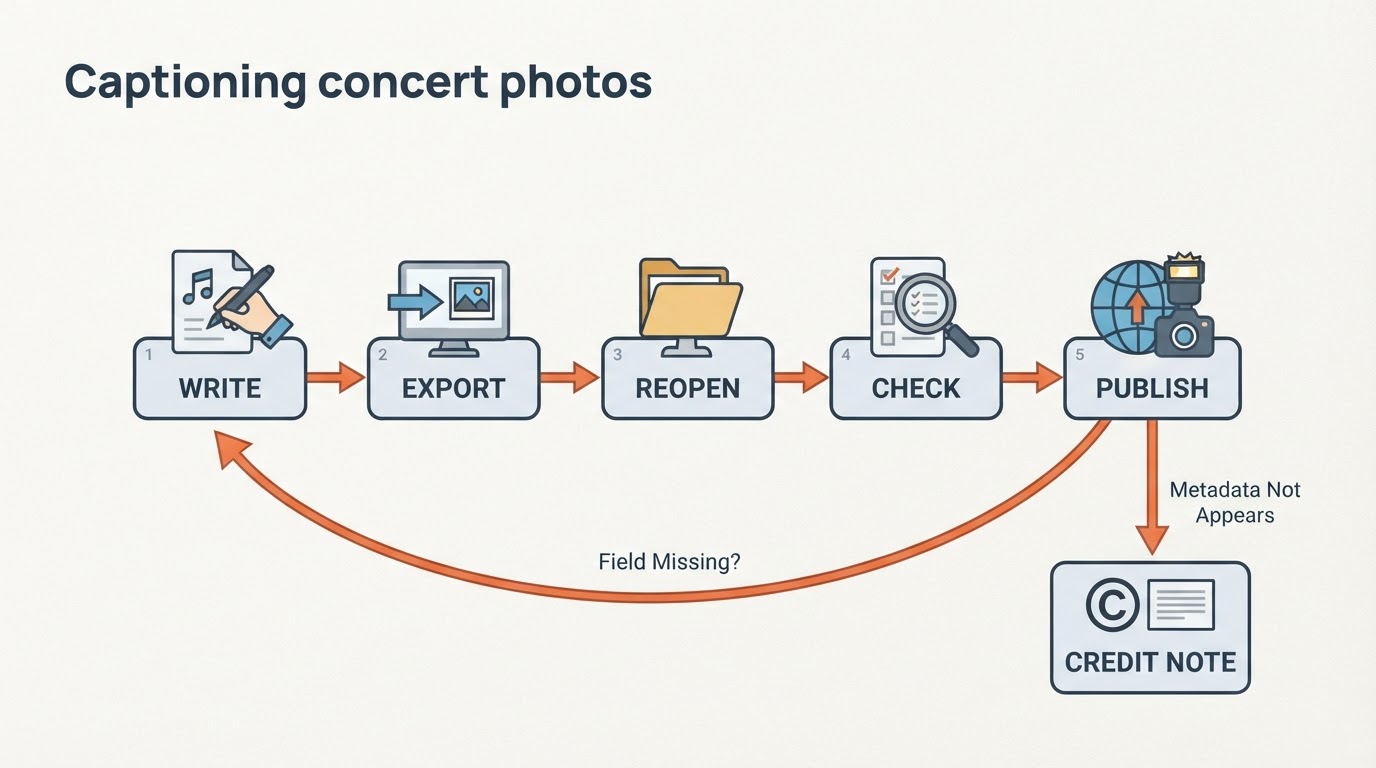
- Work on a copy of the original so the archive file stays untouched.
- Enter the caption, headline, alt text, creator, credit line, location, and date created in your editor's metadata panel.
- Export the file at the size and format you will actually deliver.
- Reopen the exported file in a metadata viewer and read every field back. Check the exported copy, not the catalog thumbnail.
- Upload a test copy to the destination and inspect the published result. Look for the visible caption and the credit, not only the image.
- If a field is missing after export or upload, add the credit to the visible caption and fix the export preset before the next delivery.
This is a reader-facing check: it shows what the recipient will see. It does not establish ownership, grant permission, or guarantee that a platform keeps metadata. Those questions belong to the license or assignment, not to the caption field.
When a detail cannot be verified
Missing facts are normal. The safe response is to reduce the claim, not to decorate it.
- Name the act only when the name is confirmed; otherwise use a role such as "the headliner" or "the opening act."
- Keep the venue and city when they are confirmed, and drop them when they are not.
- Leave an unknown date out rather than presenting an approximate date as exact.
- Describe visible action instead of inferred emotion: "leans back from the microphone" rather than "feels the song."
- Use a clearly fictional placeholder while drafting, and make sure no placeholder reaches a client or a published post.
A broader truthful description is acceptable. An invented specific is not. If a client needs a name you cannot verify, say so in the delivery note and let the client supply the detail from their own records.
Keep the caption near the edit
The best time to record caption facts is while the frames are still in shooting order. The site's guide to editing concert photos in Lightroom describes a restrained, top-down editing pass; pair it with a short caption note per select so the act, venue, city, and date are written down before filenames and exports separate the images from the show.
A contact sheet and a worksheet on the same desk are enough. You do not need a special tool or a new catalog. You need one place where verified facts live next to the frames they describe.
A caption you can defend
Read the finished caption as a stranger would. Can you point to the source for every name, place, and date? Is the visible caption distinct from the headline, alt text, and Description field? Does the credit match the one the client or supplier requires?
If any answer is no, the fix is usually to delete a detail rather than to add a qualifier. A shorter caption built from verified facts stays useful through export, upload, and delivery. A vivid caption built from guesses becomes a correction waiting to happen.