What a Concert Photography Agreement Should Settle First
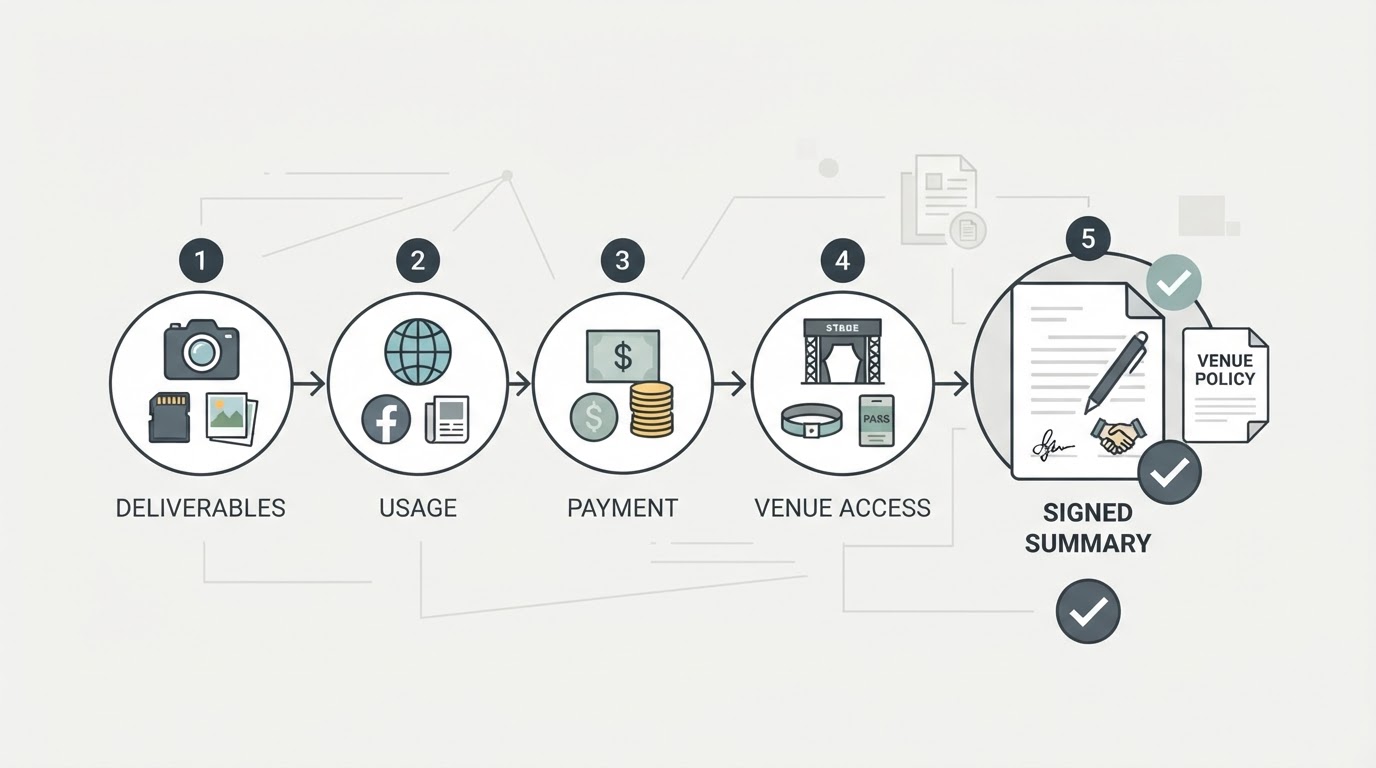
A concert photography contract does not need to be long, but it does need written answers to four questions: how many images you deliver, how the client may use them, how and when money moves, and what the venue allows. Leave any of those to a verbal understanding and the disagreement usually surfaces weeks later, when the band needs a press image or the venue wants a share of a print sale.
Published contract examples rarely fit your city, venue, or band; the questions below are what you need answered. None of this is legal advice or a substitute for a signed document reviewed by a professional in your jurisdiction.
Deliverables: How Many, Which Ones, When
- How many final, edited images will be delivered, and does the count include alternates or only the selects?
- Who chooses: you, the client, or both from a proof gallery?
- What counts as edited—exposure and color only, or retouching, alternate crops, and cleanup?
- When is delivery due—from the shoot date or final payment—and in what format and resolution?
- Are RAW files included? Treat a request for them as a separate negotiation.
- What happens if the set is cut short, the artist cancels, or access changes mid-show?
Usage and Licensing: Agree Before Anyone Posts
- Where may the images appear—social posts, an EPK, press pitches, a website, merchandise, or paid advertising?
- How long does the permission last, and in what territory?
- Is the permission exclusive? An exclusive grant stops you from licensing the same images elsewhere, so scope and price it deliberately.
- Is a credit required, and may you use the images in your portfolio?
- Can the client sublicense to a third party, such as a label or sponsor?
Ownership is separate from usage. Under U.S. law, copyright "vests initially in the author," which for an independent photographer is generally the person who took the photograph, subject to work-made-for-hire rules (17 U.S.C. Chapter 2). Paying for a shoot does not by itself transfer ownership. A transfer of copyright ownership—including an exclusive license—is valid only if it is in writing and signed by the rights owner (17 U.S.C. §204(a)). For more on permissions, see the site's image-licensing guide.
One exception is a work made for hire, where the hiring party is treated as author and owner. That can arise within the scope of employment; a specially commissioned work must fit a statutory category and have the required signed, express written agreement (Copyright Office Circular 30). Concert coverage may not fit a commissioned-work category, so do not assume a copied clause is effective without legal review.
Payment: Deposits, Balances, and Contingencies
- What deposit holds the date, and when is the balance due—before the show, on delivery, or on publication?
- Are travel, parking, credential, or rental costs reimbursed, and who approves them?
- What happens if the show is cancelled, postponed, or shortened, and which costs are still owed?
- Is a usage fee separate from the shoot fee? Broader commercial use is usually a separate grant, not part of the day rate.
- When does the license take effect, and what happens if payment is late?
Settle these as questions, not price guidance; rates vary by market and scope.
Venue Access: Credentials, Pits, and Restrictions
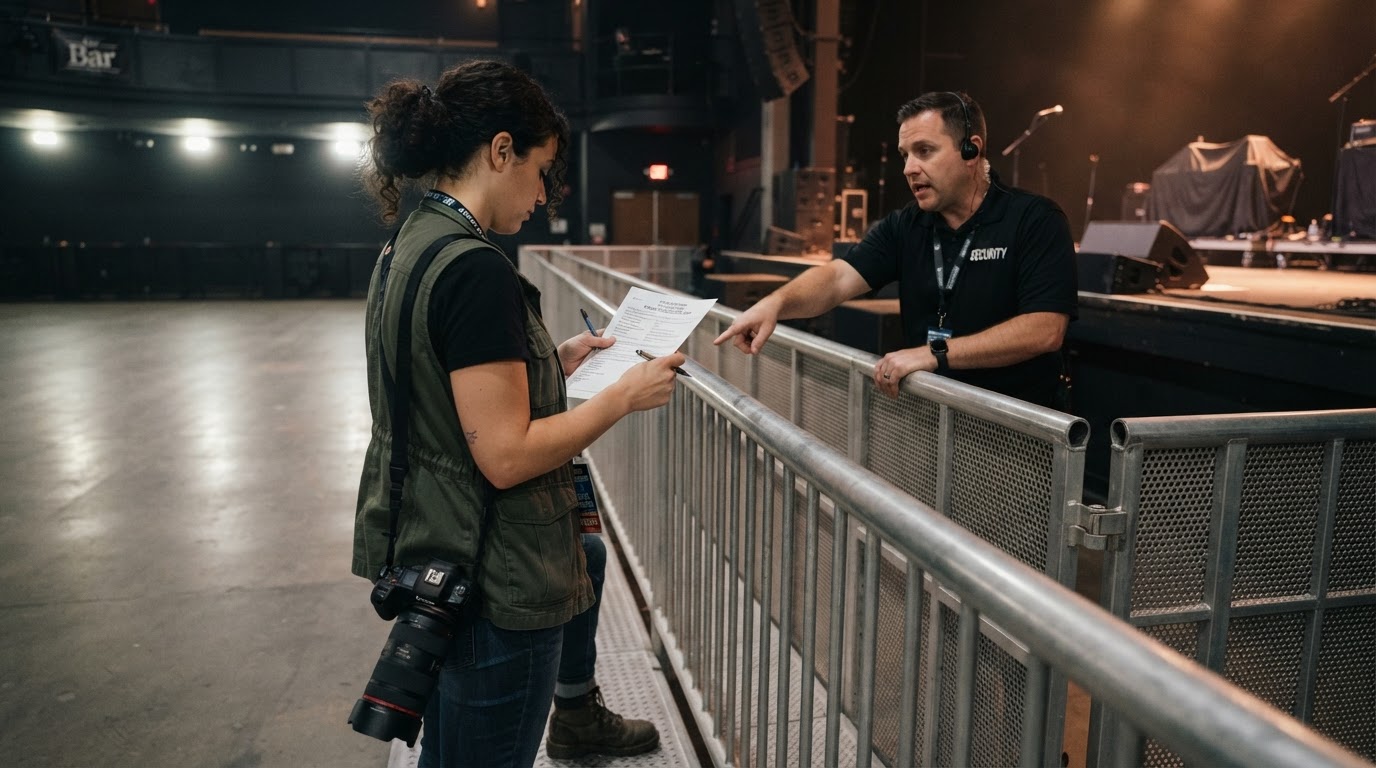
Venue rules are separate from your client agreement and can override the plan after you arrive.
- Does the shoot require a photo pass or credential, and who applies for it?
- Is pit access allowed, and for how long—the full show, the first three songs, or a fixed window?
- Are flash, detachable lenses, tripods, or certain bags restricted?
- Does the venue require a signed release or approval for commercial use?
- Who is the venue contact if access changes on show day?
Get the venue's photo policy and credential confirmation in writing and keep them with the agreement.
Decision Table: Which Question to Ask First
Situation | Ask first | Why it matters |
|---|---|---|
First shoot with a new client | Deliverable count and delivery date | Sets expectations early |
Band wants images for press and ads | Usage scope, territory, duration | Advertising is a broader grant than social posting |
Venue limits pit access | Access window and fallback plan | Access, not effort, determines what you can deliver |
Client asks for RAW files or "full rights" | Written transfer and its price | Ownership transfer needs a signed writing |
Images may appear on merchandise | Commercial and merchandising use | Merchandising is a different use from promotion |
How to Run the Pre-Shoot Conversation
- Send a one-page summary of the four areas—deliverables, usage, payment, access—the day before the call.
- Walk through each area in a short call and write the answers down. A borrowed photography agreement form is only a starting point; the answers are the decision.
- Send the written answers back the same day: numbers, dates, names, and any venue policy links.
- Have both parties sign and date the document and keep it with the venue policy and credential email.
- Before the show, re-check the two volatile items: the access window and the delivery date.
You have finished the checklist when both parties can point to dated, written answers for all four areas—and know who to contact when one changes.
Limitations
This is a pre-shoot discussion checklist, not a contract template, and not legal advice. Venue rules, permit requirements, and local law vary, and no checklist can cover a specific deal. If terms involve ownership transfer, exclusivity, significant money, or anything you do not understand, have a qualified attorney in the relevant jurisdiction review them for binding terms.
FAQ
Is a text conversation enough for a concert photography contract?
A text exchange can record what you agreed to, and a non-exclusive permission can be oral. But a transfer of ownership or an exclusive license is not valid without a written instrument signed by the rights owner. If the deal includes ownership, get a signed document.
Who owns the concert photos if we never sign anything?
Under U.S. law, copyright initially belongs to the author, ordinarily the independent photographer who created the image, and payment alone does not transfer it. Employment and valid work-made-for-hire arrangements can change that result; a separate ownership transfer requires a signed writing. Have counsel review an actual dispute or proposed transfer.
Can a venue stop me from selling or licensing the photos?
Copyright and venue access are different issues. Copyright does not give you the right to enter a venue, and venue policy or credential terms can limit how you shoot on the night. Ask for the photo policy in writing, and consider professional review if broader rights are requested.