A drone photography quote prices a defined job, not a flight
A photographer prices a defined piece of work, so the number follows the brief rather than the aircraft. Two shoots of similar-looking buildings can land at very different figures because the second one asked for a longer deliverable list, a tighter deadline, or broader rights.
The figure is usually assembled from five cost centers:
- Site review and access — travel to the location, a walkthrough, launch and landing points, and any permission the property owner has to arrange.
- Flight planning and airspace checks — confirming the location is legal to fly, planning the route, and reviewing restrictions before the day.
- Capture time — the on-site block needed for the frames and clips in the brief, including time lost to weather or competing air traffic.
- Post-production — selecting frames, colour and exposure work, stitching, retouching, and revisions.
- Licensing — the right to publish the images for a defined use, period, and territory.
A quote that names only a total hides which of these it covers. The rest of this guide shows how to read that total back into the work.
The variables that move a quote
The gap between two quotes for the same property traces back to a short list of variables. Ask about each one directly, because an unclear answer is a common source of a later change order.
Variable | What changes | What to ask |
|---|---|---|
Site size and obstructions | Larger footprints, tree cover, and neighbouring structures need more flight positions and more careful framing | How many flight positions will this site need, and why? |
Light and timing | Usable light windows are short, and the best angle may only work at one hour of the day | Which time of day does this site need, and what happens if it is overcast? |
Travel and mobilisation | Distance, tolls, overnight stays, and parking sit outside the shoot itself | Is travel itemised or folded into the total? |
Deliverable count | Stills, clips, aerial panoramas, and 3D tours are different production jobs | Which deliverables are included, and at what count? |
Editing depth | Basic correction, sky work, object removal, and multi-frame stitching differ in hours | What level of retouching is included per image? |
Revisions | Each review round costs time, especially with a stakeholder group | How many rounds are included, and what does another round cost? |
Usage rights | A single campaign, a permanent website banner, and resale licensing carry different value | What use does this quote license, for how long, and in which media? |
Deadline and scheduling | A same-week or single-window shoot constrains the calendar and may need backup days | Is the date fixed, and is a weather hold included? |
Permits and airspace | Some locations require advance approval, notifications, or a different launch plan | Who files what, and is the paperwork in the total? |
Site access and flight time decide most of the usable frames
Where the drone can launch, where it must stay clear, and when the light works determine most of what the camera can actually record. A pilot who has walked the site can answer those questions; a pilot who has only seen a map cannot.
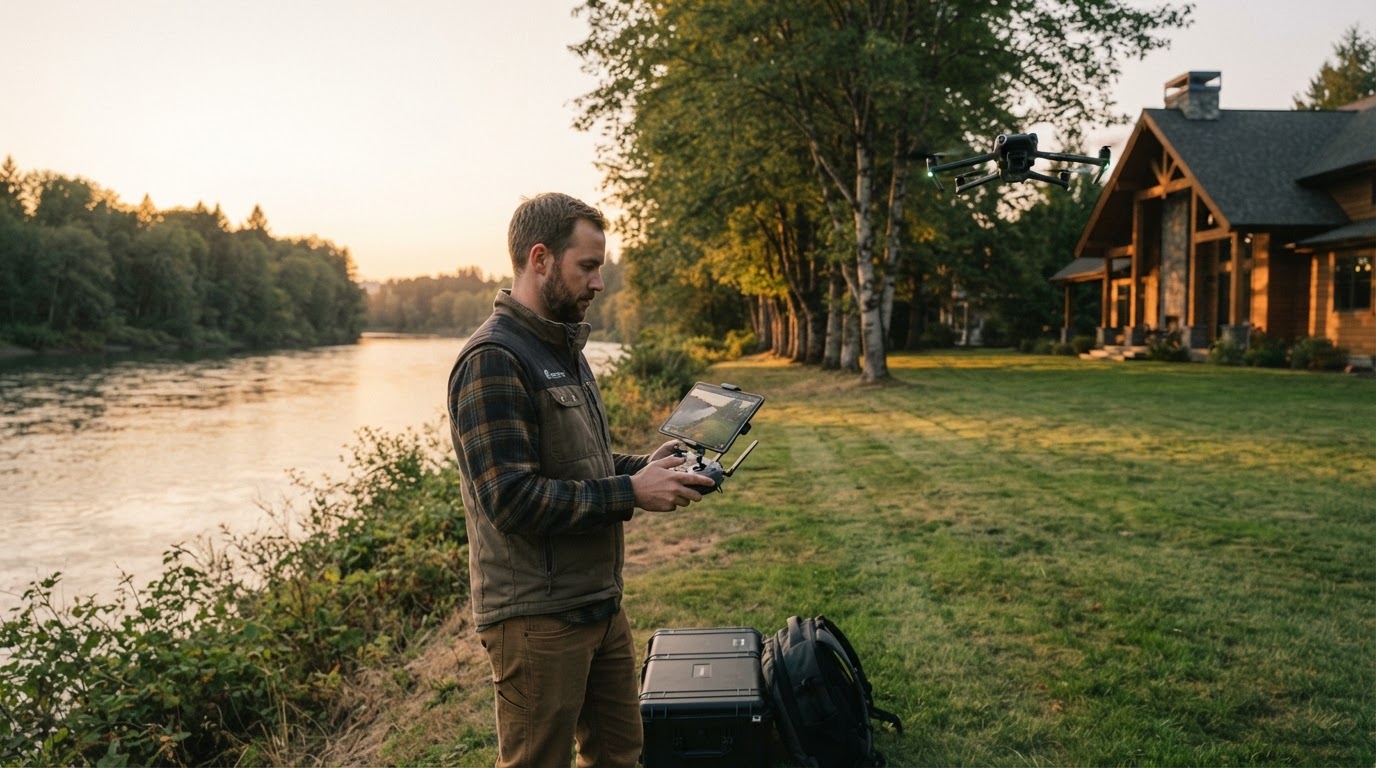
Ask for the flight plan in plain language: the launch point, the angles to be covered, the height band, and the fallback if wind or rain closes the window. A short walkthrough is not overhead you can skip. It is the step that prevents a second visit.
Scheduling belongs here too. Aerial work depends on weather, daylight, and, in some areas, time-of-day restrictions. Confirm whether the quote includes a weather hold and how a rescheduled flight is handled, so a two-hour delay does not return as a new invoice.
Airspace, permits, and site rules are part of the production
The legal side of the flight belongs in the quote, not in a footnote. Rules differ by country and by region, and they can change around airports, hospitals, stadiums, prisons, events, and temporary restrictions.
Ask four things. Who confirms the flight is legal on the chosen date? Which approvals or notifications are needed, and how far ahead must they be filed? Is any permit fee separate from the production fee? And does the pilot carry liability cover for the work? If a site owner requires permission for take-off and landing, that conversation is easier before the shoot than on the morning of it.
Deliverables and editing carry separate effort
A still frame, a short clip, a stitched panorama, and a time-lapse are different production jobs with different time costs. Ask for the deliverable list as a count, not a category: how many final images, how many clips, what length, what resolution, and which file formats.
Editing deserves the same specificity. Colour and exposure correction is routine. Removing a construction crane, blending several frames, or adding graphics to a clip is additional work. A proposal that says "professionally edited" without a revision limit is worth a follow-up question, because the difference between one review round and open-ended rounds shows up either as a higher fee or as an awkward conversation later.
For property marketing, the deliverable list usually grows to include a defined exterior set, a short walkthrough clip, and sometimes an aerial view tied to a location graphic. Property briefs also tend to specify turnaround dates, which is where scheduling starts to carry real cost.
Licensing and commercial assignment work sit on a second line
Licensing is a separate decision from the shoot. The capture fee buys the production; the licence defines what you may do with the files afterwards.
Four terms control most licence value:
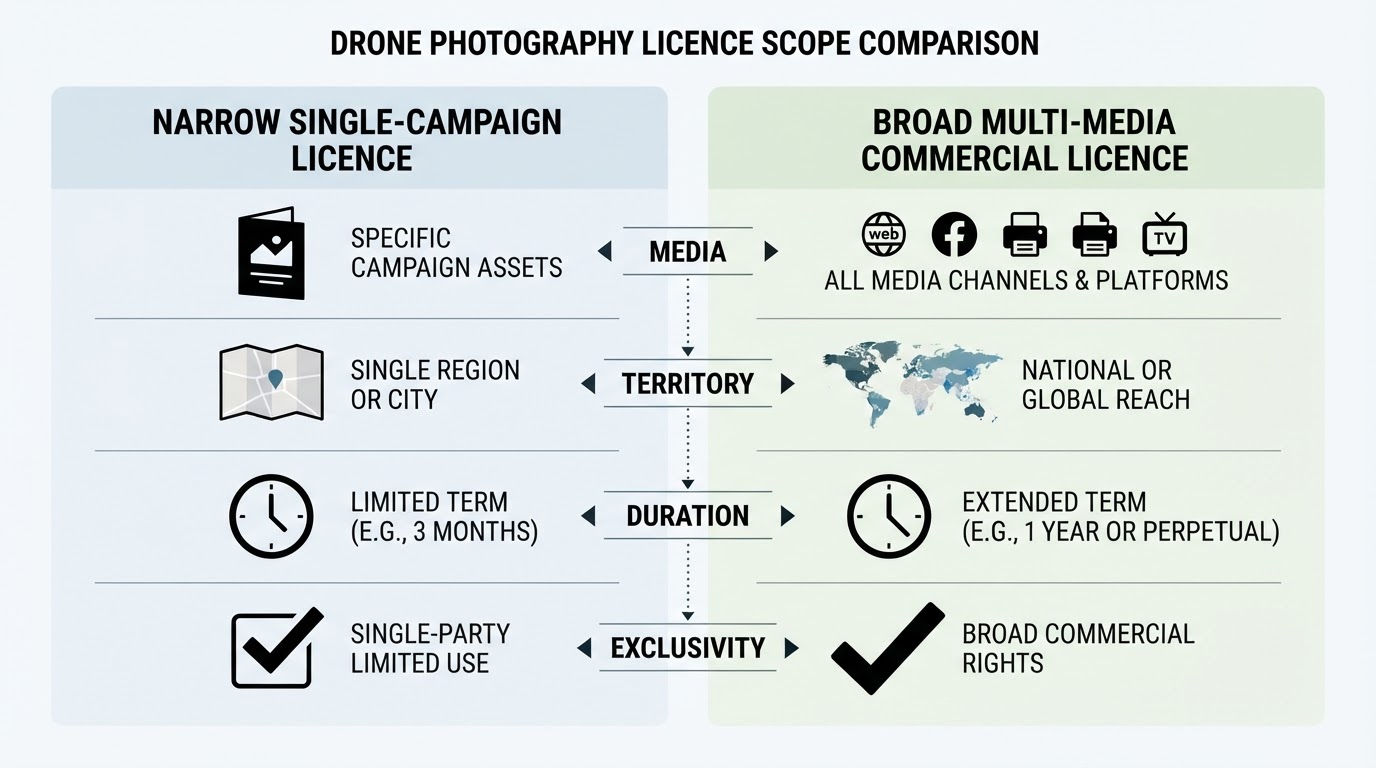
- Media — web, print, broadcast, out-of-home, or paid social.
- Territory — one market, one country, or worldwide.
- Duration — a campaign window, a fixed number of years, or perpetual use.
- Exclusivity — whether the photographer may license similar aerial imagery of the same area to others.
For commercial assignment work, also confirm who holds the copyright, whether the photographer may show the images in a portfolio, and whether releases are needed for people or identifiable private property in frame. If the campaign may expand — a new market, a second brand, a longer run — ask for the extension terms at the start. A defined extension is easier to price than a renegotiation after publication.
How to read a drone photography proposal
A usable proposal reads like a scope, not a price tag. Look for a document that separates production from licensing, names the deliverables, and states the assumptions it was built on.
Check that it includes:
- Scope — the site, the flight plan, and the deliverable list with counts.
- Production schedule — shoot date, weather contingency, and delivery timeline.
- Post-production terms — editing level and the number of revision rounds.
- Licence terms — media, territory, duration, and exclusivity.
- Costs — production, licensing, travel, and any permits shown as separate lines.
- Change terms — how extra deliverables, additional rounds, or expanded use are priced.
- Insurance and compliance — who carries liability cover and who confirms the flight is legal.
If a proposal omits the licence terms, the deliverable counts, or the revision limit, ask before comparing it with another. An incomplete scope and a complete one are not priced on the same basis, so the gap in the documents is worth resolving first.
What to confirm before paying
Confirm five points before money moves:
- Deliverable count and format in writing, including resolution and file type.
- Licence scope in writing, with media, territory, duration, and exclusivity named.
- Revision limit, plus the price of another round.
- Cancellation and weather terms — what is refundable and what is rescheduled.
- Delivery date and method, so the files do not become a separate negotiation.
Also check that the invoice matches the accepted proposal. If the number moved, ask which line moved and why before approving it.
How to request an exact figure
You get a specific number by giving the photographer a specific brief. Vague enquiries return ranges; a written brief returns a quote.
Send these six items in one message:
- Location — the address or site boundary, plus any access restrictions.
- Use — the campaign or page the images will appear on, with the media, territory, and duration you need.
- Deliverables — final still count, clip count and lengths, and required formats.
- Timing — your deadline, the earliest acceptable shoot date, and whether the date is fixed.
- Site conditions — obstructions, neighbouring buildings, trees, and any height or airspace limits you already know about.
- Budget range or decision criteria — optional, but it helps the photographer propose the right scope rather than a padded one.
Ask for the quote as line items with the licence terms attached. A photographer who answers with a scope, a schedule, and a defined licence gives you something you can compare and approve. A number alone does not.
What a quote cannot answer yet
Two limits are honest rather than evasive. A photographer cannot price a site they have not assessed, and they cannot price a licence without knowing the use. If you need a figure before a site visit, ask for a scoped estimate that names its assumptions and states what would change it. That is more useful than a firm number that arrives with conditions attached.