The labels cover four different builds
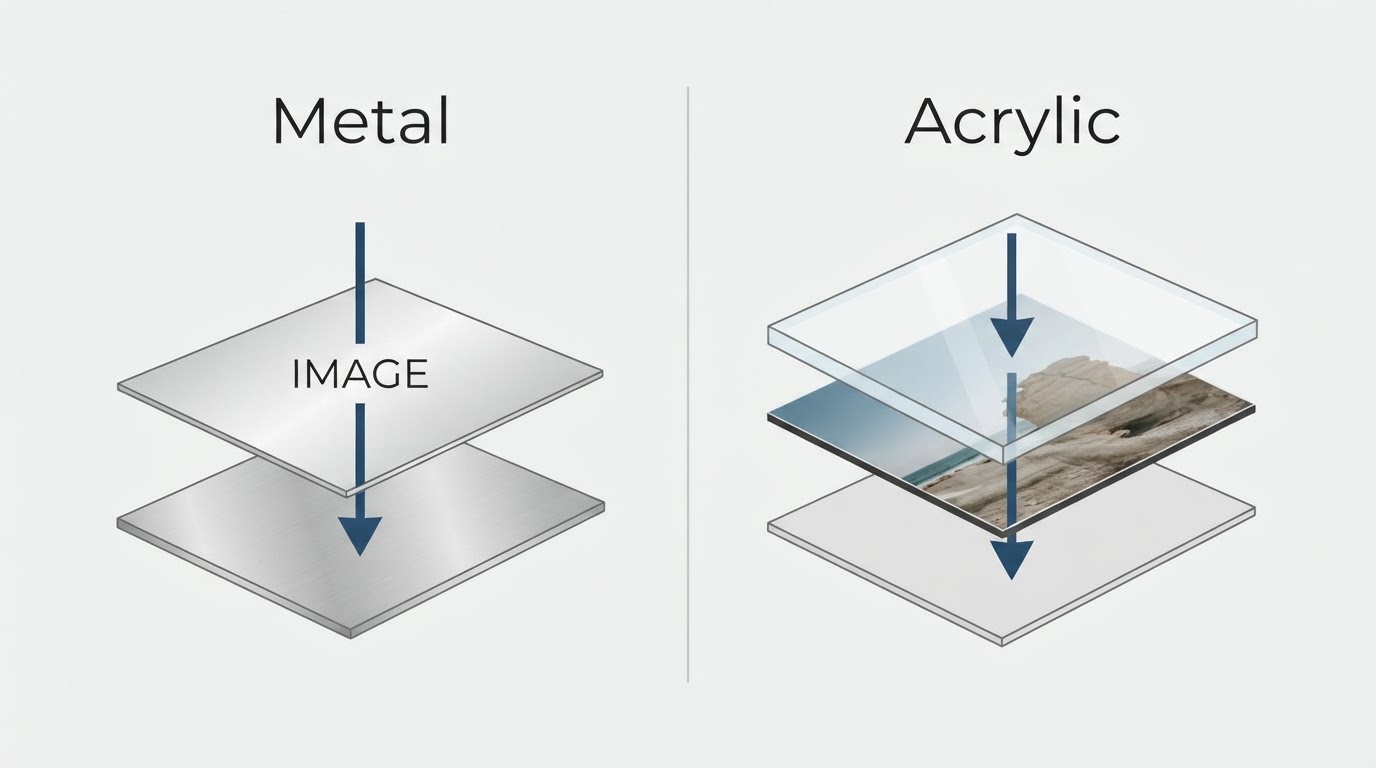
"Metal print" and "acrylic print" name families, not single products. Under the metal label you can be buying dye sublimation into a coated aluminium sheet, UV fine-art ink printed directly onto an aluminium composite panel, or a paper photo print laminated onto an aluminium backing. Under the acrylic label you can be buying a photo print face-mounted behind a glossy or matte acrylic sheet.
A coated metal sheet, a composite panel carrying a paper print and an acrylic face mount have different layers. Compare the exact construction and finish before comparing prices.
WhiteWall's US catalogue shows the spread. Its acrylic pages list photo prints under glossy 2, 4 and 6 mm acrylic and a matte acrylic version at 2 mm, with face mounting that uses silicone and an aluminium Dibond backing (WhiteWall acrylic prints, checked 30 October 2026). Its metal pages list direct print on aluminium Dibond, photo paper mounted on aluminium, brushed aluminium and ChromaLuxe HD (WhiteWall metal prints, same date). Other labs use different names and dimensions, so confirm the construction rather than the family label.
Practical Photo Notes does not sell prints. The manufacturer pages here are cited for construction and care facts.
The four builds side by side
Build | How the image is made | Face and panel | What it changes |
|---|---|---|---|
ChromaLuxe HD metal | Dye sublimation into a coated aluminium sheet | Glossy coated aluminium in the cited range | Thin and rigid, with no paper or glazing; the gloss face reflects |
Direct print on aluminium Dibond | UV fine-art ink printed straight onto the panel | Matte direct-print face; brushed aluminium is a separate variant | A flat matte face with a faint sheen in bright areas; brushed versions show the metal grain |
Photo print on aluminium backing | Developed photo paper laminated to aluminium | Matte or glossy lamination | The paper surface and laminate decide the look, not the metal underneath |
Acrylic face mount | Photo print under acrylic, often silicone-bonded to a backing | Glossy 2, 4 or 6 mm, or matte 2 mm acrylic; aluminium backing | A clear or matte plastic face over the print, with a visible edge |
These are examples from WhiteWall's range. Confirm another lab's actual panel, finish and mount rather than transferring these choices to a different product.
Gloss and matte are separate from the base
Choosing acrylic does not commit you to a mirror finish, and choosing metal does not commit you to a matte one. WhiteWall's matte acrylic is 2 mm, its glossy acrylic comes in 2, 4 and 6 mm, and its metal range includes a matte direct print, a gloss ChromaLuxe and brushed panels whose unprinted areas stay reflective. Base and finish are two decisions. In a lit room, the finish controls what the surface does with reflections; the base controls the edge, thickness and mounting.
A gloss face reflects what is in front of it. A matte face scatters that reflection and reduces the mirror effect without making the print disappear in strong light. Brushed metal sits between the two: printed areas can be matte while the brushed base shows a metallic sheen in bright areas.
What a bright room changes
A glossy face reflects the brightest thing in front of it: a window, a lamp, a doorway or a pale wall. On a dark photograph those reflections land in the shadow tones; on a bright, high-key image there is more print luminance to compete with them. How much you notice depends on the light's position relative to the print and where you stand.
At arm's length you can usually look past a reflection and read the image. From across the room the panel can behave as one reflective plane, so a window opposite the piece shows as a bright rectangle. Judge a sample from the place you will actually view it.
Matte finishes reduce the effect: matte acrylic at 2 mm, matte direct print on Dibond, matte lamination on a photo-on-aluminium print. They do not change the file. If the wall faces a window, that is the first comparison to run.
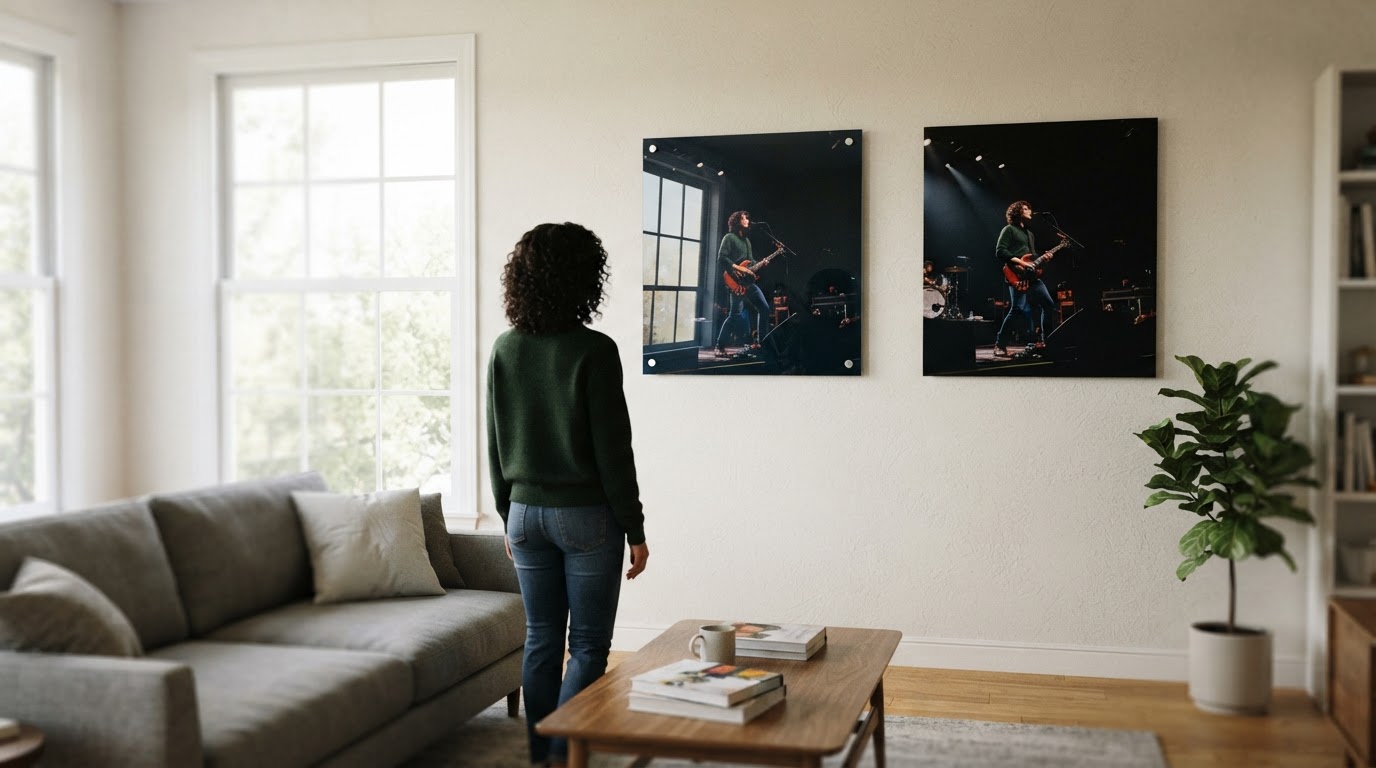
Dark concert photographs with deep blacks and small pools of light make reflections easy to see, while a dim hallway gives a gloss face less to reflect. That is a reason to compare in the room, not a rule that one format belongs to a genre.
Bathrooms: use the product rating, not the material
"Metal" is not a humidity rating. WhiteWall explicitly lists its ChromaLuxe HD metal print for bathrooms and outdoor areas. It lists direct print on aluminium Dibond for sheltered outdoor areas. Those are different location claims; neither authorizes every metal-backed or acrylic print for a bathroom. A maker can rate one build and not another because of the coating, edge sealing or mounting, so read the rating for the exact product and size.
For a bathroom, start with a product the maker explicitly lists for that location. Then ask how the edges and fixings are sealed, whether the mount is rated for the room, and what cleaning is allowed. WhiteWall's care guidance for acrylic, metal and canvas prints is a soft, dry, lint-free cloth, no glass cleaners on acrylic or backed products, and no wiping pressure, with product-specific instructions taking precedence (WhiteWall care guidance, checked 30 October 2026). That is cleaning guidance, not a moisture guarantee.
What the material does not settle: sharpness, colour and depth
Claims that metal prints hold detail more tightly, or that acrylic prints have more depth, are visual preferences rather than specifications. The manufacturer material reviewed here describes construction and finish, not comparative resolution or colour tests. Detail in the finished piece is set mainly by the file's resolution, the crop, the printer and paper, and the viewing distance. Colour is set by the profile and the paper or coating.
A sample can show the surface reflection and visible edge in your room. That observation does not establish comparative resolution, colour accuracy or service life.
Test a sample on the actual wall
Order the smallest size in both builds if the lab offers them, ideally with the same image. View each at the height and distance you will use. Do it twice: daylight and evening, lights on and off. The version that holds up in both is the one to order.

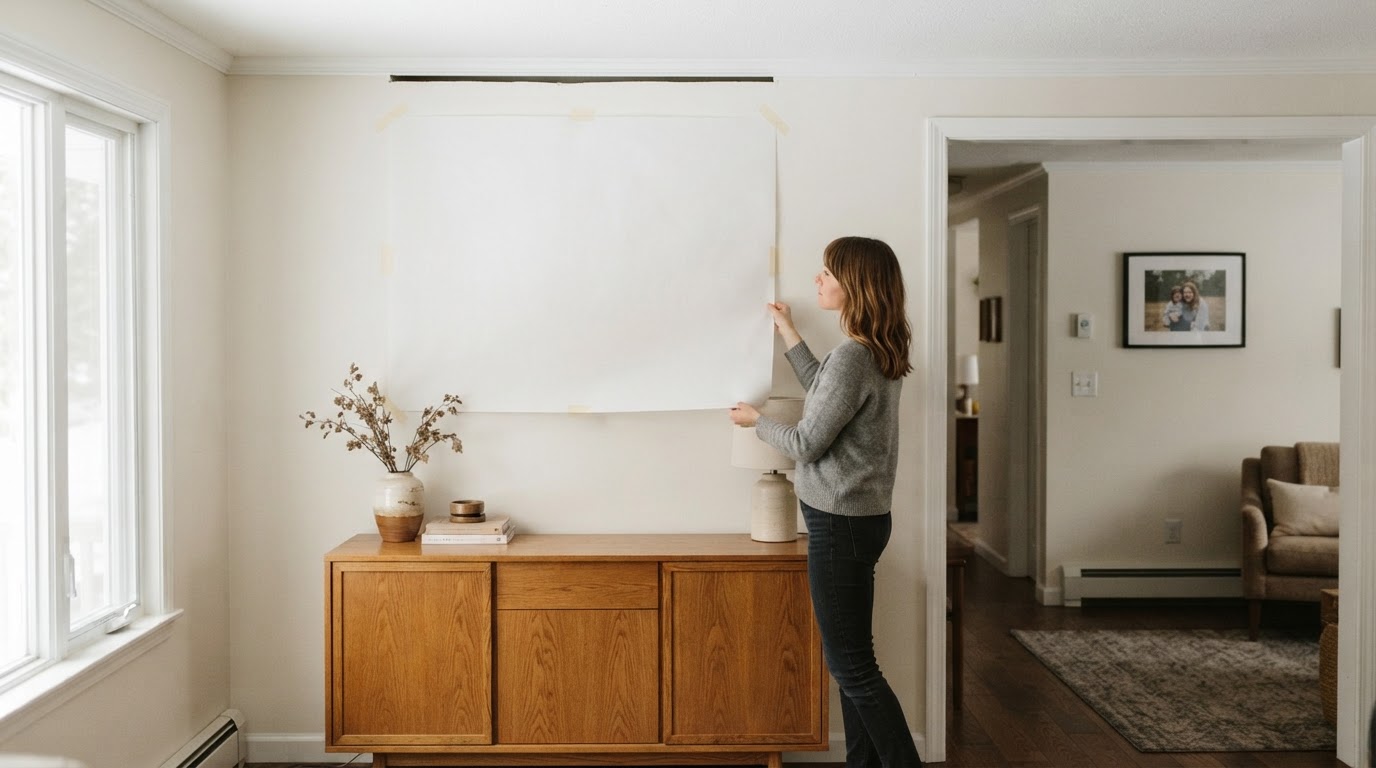
Then check the edge and the back: how the face reads at a shallow angle, how the piece will sit against the wall, and what the fixing point looks like. Mark the intended size on the wall with painter's tape and check it from the doorway as well as from the sofa.
Mounting and wall checklist
Hardware varies by lab, size and build, so ask rather than infer:
- What is included: a recessed subframe, a French cleat, a wire and hook, standoffs or a float mount?
- Does the fixing need a stud, and which anchors are specified for plasterboard, brick or stone?
- Can the piece be adjusted sideways or levelled after the holes are drilled?
- What is the shipped weight for this size, and does the maker recommend two installers?
- What wall condition and mounting clearance does the supplied bracket require?
- For a bathroom, are the fixings and seals rated for the room?
A thin metal panel and a thick acrylic face create different gaps at the wall, so the same fixing is not automatically right for both.
Where the metal-only questions go
If the choice is already metal and you need to compare base, surface and mount, Metal Prints: Compare the Base, Finish and Mount Before Ordering covers that decision. If you are preparing a file for a lab and need the crop and proof steps, Custom Metal Prints: File, Crop and Proof Approval Checklist covers that handoff. Neither is a product page, and neither sells printing.