Where to get metal prints near me
Four kinds of local businesses can produce or arrange a metal print, and the main difference is who runs the printer.
Fine-art print shops and photo labs. Some print aluminum in-house with dye-sublimation: the image goes onto transfer paper, then a heat press bonds the ink into the panel's polymer coating. Others take your order and send the job to a partner lab. Ask which one you are talking to before you plan a deadline around it.
Sign and graphics shops. These usually print direct to the panel on a flatbed UV printer. That route handles large rigid pieces and short notice well. Their color workflow is built around signage and vehicle graphics, so ask how they handle a photographic file, how they proof it, and whether they can hold smooth shadow gradations.
Frame shops and gallery services. Most do not print aluminum themselves. They contribute the parts that are easy to get wrong: measuring the wall, checking the crop, choosing hardware, and hanging a heavy panel straight.
Order desks that outsource. A storefront can take your file and have the panel printed somewhere else. Confirm the production location, the shipping schedule, and whether anyone will show you a proof.
Provider | Good for | Confirm before you commit |
|---|---|---|
Fine-art print shop or photo lab | Photographic color, paper-like detail, in-house control | Whether aluminum is printed on site, and which coating they use |
Sign and graphics shop | Large panels, tight timelines, rigid substrates | Photographic color handling and proof options |
Frame shop or gallery service | Wall measurement, hardware, installation | Who prints the panel, and where |
Order desk that outsources | Convenience and a single payment | Production location, proof stage, and delivery date |
Key answers at a glance
Seven answers cover most of the decision.
- Where to start: call one shop that prints aluminum on site and ask to see the coating you are buying.
- Fastest route to a deadline: an in-house shop with a stated cutoff time for same-week production.
- Best proof: a physical proof or an offcut of the same coating, viewed in the room where the print will hang.
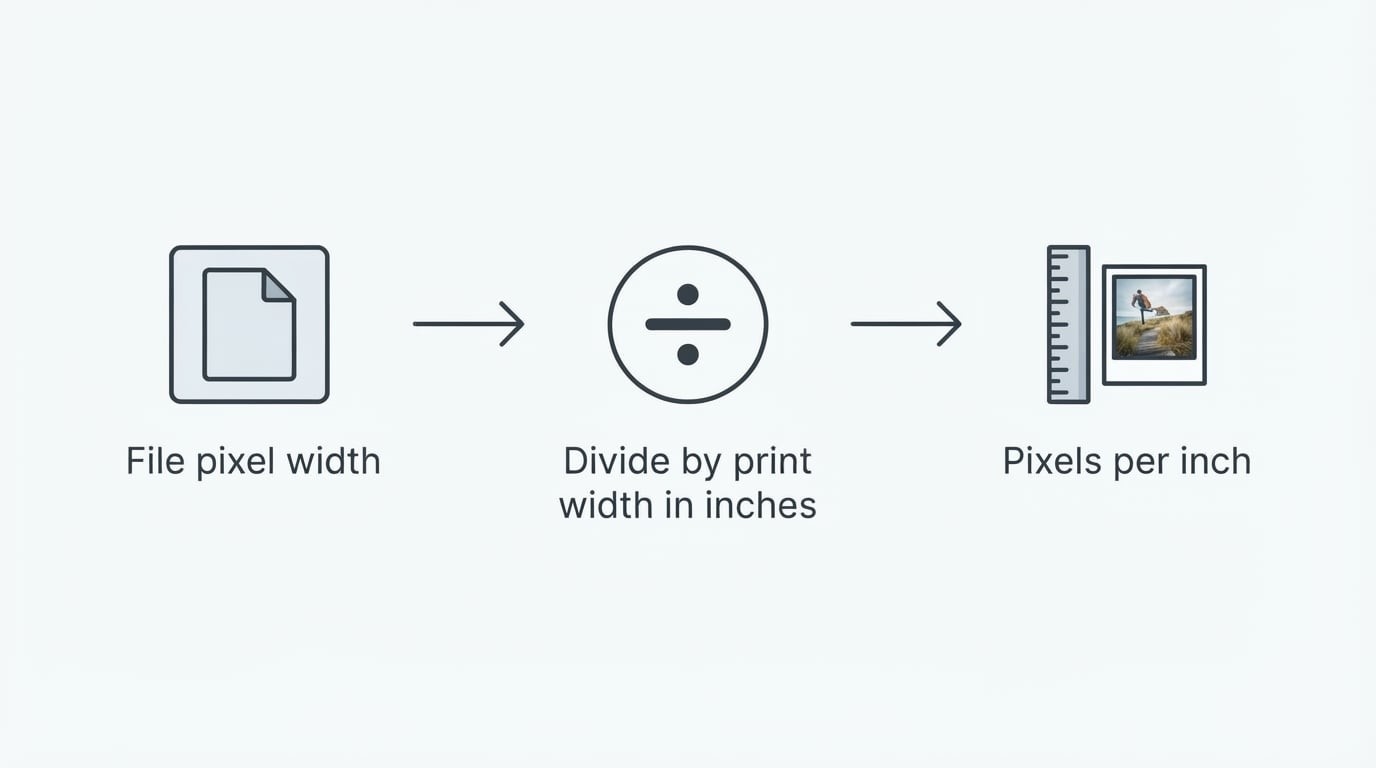
- File check: divide pixel width by the intended width in inches before you approve a size.
- What to bring: the file, the exact size, and a photo of the wall with measurements.
- Pickup or ship: pick up anything large or due soon, and ship anything routine and small.
- The question that separates providers: "Who prints this panel, on what machine, and with what coating?"
Custom sizes: match the file to the panel
A custom metal print is limited by two numbers: the pixels in your file and the largest sheet the shop can coat and press.
Start with the file. Divide its pixel width by the intended width in inches, then do the same for height. A 6000 × 4000 px file at 24 × 36 inches works out to about 167 ppi on both axes, which holds fine detail at arm's length. Push the same file to 40 × 60 inches and it lands near 100 ppi, so foliage, gravel, and distant ridgelines soften. Crop first, then size, because cropping removes pixels you were counting on.
Ratios matter as much as pixels. A 3:2 camera file fits 24 × 36 exactly. On a 24 × 30 panel the same file has to lose length on the long edge, so decide whether to crop the sky, the foreground, or both. If the image wraps around the panel edge, add margin for the turn; if you want every pixel visible, choose a size that matches your file's ratio and accept the nearest standard dimension.
Ask two production questions before you settle on a size: the largest single panel the shop can make, and whether an oversize piece is printed as one sheet or split into a set. A split set needs a decision about the gap between panels, and that gap reads as part of the design once the piece is on the wall.
Choosing the best option for your print
Choose by production route, proof policy, and deadline, and treat price as the last filter rather than the first.
Three criteria separate a workable quote from a risky one. First, who prints the panel: an in-house shop can answer questions about coating and reprints without relaying messages. Second, what proof you get: a screen preview cannot show how gloss coating handles a bright sky. Third, what happens if the result is wrong: ask for the reprint policy in plain terms before you pay.
Then look at what the quote includes. Panel size drives most of the cost, and coating, hardware, proof production, file preparation, rush scheduling, delivery, and installation each add a line. Two quotes for the same dimensions can describe different products once hardware and proofing are counted. Ask for the quote itemized by those lines and compare like with like.
If the piece will hang where people stand close to it, weight the proof and coating questions higher. If it is a large lobby or stairwell piece, weight the hardware, installation, and split-panel questions higher.
Local pickup versus shipping
Pick up when the deadline is tight or the panel is large, and ship when the piece is routine and small enough to travel in rigid packaging.
Pickup removes the carrier from the chain, which shortens the wait and lets you inspect the panel before you leave. It also moves the damage question earlier: check corners, edges, and the coating under a light at the counter, and confirm who handles a problem after the piece leaves the shop. Measure your vehicle opening and cargo space before you choose a pickup date for anything wide. A panel that will not pass through the hatch turns a finished job into a second trip.
Shipping suits standard sizes and repeat orders. Ask how the panel is packed, whether corners get protectors, which carrier runs the delivery, and who files the claim if it arrives damaged. Ask for the claim window in writing, because a small scratch found two weeks later is a different conversation from one found on delivery day.
A third arrangement covers deadlines that neither route handles: have the shop hold the finished panel for pickup after the event and ship it later. That keeps production moving without forcing a rushed delivery.
Proofing before production
A physical proof is the only check that shows the coating, the crop, and the color together, and it is worth the extra step on anything large.
A screen proof confirms layout and crop, but it cannot reproduce how a coating reflects light. Ask for one of three things, in descending order of usefulness: a proof printed with your file on the same coating, an offcut of that coating showing a neutral gray and a saturated color, or a small sample print of a comparable image. View the sample in the room where the print will hang, at the time of day you will look at it most.
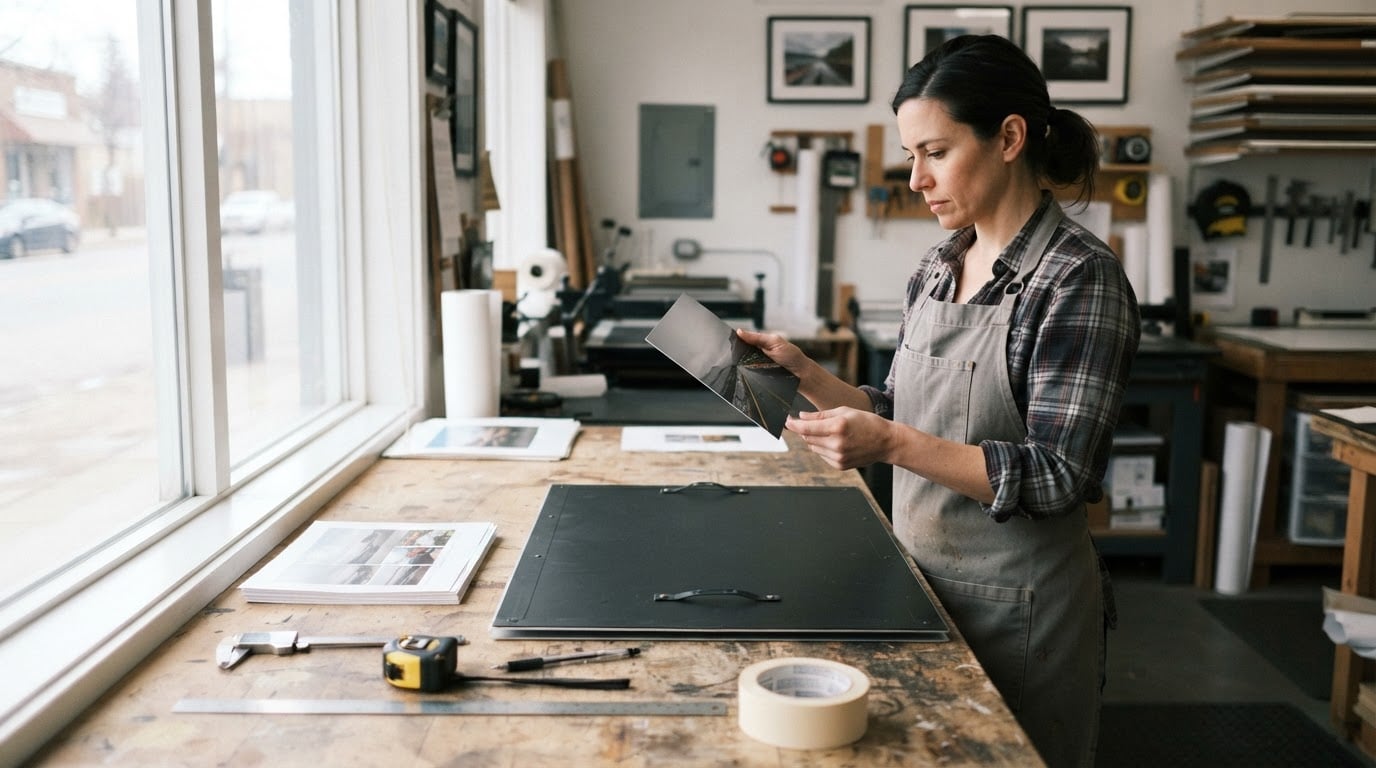
Check four things before you approve. Look at a neutral gray for a color cast. Look at the brightest highlight for detail that survives the gloss. Look at the deepest shadow for detail that has not closed up. Look at any skin tones in the frame for a shift toward red or green. Then confirm, in writing, the panel dimensions, the crop, the coating, and the edge treatment.
Approval is the point where the job freezes. Once the panel goes into production, a change of crop or size becomes a new order.
What to bring to a local shop
Bring the file, the size, and a photo of the wall, and the conversation takes ten minutes instead of three visits.
- The image as a high-quality JPEG or TIFF, on a drive and through a link, in the color space you edited it in.
- The exact panel size in inches, with the orientation you want.
- A photo of the wall that includes the floor or ceiling line, plus the width and height you can use.
- Notes on the light: which direction the window faces, whether a lamp sits near the wall, and when the room is brightest.
- Your deadline and the date you need it on the wall, not the date production can finish.
- Any hardware constraint, such as a plaster wall, a brick wall, or a hanging system already in place.
If the image is a new edit, bring the layered file or the original capture as well. A shop that can adjust the file with you will ask for it, and having it on hand avoids a second appointment.
Mistakes that are expensive to fix
Most metal print problems are decided before production starts, and the costly ones come from skipping a measurement or a proof.
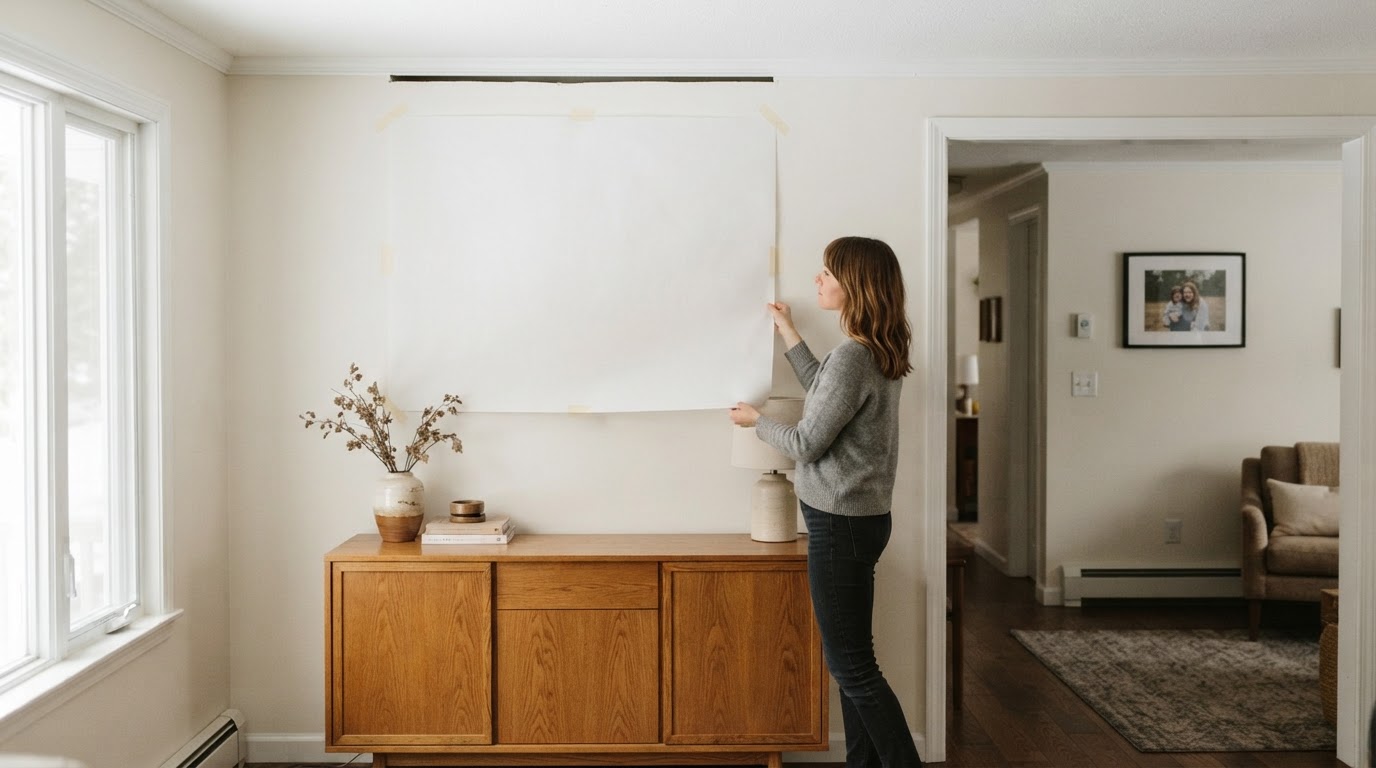
Sizing a panel before measuring the wall is the most common one. A print that looks modest on a screen can dominate a hallway, and a piece chosen for a sofa wall needs to be checked against the sofa, the ceiling, and the space to each side.
Approving a proof on a laptop screen is second. A laptop seen at an angle and at full brightness misrepresents both color and contrast, and gloss coating will look different again on the wall.
Assuming "local" means printed locally is third. Ask the question directly, because an order desk with a local address can add days of shipping to a job you thought was in town.
Ordering an oversize panorama as one sheet is fourth. Very wide panels may need a split, and a split needs a decision about the gap and about how the two pieces align.
Leaving the crop agreement verbal is fifth. Write the dimensions and the crop on the order, so both sides are approving the same thing.
Landscape and fine art images on metal
Metal holds landscape detail and saturated color well, and the coating decides how the brightest parts of an image behave.
A white-coated panel reads closer to paper and keeps highlights controlled. A clear-coated panel lets the aluminum show through thin areas, which deepens skies and water but turns pale snow and overcast light metallic. Gloss coating pushes contrast and reflection; matte coating softens both. For New England scenes with snow, hazy coastlines, or a high-key morning sky, a matte or white base is the easier starting point, and a gloss panel rewards images with strong contrast and deep shadow.
Orientation is a local decision as much as an artistic one. A coastal horizon wants a wide panel on a wide wall, and a vertical waterfall or tree line wants height. Hold the file at the size you are considering, from the distance where people will stand, before you commit to the panel.
What to do first
Measure the wall, then call one shop that prints aluminum in-house with the file and the size ready.
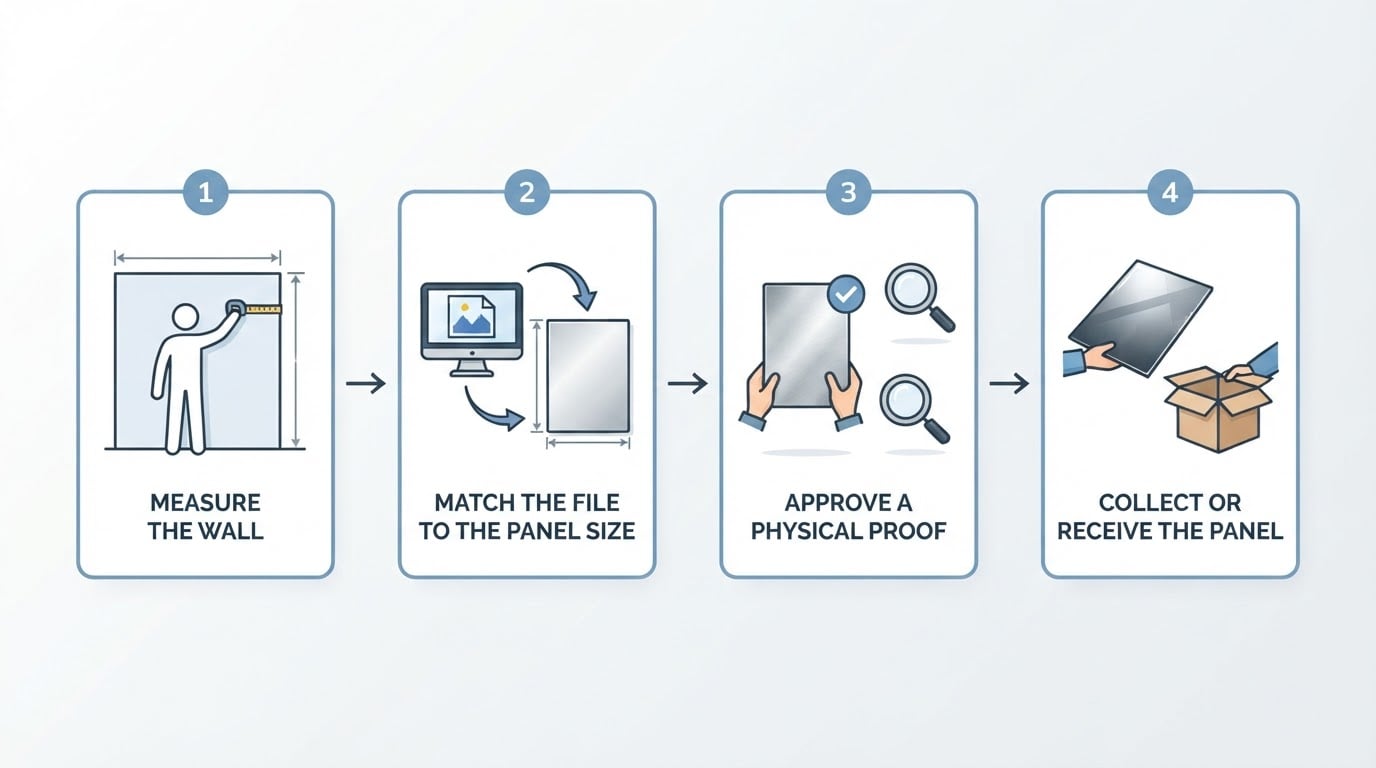
Ask for the coating sample, the quote itemized by hardware and proofing, and the reprint policy in one conversation. With those three answers you can decide between pickup and shipping, approve a proof, and put a date on the wall.