What The Three-Song Rule Usually Means
The three-song rule is the working assumption that photographers credentialed for a set shoot from the photo pit for the first three songs, then leave. The pit is the narrow strip between the barrier and the stage, and the window is short: Digital Photography School describes it as "average 10 minutes" of shooting time.
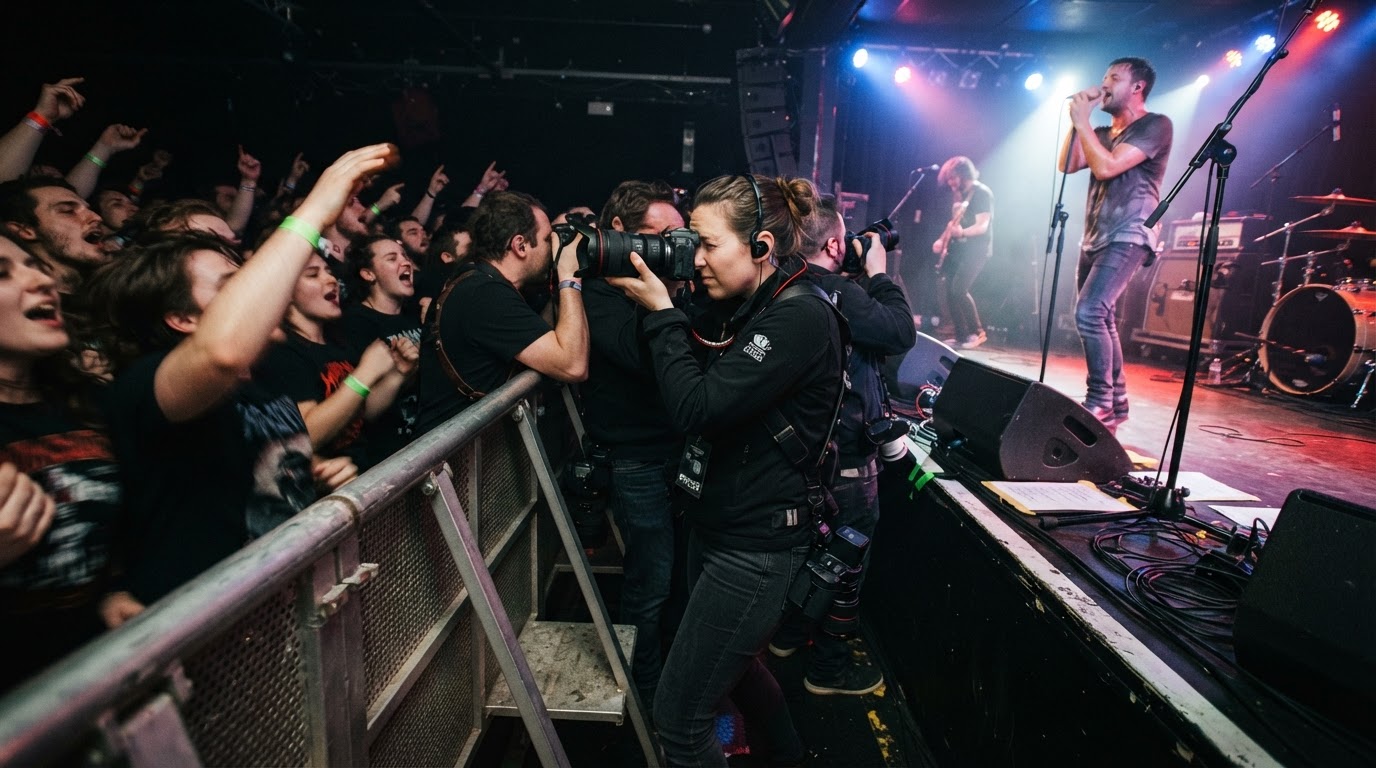
It is a convention, not a statute. ishootshows.com frames shooting volume around "a headlining band with a three-song limit", and the limit belongs to the terms of the shoot. A credential does not promise exactly three songs. Some artists allow one song; some ask certain photographers to cover the whole set. If you still need access, start with the separate concert photo-pass request guide.
When The Window Starts, And How It Ends
The window normally starts when the artist plays the first song of the set you are accredited to shoot. It is not tied to doors or to the support act. If you are approved for a support act rather than the headliner, the window applies to that set.
When the third song finishes, the window closes. Pit security or the tour's media contact normally enforces the timing, and what happens next depends on the pass: you may be walked out of the pit, cleared out of the front-of-house area, or escorted from the building. Know your exit before the first note.
Is Flash Allowed?
Assume flash stays off. The convention is usually said in full as "first three songs, no flash", and the pass email that sets your window normally states whether flash, monopods, or specific lenses are allowed.
If a shoot genuinely needs flash, ask the artist's or venue's contact for the exception in writing before the show. Testing it during the set is how photographers lose credentials.
Why Artist And Venue Instructions Override The Shorthand
Photography decisions are often made at the artist level, not the venue level. Red Rocks states in its official FAQ that "this decision is made by each individual performer, not by Red Rocks."
That line explains why the shorthand bends. Some tours shorten the window to one or two songs. Some deny pit access and place photographers at an approved position farther back. Others grant longer access: Digital Photography School notes that if you are allowed to shoot the complete show, "you have to ask the band first".
When the written terms differ from the industry shorthand, the written terms win. Treat three songs as the default you assume until you read the actual instructions.
Pre-Show Verification Checklist
Work through this before doors open:
- Re-read the credential email or pass terms. Note the window length, the flash rule, any support or lens restrictions, and where you may stand.
- Confirm the decision-maker. Ask who has final say on the night — the tour manager, the venue's media contact, or the performer's representative — and get a name.
- Check the venue's public camera policy. It may state that the artist decides, which tells you where to take the question.
- Confirm the logistics: which entrance, when to arrive, and whether the name on your ID must match the credential.
- Get the exit plan in advance: when the window ends, who signals it, and where you may go afterward.
- Pack only the gear your terms allow and leave the rest in the car.
A Fast Shot Plan For A Three-Song Window
Prepare before the first note: set exposure for the opening lighting, carry two workable lenses instead of swapping constantly, and check battery and card space.
- Song one: establish. Get the lead singer and one wide frame showing the stage and the room. Digital Photography School's breakdown starts with the singer, then works through the band.
- Song two: commit. Work tight portraits and move through the guitarist, bassist, and anyone else you have not covered.
- Song three: fill gaps. Get the drummer and backline, a full-band frame with a wide lens, and a frame of the audience — turn around in the pit, as Digital Photography School suggests.
Budget frames against a realistic hit rate. ishootshows.com reports keeping 10% to 30% of shots, with 200 to 250 images as the average raw output for a headlining band on a three-song limit.
You are done when the third song ends and you have at least one usable frame of each band member, one wide stage frame, and one audience frame — or you leave with fewer frames and your credential intact.
Decision Matrix: When Instructions Differ From The Shorthand
What the terms say | What it means | What to do |
|---|---|---|
Two songs, no flash | Your window is shorter than the default | Prioritize the lead singer and one wide frame; do not shoot into song three |
Full show approved | The default does not apply to you | Confirm flash and position rules anyway |
No pit access, pass approved | You shoot from elsewhere | Confirm the allowed position before doors |
Paperwork attached to the pass | Access has usage conditions | Read the terms before you sign; ask about anything unclear |
Instructions conflict | The stricter reading applies until clarified | Ask the named contact in writing |
Limitations Worth Accepting
- The three-song rule is not law, not universal venue policy, and not a guaranteed pass. It varies by artist, tour, and venue.
- A photo pass grants exactly the access written into it, no matter what the shorthand says.
- Lighting, layout, and security practice differ by room, so plan for variation.
FAQ
Does the three-song window start at the first song or at doors?
At the first song of the set you are accredited to shoot. Doors and support acts do not start your window.
Is flash ever allowed during the three-song window?
Rarely, and only when the written terms say so. Assume no flash and ask before the show if your plan depends on it.
What if the artist lets photographers shoot the whole show?
Then your written terms define your access and the three-song default does not apply to you. Confirm the window in writing, and still follow position and flash rules.