What drone videography services actually include
A drone videography engagement is more than an aircraft and a camera. A complete service usually combines a commercially qualified pilot, flight planning and airspace checks, an aircraft carrying a stabilized gimbal camera, on-site safety management, and post-production editing. The depth of that package is what separates providers: some offer a single pilot and one edited sequence, while others bring a larger crew, ground-based coverage, and a full post-production pipeline.
Aerial video is also only one layer of a visual package. A drone can show a site in its surroundings, but it cannot capture the conversations, interiors, or close detail that ground coverage provides. Knowing where the aerial layer ends helps you brief the whole job.
Where aerial footage earns its cost
Elevated footage pays for itself when a story depends on position, scale, or movement that a camera on the ground cannot show. Typical commissions include:
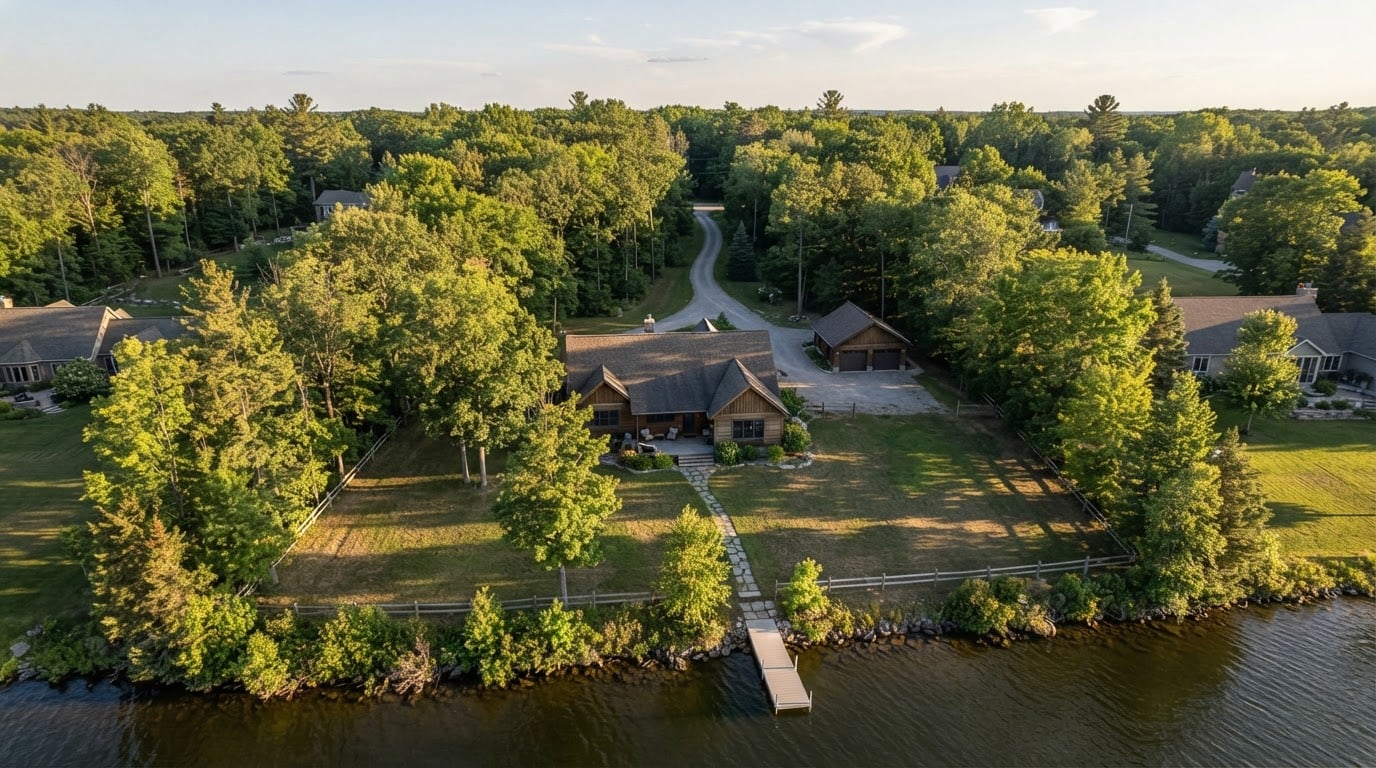
- Real estate and property documentation. Large or waterfront properties read differently from the air, where access roads, boundaries, water, and surrounding land all become part of the picture.
- Tourism and destination campaigns. Coastal landmarks, parks, and town centres often need a wide frame that places a location inside its landscape.
- Venue, festival, and promoter work. An aerial pass can establish where an event sits, how crowds move through a site, and how the layout works — context that helps sponsors, ticket buyers, and future bookings.
- Brand and facility overviews. A business can present a whole site, campus, or operation instead of a sequence of disconnected interior shots.
- Landscape and print imagery. Elevated perspectives can also stand alone as still images or print titles rather than existing only as motion footage.
If the story does not depend on height, distance, or movement, the aerial element may be decoration. A provider who tells you so is worth keeping.
Planning the shoot: from objective to shot list
Aerial work is planned, not improvised. Start with the one decision the finished video has to support — a leasing decision, a campaign launch, a sponsorship pitch, an event recap — then let that decision filter everything else.
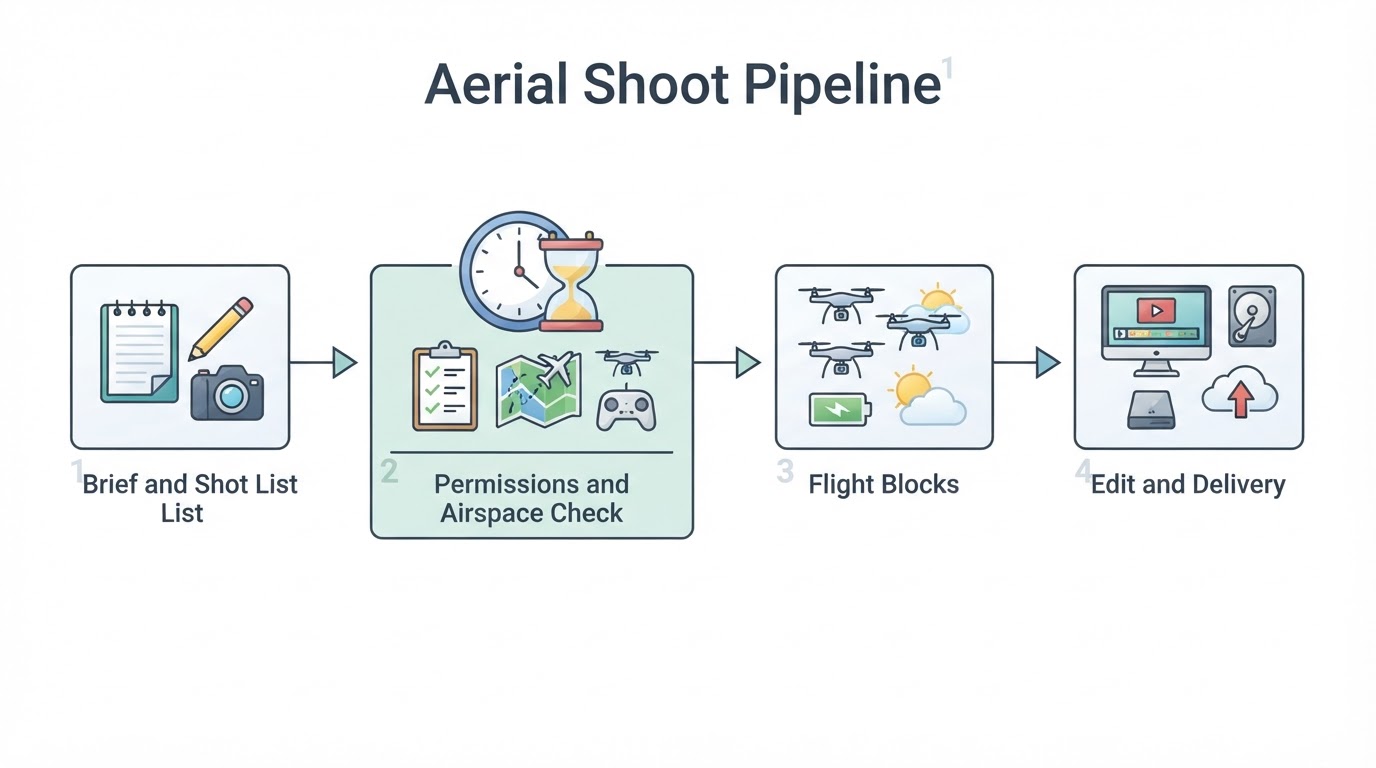
- Write the objective in one sentence. If two stakeholders disagree about it, settle the disagreement before the flight rather than in the edit.
- Build a shot list of six to twelve shots. Each line should name the location, the angle or height, and what the shot is meant to prove.
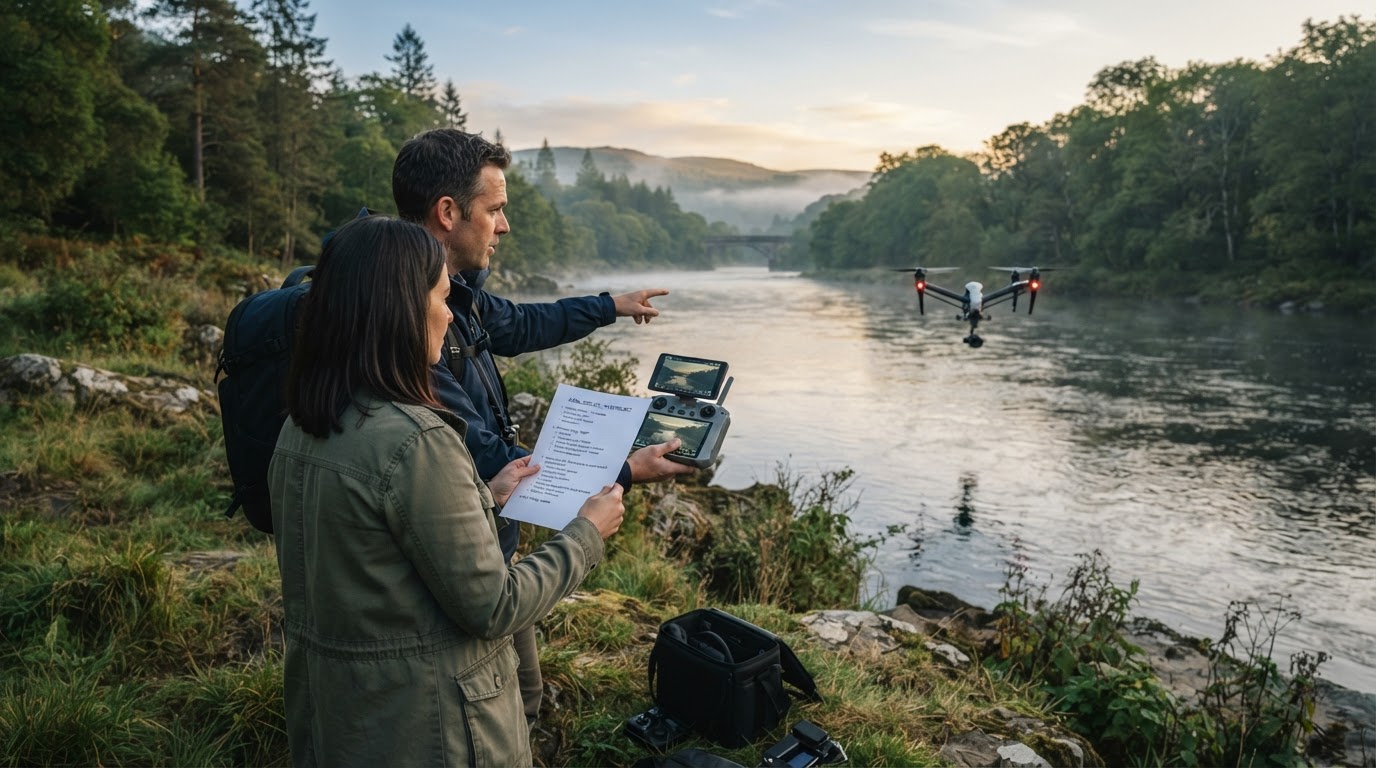
- Recon the location. Identify launch and landing zones, access and parking, obstacles such as trees, wires, and poles, and the position from which the pilot can keep the aircraft in sight.
- Check permissions early. Confirm who owns the property, whether airspace or local rules apply, and what written consent the site owner needs to provide. Approvals can take longer than the shoot itself.
- Match the shot list to light and weather. Decide which shots must happen at a particular hour and which can move if wind or rain forces a reschedule.
- Agree the contingency. Ask what happens when the weather call goes the wrong way, and who covers what when a shoot is moved.
A shoot-day workflow that keeps everyone aligned
Well-run aerial days follow a short, repeatable sequence.
- Brief and site walk. Walk the site with the pilot, confirm the shot list, note any last-minute changes, and mark the safety perimeter.
- Airspace and safety check. The pilot confirms site conditions, equipment status, and any required clearances before the first launch.
- Flight blocks. Group shots by location and light so launch, landing, and repositioning time is not repeated unnecessarily.
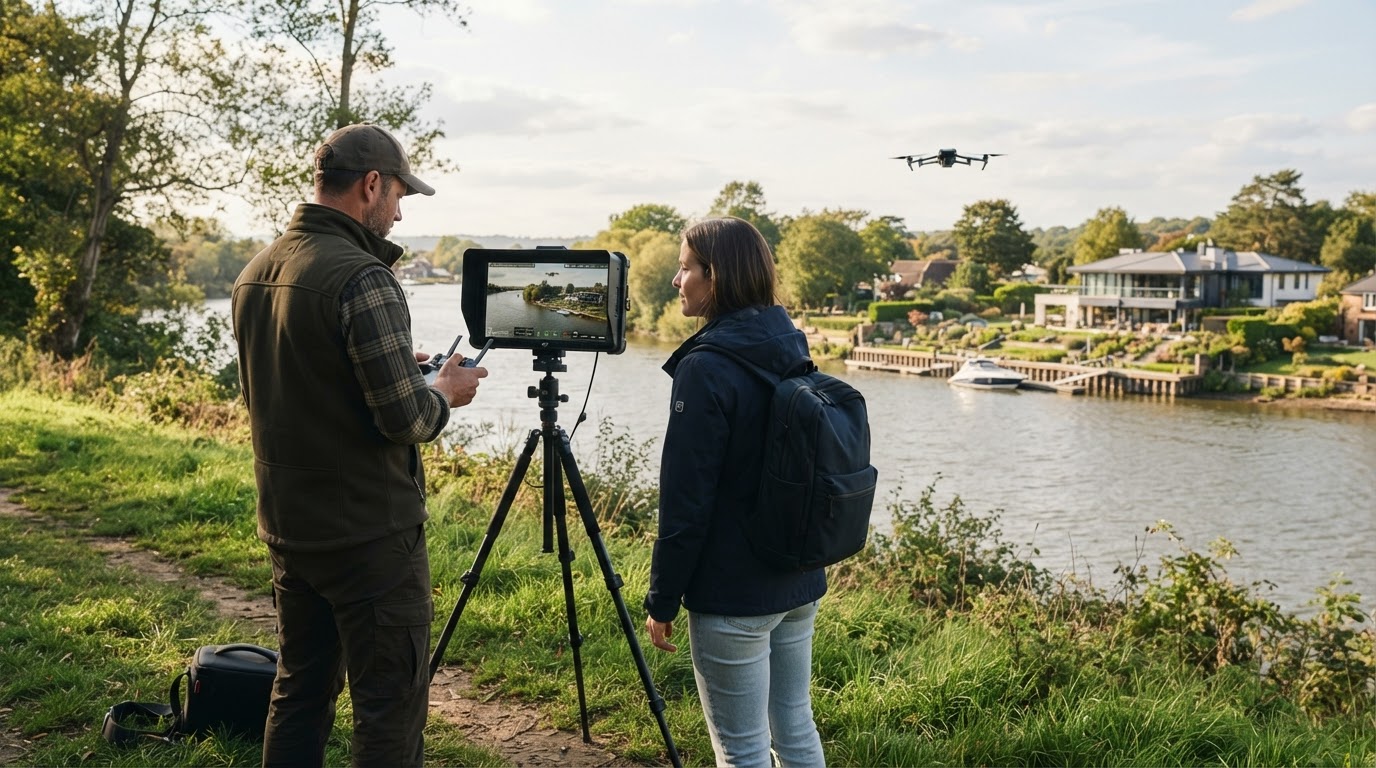
- Monitored capture. Review key frames on the monitor while the aircraft is still on site, so a missing angle can still be fixed that day.
- Data backup. Copy and verify the footage before leaving, ideally onto a second drive.
- Wrap notes. Record what was captured, what was skipped, and what the edit should prioritise.
Deliverables to agree before the shoot
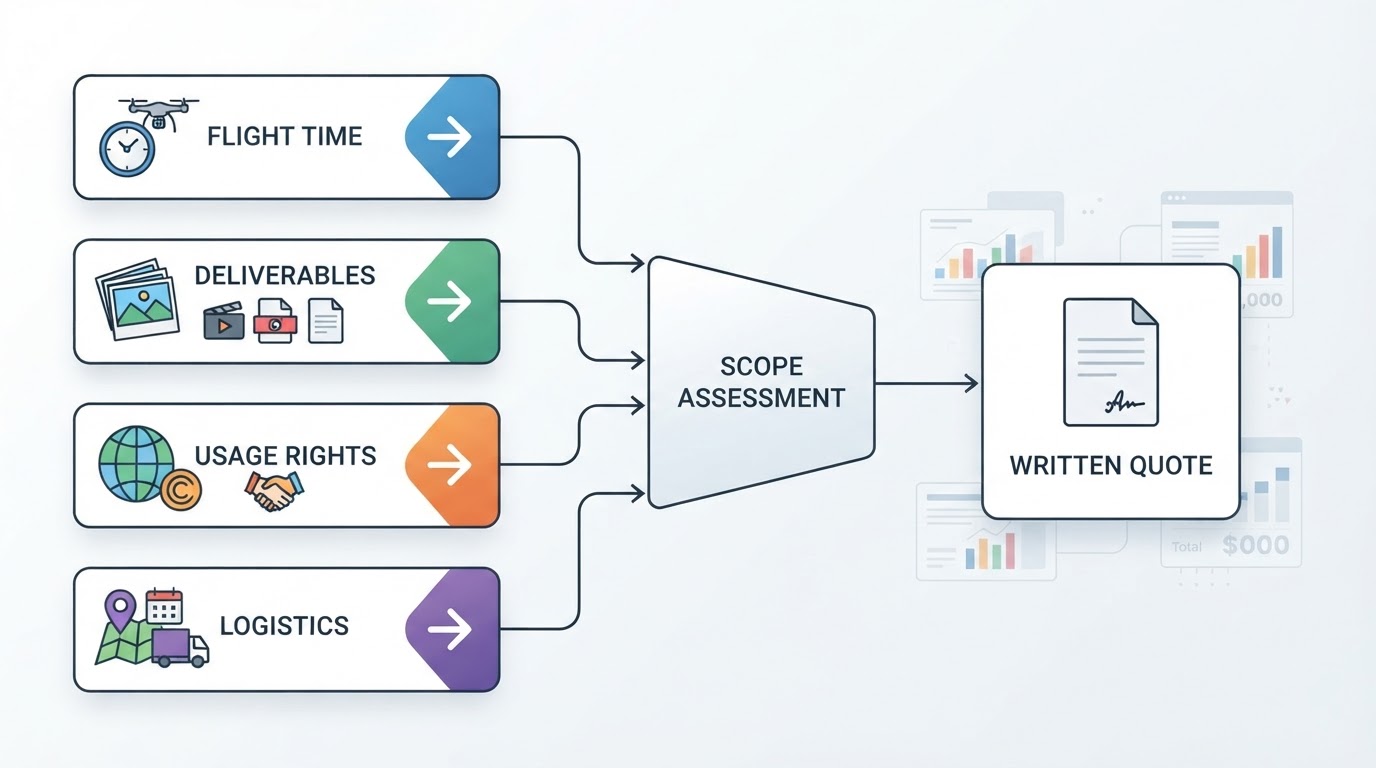
Deliverables vary widely between providers, so put them in writing. A clear scope answers six questions:
- Edit scope. Is the result one edited sequence, several cutdowns, or a set of selected clips?
- Versions and formats. Which resolutions, frame rates, and aspect ratios are needed? A widescreen feature cut and vertical social edits are different jobs.
- Revisions. How many review rounds are included, and what counts as a new edit rather than a revision?
- Source footage. Is raw material included, and under what terms?
- Usage and licensing. Where may the footage be published, for how long, and in which contexts? Confirm this in writing instead of assuming it.
- Timeline. When does the first cut arrive, and what does the final handover contain?
How to evaluate a drone videography provider
Judge providers on evidence you can check rather than on the polish of a showreel.
- Relevant portfolio. Ask for commissioned aerial work that resembles your project, not only scenic demonstration footage.
- Certification and insurance. Confirm the pilot is qualified to fly commercially in your region and carries appropriate cover.
- Permission handling. A capable provider can explain how it approaches airspace rules, property access, and the documentation a client may need for its own approvals.
- Weather and contingency policy. Look for a provider who names the weather call in advance and states the reschedule terms.
- Communication and crew. Confirm who will be on site, who runs the flight, and who you deal with during the edit.
- Pricing structure. Half-day, full-day, and project rates show how a provider thinks about scope. A single flat number for an undefined job is a warning sign.
- Licensing terms. The most common surprise after delivery concerns usage rights rather than footage quality.
- References. Speak to one previous client in a category close to your own.
Practical preparation steps on the client side
A little preparation protects the whole shoot:
- Nominate one decision-maker who can approve the shot list and the final cut.
- Confirm access, parking, and any site induction or security requirements.
- Make sure the areas in shot look the way they should: clear access, tidy surrounds, staged equipment, and the right people present.
- Hold a backup date in the calendar for weather.
- Prepare the review brief before the first cut arrives instead of collecting feedback from several people after the fact.
- Brief anyone who will appear on camera and check which consent or release forms they need to sign.
How aerial work fits with a broader photography package
Many photographic practices offer drone coverage as one line among several rather than as a standalone business. Chris Sidoruk Media, for example, lists drone photography and video as a distinct service alongside its ground-based photography and its New England landscape print work. Several of its published print titles are shot from the air, including views of the Housatonic River dam and the Shelton riverfront in Connecticut and the Marginal Way coastline in Maine, and the aerial service sits within the same New England coverage footprint as its other photographic work.
That structure is common for a reason. When the same provider covers a site from the ground and from the air, you deal with one brief, one schedule, and one set of usage terms instead of stitching two suppliers together.
The trade-offs to plan around
Aerial video is powerful where it is strong and limited where it is not. A drone does not record the ambient audio that gives an event its energy, and flight time is bounded by battery capacity and safety margins, so the aircraft works in shorter blocks than a ground camera. Wind, rain, and light decide whether a day can be flown at all, and airspace, privacy, or property restrictions can remove a location from the plan entirely.
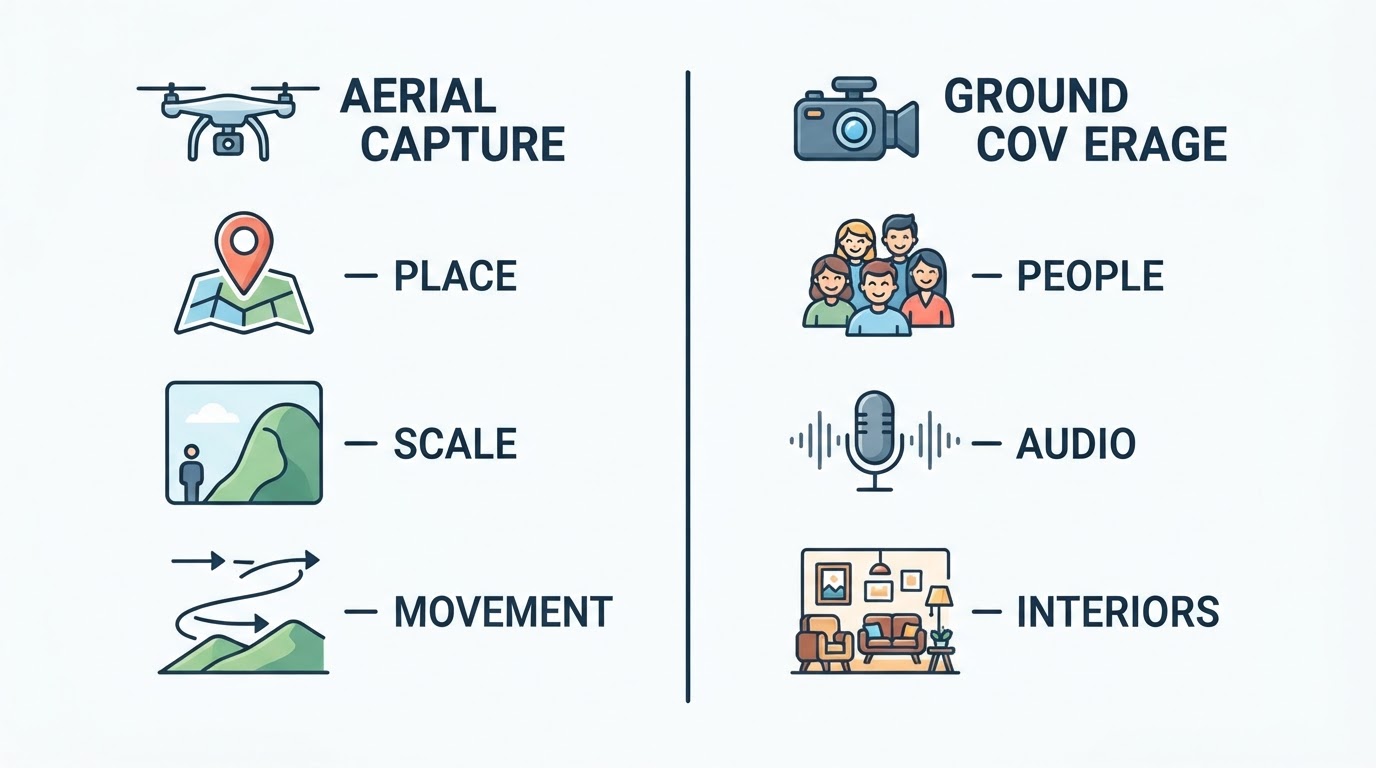
None of that makes aerial footage a poor choice — it makes it a choice to schedule deliberately. Budget extra time for approvals, keep a weather backup date, and combine aerial coverage with ground coverage when the story needs people, interiors, and sound as well as place, scale, and movement.