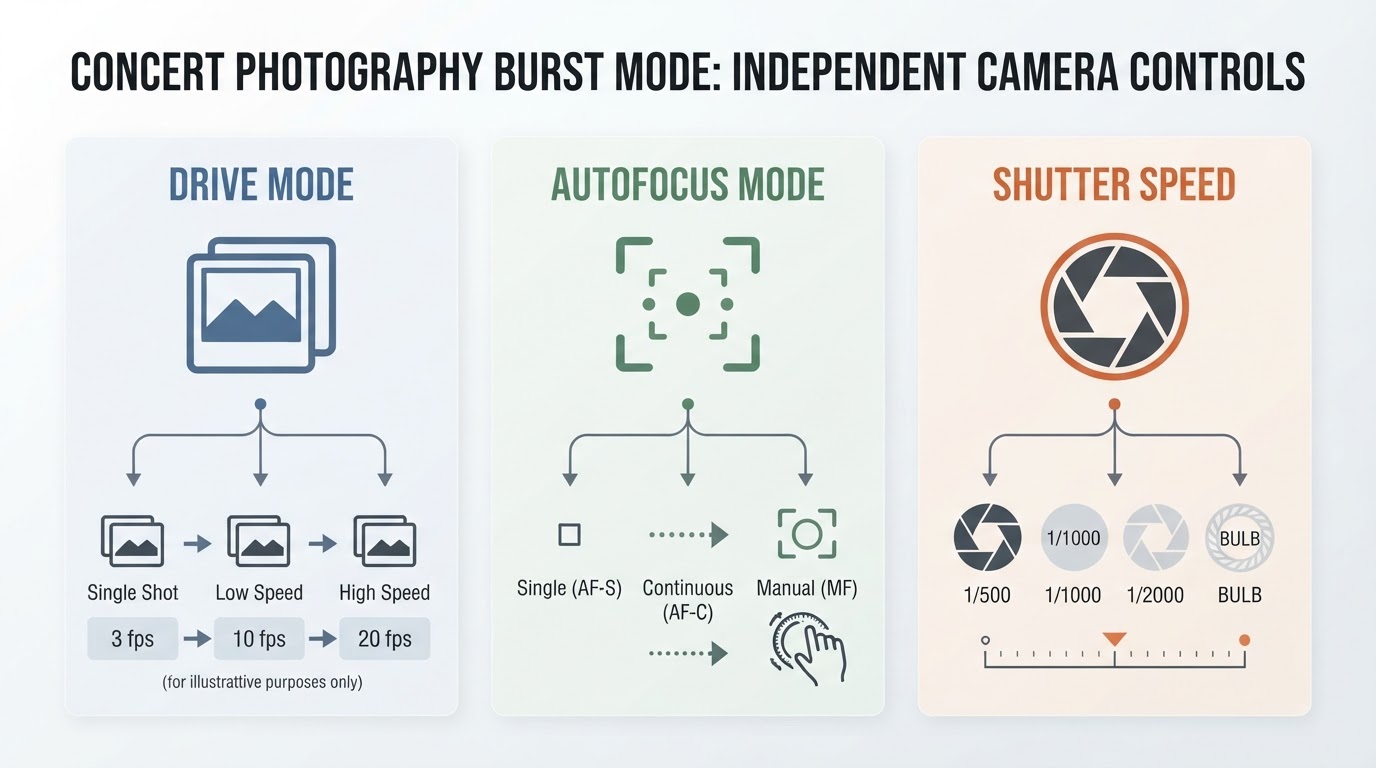
Drive mode, autofocus, and shutter speed are separate decisions
Burst mode only governs how many exposures the camera makes. Autofocus decides whether the performer stays sharp, and shutter speed decides how the movement is rendered. Raising the drive rate without setting the other two only produces more versions of the same miss.
With continuous autofocus — AF-C on Nikon, AI Servo on Canon — the camera keeps adjusting while the performer moves. With single-shot autofocus, focus locks on the first press of the shutter release and stays there for the sequence, so a performer walking toward you can drift out of focus partway through a burst. How well continuous tracking holds depends on the AF mode, the subject-detection settings, and the body itself; a burst cannot recover frames that were focused on the wrong target. If you are still choosing an area mode, the site's guide to concert photography autofocus settings covers that decision separately.
Shutter speed is a third, independent choice. It sets the exposure time, and it is what determines whether a raised hand is frozen or smeared. A burst does not substitute for an appropriate shutter speed, and it does not guarantee that every frame will show the same amount of blur: a limb can be moving at different speeds at different instants, so one frame in the same sequence can read sharper than another. Choose the exposure time for the motion you expect and accept that the sequence will vary.
In Nikon's article on shooting events with the D500, Todd Owyoung's working setup is Continuous High drive, AF-C, and RAW. That is one photographer's configuration on one body, not a universal recipe. The transferable part is the separation: choose a shutter speed that suits the movement, choose a focus mode that tracks while the performer moves, then choose a drive rate you can control.
Which moments deserve a burst
Use a burst when the peak is brief, physical, and predictable: a jump at the end of a chorus, a guitarist lifting the neck, a drummer's fill, a singer stepping back from the mic, a hair whip, or a horn player raising the bell. These gestures have a short window where the body reads clearly, and a single frame has to land inside it.
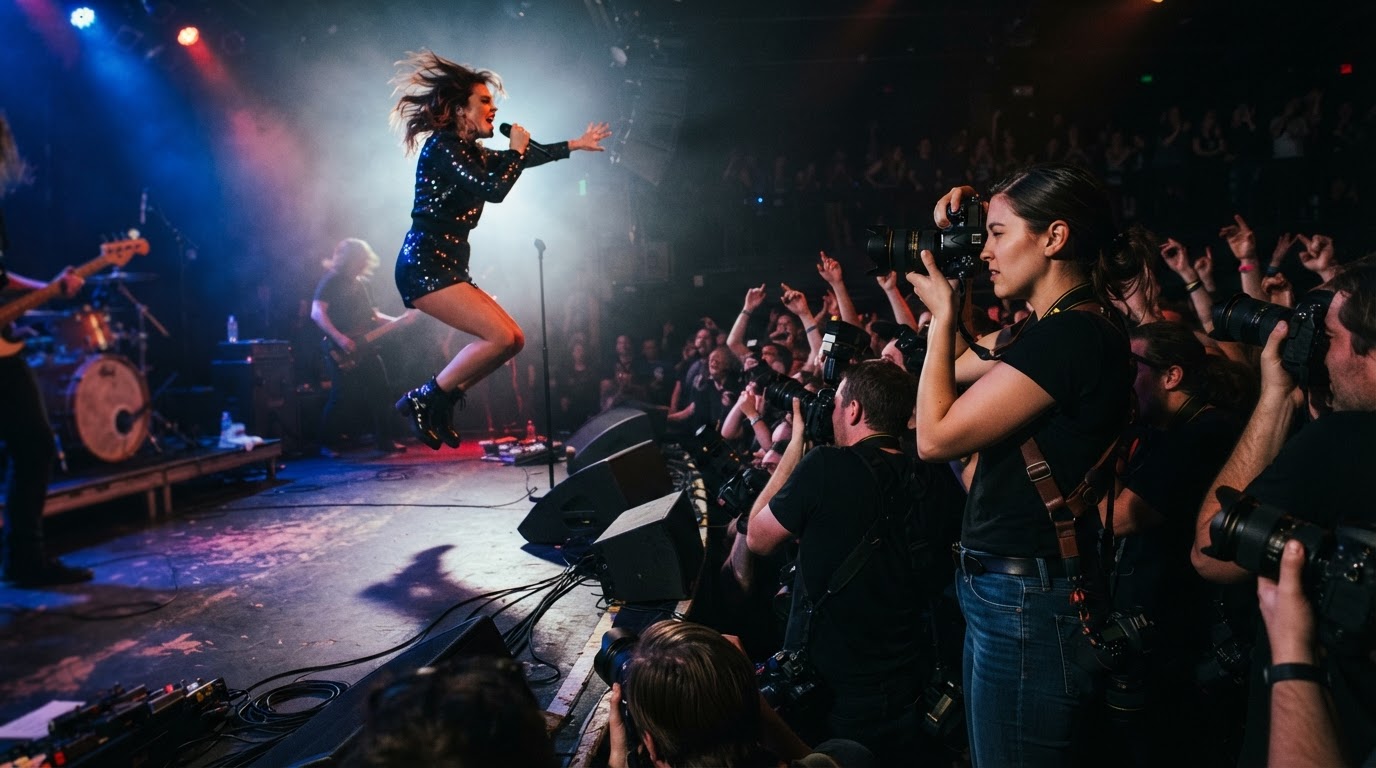
Match the length of the burst to the gesture. A slow spin, a bow, or a hand held through a line gives you time for two or three deliberate frames. A jump or a hair whip compresses the peak into a moment that a slower drive rate can step straight over. Continuous low can spread a longer movement without spending many frames; a higher rate suits the shortest, sharpest peaks. The number of frames should follow the gesture, not the maximum setting on the dial.
Single frames still make sense for most of the set. A held note, a static portrait at the mic, a wide silhouette, or a frame where composition matters more than motion will not improve with ten near-identical exposures. A useful test before you press: can you name the peak you are waiting for? If you can, a short burst is worth the frames. If you are only hoping something will happen, a single frame and an unobstructed view are usually the better bet.
Keep bursts short and watch the buffer
The buffer is the camera's short-term memory for exposures waiting to be written to the card. When it fills, the frame rate drops or the shutter waits until the card catches up. RAW files are larger than JPEGs, and RAW plus JPEG fills the buffer faster still, so file format, card write speed, and buffer depth together determine how long a burst can run before the slowdown. Those limits belong to your body; the manual states them more accurately than a general frames-per-second figure.
A card-write light or ongoing write activity does not by itself mean the buffer is full, and the buffer does not have to be completely empty before another useful burst. What matters is how much capacity remains and whether the frame rate has slowed. If your camera shows a buffer or remaining-frames indicator, read that; if there is still room and the rate is unchanged, a short burst is fine. If the rate has dropped, let capacity recover before the next peak.
Give the burst a length before you press: one gesture, one landing, one phrase, then release. Holding the release through a verse because the framing looks good produces a long sequence that is slow to write and unlikely to contain a better peak than the two or three frames at the end of a phrase. The faster the drive, the shorter the press needs to be.
Card and format limits are model-specific. Nikon's article on the D500 outlines continuous rates in terms of that body's file format and card type. Those figures belong to that camera, so check your own manual for its buffer depth and card requirements instead of carrying another body's numbers across.
Electronic shutter and LED stage lighting
If the camera offers an electronic shutter or a silent drive mode, test it under the venue's LED lighting before a set you cannot repeat. Some camera and lighting combinations produce banding or flicker at certain shutter speeds, and the interaction depends on the body, the fixtures, and the setting. A test frame at the shutter speed you intend to use tells you more than assuming silent mode behaves like the mechanical shutter.
What to review after a burst
Review when checking the camera does not cost you access or a moment. Between songs, or when the lighting drops and the next peak is not imminent, a quick look can tell you whether focus and timing are holding. If reviewing means missing the next gesture, wait and review later; the frames will still be there.
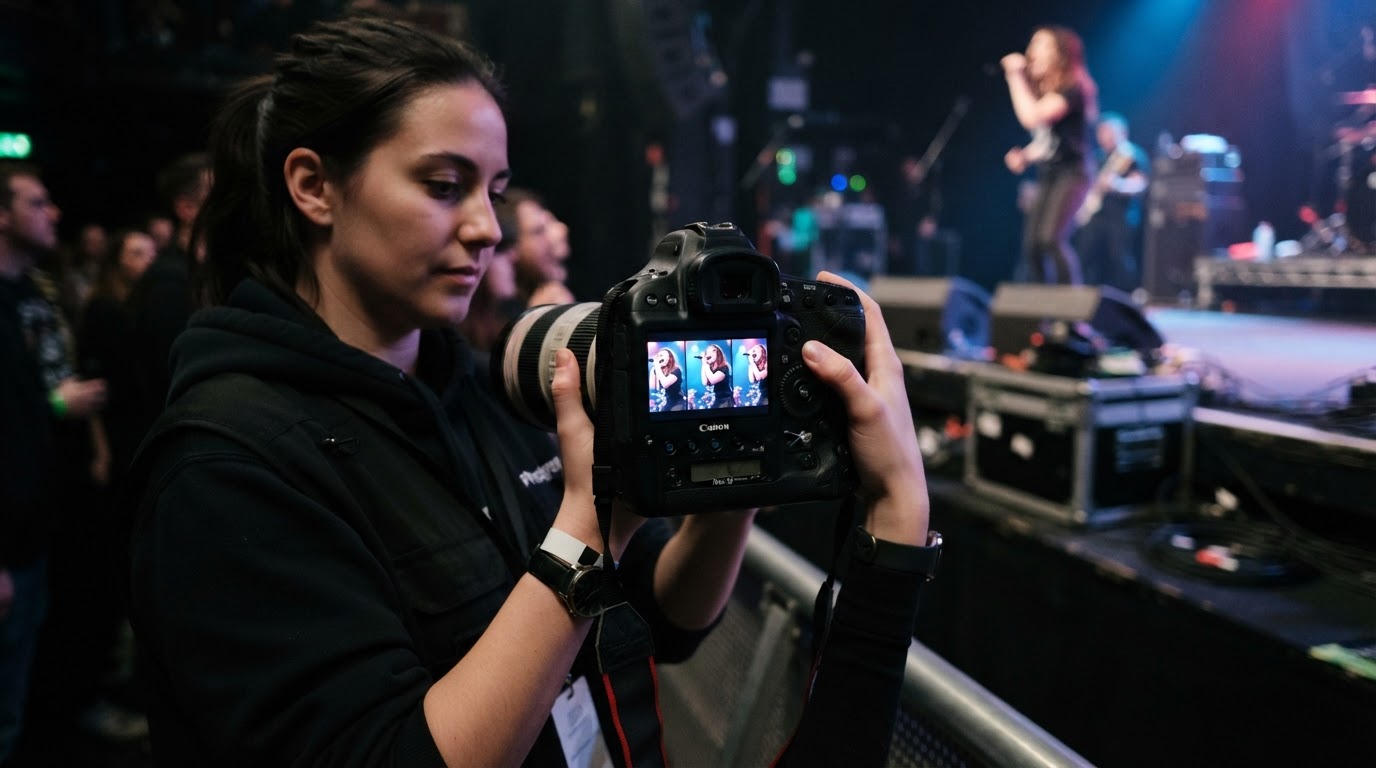
When you do review, work in a fixed order:
- Focus: Is the intended eye or subject sharp? A sequence can contain one sharp frame and a dozen soft ones.
- Motion: Is the blur where you want it? Blur in hands or hair can suggest speed; blur across the face usually ends the frame's usefulness.
- Expression and gesture: Choose the frame where the body reads clearly at a glance, not necessarily the last frame in the sequence.
- Duplicates: Note the near-identical misses and cull them later, once the card is backed up and editing is not competing with access.
The keeper count is not a score. What matters is whether the sequence contains the frames that hold the peak, and culling can happen later.
Practice before the set
Learn how your camera behaves at the drive rate you intend to use in a permitted, low-stakes setting: a rehearsal, a support act, or a quiet moment before the set if your access allows. Photo-pass terms, song limits, and rules on flash or silent shooting vary by venue, artist, and tour, so confirm access rather than assume it. Practice on the card and file format you will use for the show, and note how many frames you can fire before the camera slows. That knowledge is what makes a short burst useful: enough frames to catch the peak, and no more than the moment needs.