Commission workflow reference
This is supporting reference for understanding a commissioned shoot, not an offer from this editorial project. Use it to separate preparation, production, delivery and rights. For a concert-specific agreement discussion, use the linked checklist instead of assuming a generic commission settles show access.
What the term actually covers
Commercial photography means photographs made to serve an organisation's purposes: a product, a venue, a property, a service, a publication that a business controls. The subject can be anything. A concert stage, a hillside, a workshop floor, a portrait of a founder. What makes the work commercial is the arrangement rather than the scenery. Somebody commissioned it, somebody intends to use it, and somebody will decide how far that use extends.
That arrangement produces three consequences worth understanding before you speak to anyone.
You are buying a defined outcome rather than a set of options. The commission exists to produce images that do specific jobs in specific places.
The fee has two parts that behave differently. Production pays for people, time, and access. Usage pays for permissions. A photograph can be inexpensive to make and expensive to use, and the reverse also happens.
Do not assume who owns copyright or what delivery permits. Applicable law, employment or work-made-for-hire arrangements and any written transfer can change the answer. Identify the rights holder and agree the permitted uses before publication.
How an assignment runs
Six stages take a commission from idea to delivered files: the brief, scouting and scheduling, the shoot itself, selection and retouching, licensing, and delivery with archiving. The shoot day is normally the shortest of the six and the least reversible. Everything before it shapes what can be captured, and everything after it shapes what you are actually able to do with the result.
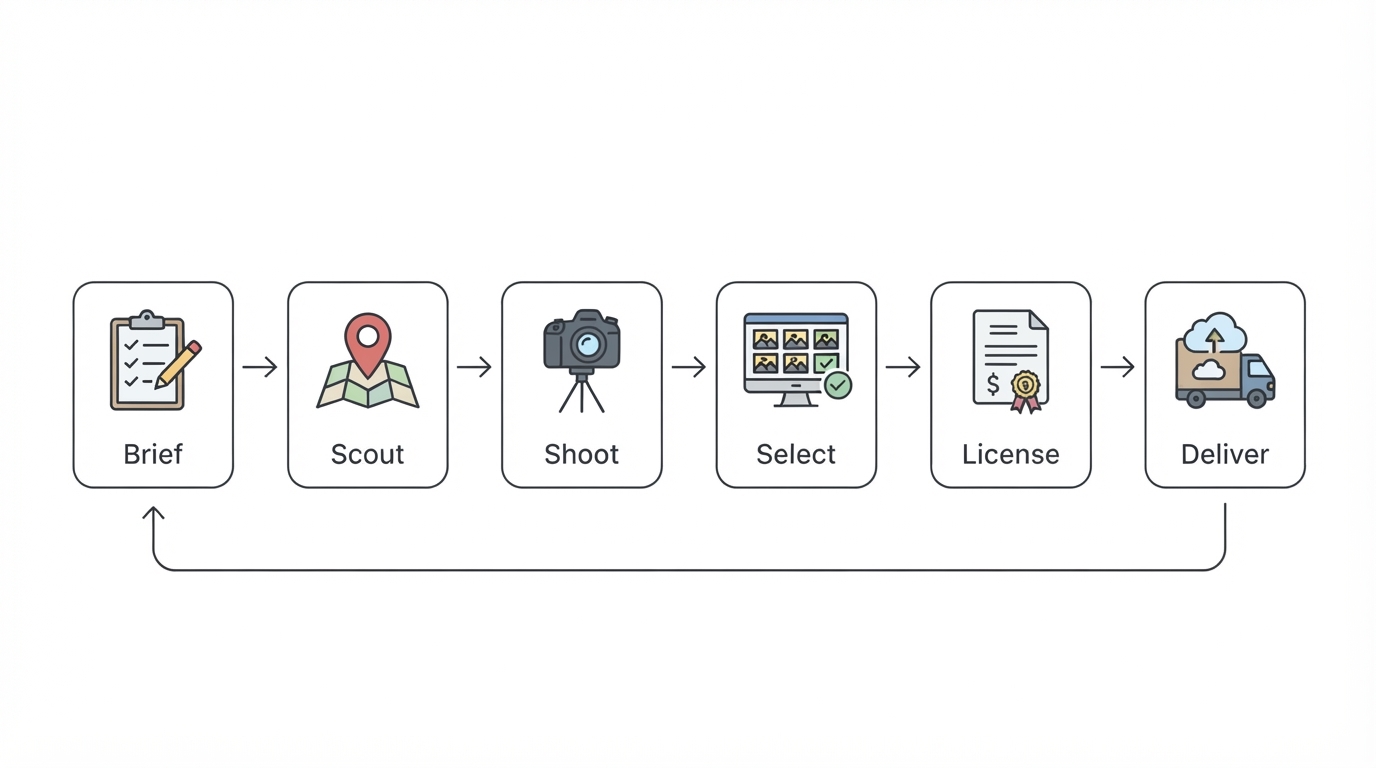
The most common structural mistake is booking the shoot first and negotiating terms afterwards. Time, place, and money all get fixed in that first conversation, so the licensing discussion then happens when your options have already narrowed.
Stage one: the brief and the moodboard
A brief for a commercial assignment is a decision record rather than a wish list. It should settle:
- Where the images will be seen, named specifically, because a website header and a printed poster impose different requirements.
- The single job each image has to do, and how many finished images you need.
- Required shapes and crops: horizontal, vertical, square, plus the safe area around a subject when text will sit over the frame.
- Scenes that must appear and scenes that must not.
- Who signs off, and by when.
- The final deadline, and the reason behind it.
Moodboards work best when they describe qualities instead of requesting copies. Split the references into light, composition, colour, styling and props, and tone, then annotate each one with why it is there. A frame pulled from a well-known advertising campaign is useful as a description of taste and unhelpful as an instruction, because it conveys the direction without clarifying what is achievable in your location with the time you have.
Stage two: scouting and scheduling
A location visit answers questions that email cannot. Where the light falls at the hour you want to shoot. What the space sounds like. Whether there is power, somewhere private to change, shelter for equipment, and permission to be there at all. What happens if the weather or the schedule moves.

Scheduling gets easier when you work backwards from the date the images must be in use rather than forwards from the shoot date. Retouching, review, and internal approval consume more calendar than most people plan for, and every stage needs a named person and a stated turnaround. If an approval requires three people and one of them travels, put that in the schedule at the beginning instead of discovering it at delivery.
Stage three: what happens on shoot day
The shoot day runs on a call sheet: who is needed, when, where, what they bring, and the order of setups. Good order follows two rules. Shoot the most demanding or light-dependent setups while the conditions still hold, and shoot the images that matter most before fatigue enters the room.
Build in one working checkpoint with the person who will approve the images. Reviewing a handful of frames on set is cheap. Learning that the framing or the styling was wrong after the crew has packed up is not. Capture variants deliberately while you are there: horizontal and vertical, wide, medium, and detail, with people and without. A frame with people and the same frame without them are different pictures with different uses, and one cannot become the other later.
Stage four: selection, sequencing, and retouching
Selection usually begins with a contact sheet review and three piles: selects, alternates, and everything else. Alternates are worth keeping on purpose. They are what protects you when a colleague asks for something the selects do not cover.

Retouching is where expectations drift most, because "finished" means different things to different people. Agree on it in writing before delivery. A finish pass typically covers colour, tone, dust, crop, and small distractions inside the frame. Broader work such as composites, background replacement, object removal, reshaping, or extending a frame is a separate scope with its own cost and its own calendar. Name the number of review rounds included, and say what happens once the last one is spent.
Stage five: usage rights and licensing
This is the section to read twice. A licence describes what you may do with the images, and it is normally assembled from several independent settings rather than one yes or no:
- Media and channels: website, paid social, print, out of home, email, internal communications.
- Term: the dates during which the images may be used.
- Territory: where the campaign runs.
- Exclusivity, including category exclusivity, which keeps the images away from a competitor for a period.
- Editing permissions: whether you may crop, overlay text, recolour, animate, or composite the photographs.
- Sublicensing: whether partners, retailers, distributors, or an agency may reuse them.
- Credit: whether the photographer must be named, and where.
- Releases: model and property releases, and your position on recognisable faces, logos, artwork, and private interiors.
- End of term: renewal terms, and who is responsible for taking the images down.
Two failures cost the most. Buying a licence broader than the plan requires, which spends money on permissions that will never be used. Or buying a narrow licence for a small test and then scaling the work, at which point the images are already in circulation under terms that do not cover the new activity. Match the licence to the plan, and re-open the conversation when the plan changes.
Stage six: delivery and archiving
A clean delivery package contains the formats your channels need, the colour space and resolution appropriate to each, a naming convention that survives a shared drive, and a short index listing what was supplied. Attach the licence summary to that index. A licence that lives only inside an email thread disappears at the next staff change.
Archiving is a separate agreement from your own backups. Decide how long the master files are retained, who can request them later, in what form, and where retention ends. That matters when the same shoot is revisited two years later for a different channel.
Budgeting by scope instead of guesswork
A quote built on a day rate alone tells you very little. The cost of a commercial commission comes from six scoping drivers, and each one can move up or down:
- Distinct setups or scenes, which is a better unit than hours on site.
- How many finished images you need, and the retouch level each one requires.
- Usage breadth: channels multiplied by term, territory, and exclusivity.
- Location complexity: permits, after-hours access, travel, load-in, and the risk of losing a day.
- People: crew, assistants, styling, talent, and the releases that travel with them.
- Decision speed and review rounds, which convert directly into schedule risk.
Ask for production and usage priced separately. It makes two quotes comparable, and it lets you rebalance when the total is too high. Fewer setups, a narrower licence, and less retouching all lower the cost, but each changes the result in a different way, so it helps to know which one you are trading away.
One trade-off is rarely discussed. Spending on very broad usage can be less valuable than spending on fewer, stronger images, because a weak picture licensed everywhere is still a weak picture.
How to start an assignment inquiry that gets a useful reply
A short message covering the essentials produces a better answer than a request for a general price list. Include what the images are for and where they will appear, the number of finished images and the shapes you need, the shoot window and the date the images must be live, the usage you expect across media, term, and territory, who approves, and the range you have set aside. Mention anything already arranged, such as the venue, the people appearing, or the permits.
Then ask for four things back: availability, an outline that separates production from licensing, the retouching standard included, and what the photographer needs from you in order to quote. Those four answers reveal whether the project has been understood, which matters more than the first number you are shown.
Related next step
Continue to the related checklist. For this site’s primary subject, browse the concert photography guides.
For US ownership background, read 17 U.S.C. Chapter 2. This reference does not determine the rights in an individual agreement.