Does the Sony RX100 VII work for concert photography?
Short answer: sometimes. According to Sony's published specifications, the RX100 VII pairs a 1.0-type (1-inch) sensor with a fixed 24-200mm-equivalent zoom whose maximum aperture is F2.8 at the wide end and F4.5 at the long end. It is a pocket-sized option for permitted shows where you can shoot wide from close in, not a substitute for a camera with a larger sensor and a fast prime.
What Sony's published specifications establish
- Sensor: a 1.0-type (1-inch) sensor - larger than a phone sensor, smaller than the APS-C or full-frame sensors many interchangeable-lens cameras use.
- Lens: a built-in ZEISS Vario-Sonnar T* zoom covering a 24-200mm equivalent range, with a maximum aperture of F2.8 at 24mm and F4.5 at 200mm.
The fixed lens makes this a compact rather than an interchangeable-lens system - a distinction that matters at the venue door.
Why the aperture change at telephoto matters in a dark venue
The important detail is that F2.8 is the maximum only at the wide end; the maximum narrows as you zoom. At 200mm the lens is F4.5, about 1.4 stops less light than F2.8 at the same shutter and ISO. In a dark room, that can require a slower shutter or higher ISO; the outcome depends on the actual stage light.
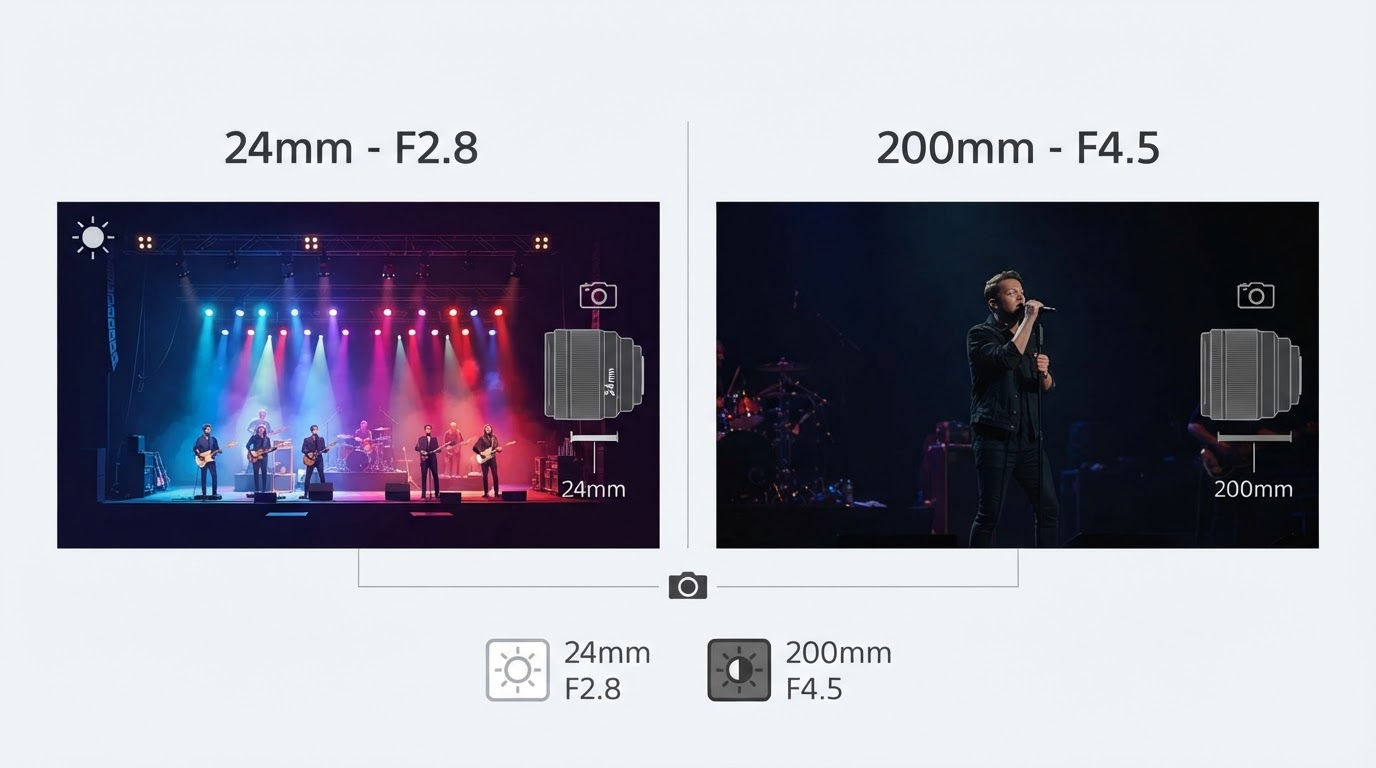
If you cannot get close, the long end costs more than a stop of light: raise ISO, lower the shutter speed, or accept a darker exposure - all three have visible costs at a live show.
Shutter speed and ISO tradeoffs
Live music forces a choice: freeze the performer, or keep noise down. A 1-inch sensor has less ISO headroom than a full-frame body, so both sides of that tradeoff bite earlier.
- Subject motion matters separately from camera shake. A performer's hands, hair and instrument move constantly. Try a relatively fast shutter, review at full size, and adjust to the actual motion and light rather than treating one speed as a guarantee.
- Stabilization helps the camera, not the musician. Stabilization reduces handheld shake, so static moments can hold a slower shutter. It does nothing for a singer who will not stand still.
- Balance ISO with motion blur. Higher ISO can increase visible noise and reduce usable dynamic range, but an underexposed or motion-blurred frame may be worse. Set a ceiling you accept and review real frames.
A starting experiment is shutter priority with a fast enough shutter for the performer, Auto ISO within a limit you accept, and continuous autofocus. The camera chooses the aperture in shutter-priority mode; check whether it reaches the lens's maximum before pushing ISO.
Venue camera policy: where a fixed-lens compact fits
Camera rules come from the venue, promoter and sometimes the artist, and differ from show to show. Some policies distinguish fixed-lens compacts from interchangeable-lens cameras; others prohibit all cameras. Do not assume the RX100 VII will be admitted merely because its lens is fixed.
That is a tendency, not a guarantee. Verify before you travel:
- Read the venue's own FAQ or prohibited-items page - not a third-party summary.
- Check the specific event page and any tour rules.
- Call the box office or guest services with the exact model name and lens description.
- Keep a dated copy of the policy in case the door decision differs.
If the published rule bans all cameras, or requires a photo pass beyond a phone, no setting can solve it.
Decision table: does this camera fit your show?
Situation | What works in your favor | What works against you | Realistic call |
|---|---|---|---|
Small club, standing near the front | Short distance, wide F2.8 end, loud stage light | Crowd movement, uneven light | Workable, shoot wide in bursts |
Mid-size theater, seated in the middle | Zoom reach to 200mm | Distance forces the F4.5 end, dim between songs | Mixed: high ISO, some misses |
Arena or amphitheater from the seats | Occasional bright stage moments | Long reach at F4.5, distant subject | Poor: atmosphere only |
Strict "no cameras" or photo-pass-only show | Nothing - the rule outranks the gear | Any camera can be refused | Leave it home |
Artist allows phones only | The camera is small and quiet | Policy still applies at the door | Not worth the risk |
Concrete steps before the show
- Confirm the camera policy first; the best settings are useless if the camera stays in the car.
- Take the closest position your ticket allows; the wide end gives you the most light.
- Start with shutter priority and Auto ISO within a limit you accept; check the chosen aperture and adjust shutter speed after reviewing the first frames.
- Use continuous autofocus and short bursts rather than single frames for moving performers.
- Expose for the lit performer and let the background fall dark; meter the stage instead of the room.
- Bring spare batteries and a backup phone, and review at full size before judging the show.
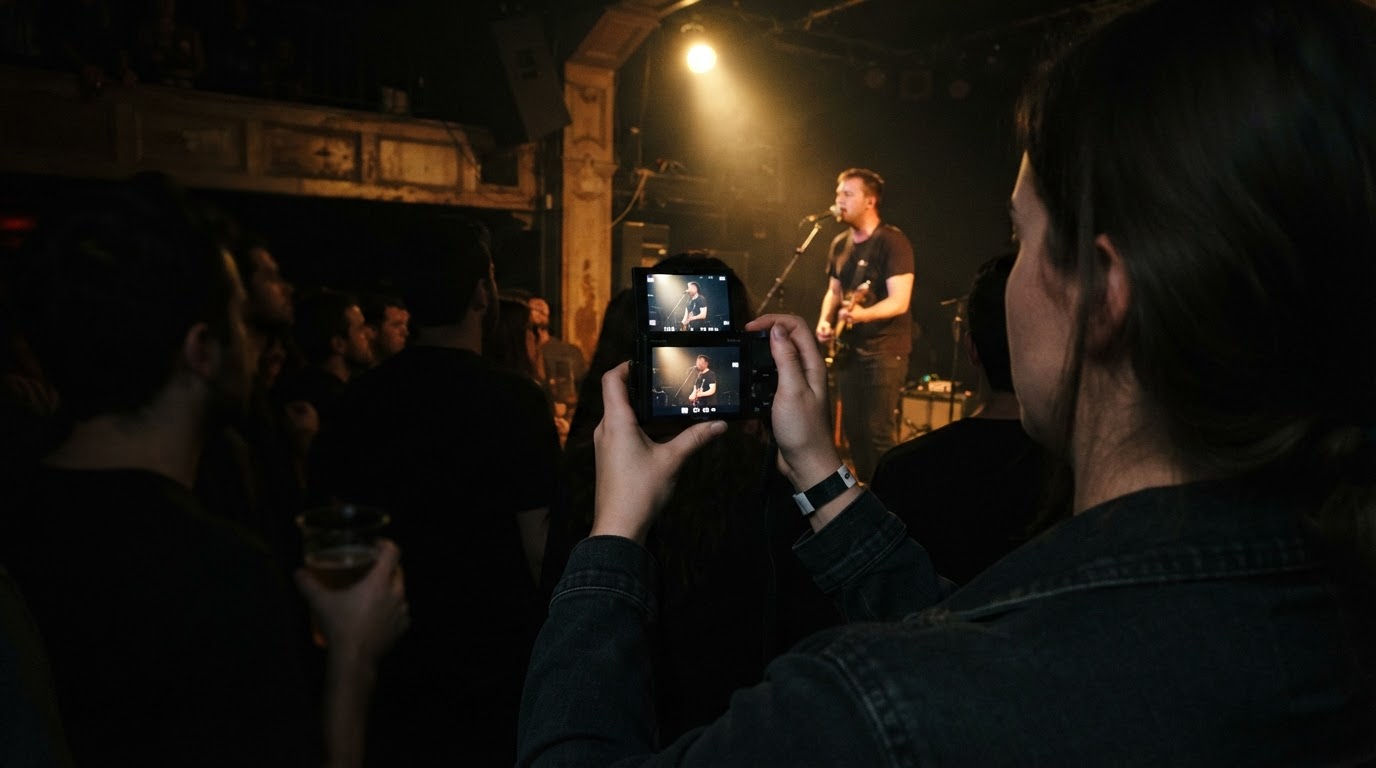
Limitations to accept
- A 1-inch sensor shows noise and limited dynamic range sooner than a larger sensor at the same ISO.
- The variable aperture removes roughly a stop and a third of light by the time you reach 200mm.
- The fixed lens cannot be swapped for a fast prime, so low light and subject separation stay limited.
- The compact body is an advantage for carrying, but permission still depends on the specific event's rules.
- None of this overrides venue policy or guarantees a usable frame in the darkest rooms.
FAQ
Is the Sony RX100 VII good enough for concert photography?
In the right conditions - close, wide, decent stage light, and a venue that allows it - it can produce usable frames. In dark, distant or strict rooms, the 1-inch sensor and F4.5 telephoto setting are the limits you hit first.
Will venues let me bring the RX100 VII to a concert?
There is no universal rule. Check the specific venue and event policy, and ask the organizer if fixed-lens cameras are unclear.
What settings should I start with?
Try shutter priority, Auto ISO within a limit you accept, continuous autofocus, and short bursts. Review the resulting shutter/aperture/ISO and motion blur, then adjust; use the wider end when composition permits because the lens is brighter there. For broader technique, see our concert photography tips.