When Deliberate Motion Blur Is the Right Choice
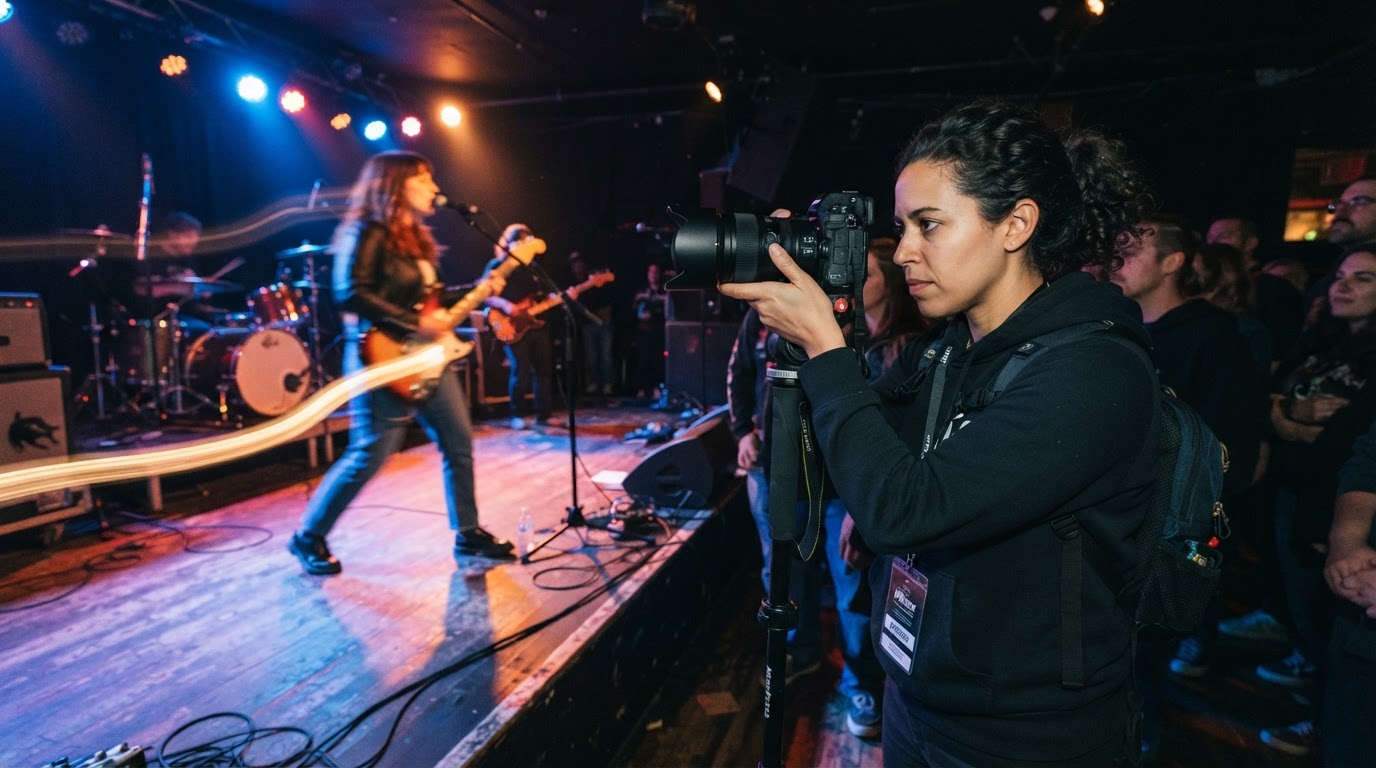
Choose a long exposure when the energy matters more than a clinically sharp frame: a singer mid-lyric, a drummer's arms, lights sweeping over a crowd. Stay with sharp settings when you need a clean image of a face or instrument; this article stays on the blur side.
A long exposure records moving light as a continuous trail; the trade-off is that everything in the frame keeps recording, so the camera has to stay still.
What you want to show | Starting approach | Main risk |
|---|---|---|
Performer's movement as a streak | Camera locked down; let the action travel | Fixed objects softening from shake |
Moving stage lights or trails | Camera locked down; the lights need no flash | Bright lamps blowing out |
Performer frozen inside motion | A short exposure or flash | Flash may not be allowed |
A clean publishable portrait | Short exposure, wide aperture, higher ISO | Not a long-exposure job |
Intentional Blur vs Camera Shake
Blur you wanted follows the subject: a singer's hand becomes a smooth streak running the way it moved, while fixed objects — a speaker stack, the stage edge — stay crisp because the camera did not move.
Camera shake is the camera moving during the exposure. It softens everything, including objects that never moved, and usually shows as doubled or jagged edges across the frame. Canon's guide to image stabilisation states the difference plainly: image stabilisation "only reduces the effect of camera shake − it has no effect on blurring caused by subject movement."
If the whole frame is soft, the problem is your support or trigger, not the stage. If only the performer streaks, the exposure is doing what you asked.
Set Up Support Before You Choose Settings
Camera-maker guidance puts support first. Nikon's long-exposure guide explains why a steady camera matters and suggests a tripod or other support for longer exposures. A remote release or self-timer can avoid moving the camera while pressing the shutter.
A monopod changes this. Canon advises leaving stabilisation on with a monopod, because you cannot hold that support perfectly still, while modern stabilised lenses can detect a tripod and adapt.
Venue rules come first. Tripods are the most restricted support because they take floor space and block sightlines, and policies differ between rooms, tours, and show formats. Ask the venue or tour's photo contact before doors open, and keep a fallback: brace against a column or rail, hold the camera close, and accept a shorter exposure.
- Confirm support and flash rules before the first song.
- Choose a spot outside walkways where nobody will bump the camera.
- Trigger the camera with a remote, cable, or timer.
- Start short, then lengthen the exposure as you learn the light.
- Review after a few frames, not at the end of the set.
Work With the Ambient Stage Light
Stage lighting is not constant: it breathes through a song, with dark verses, bright choruses, and sweeps that cross your frame.
When the stage is bright, an extended exposure collects a lot of light and moving sources merge into white. When it drops, the same exposure records the remaining trails. Watch a full song first, and change exposure between songs rather than mid-motion.
Neutral-density filters cut light so an exposure can be extended; Canon and Nikon describe them as daylight tools, the opposite of what a dark room needs.
Flash: Permission First
Flash is the most rule-bound part of the technique. Many venues and tours ban it outright; some allow it only for the first few songs. Ask first, and treat a no as final.
Where it is allowed, flash can freeze a moment while the shutter stays open. Canon's camera manual explains second-curtain sync: the flash fires near the end of a slow exposure, allowing light trails to appear behind a moving subject. Availability and controls depend on the camera and flash.
Use it sparingly: flash changes the room for everyone, and permission belongs to the room, not the photographer.
Review Exposures While the Set Is Still Going
Review belongs inside the technique. After a handful of frames:
- Zoom into a static object. If it is crisp, camera shake is under control; if it is doubled, change your support or trigger before touching the exposure length.
- Check the highlights. Stage lamps that clip to white stay white; a slightly dark frame can be recovered.
- Read the blur direction. Streaks that follow the action are the effect you wanted; streaks across the whole frame are shake.
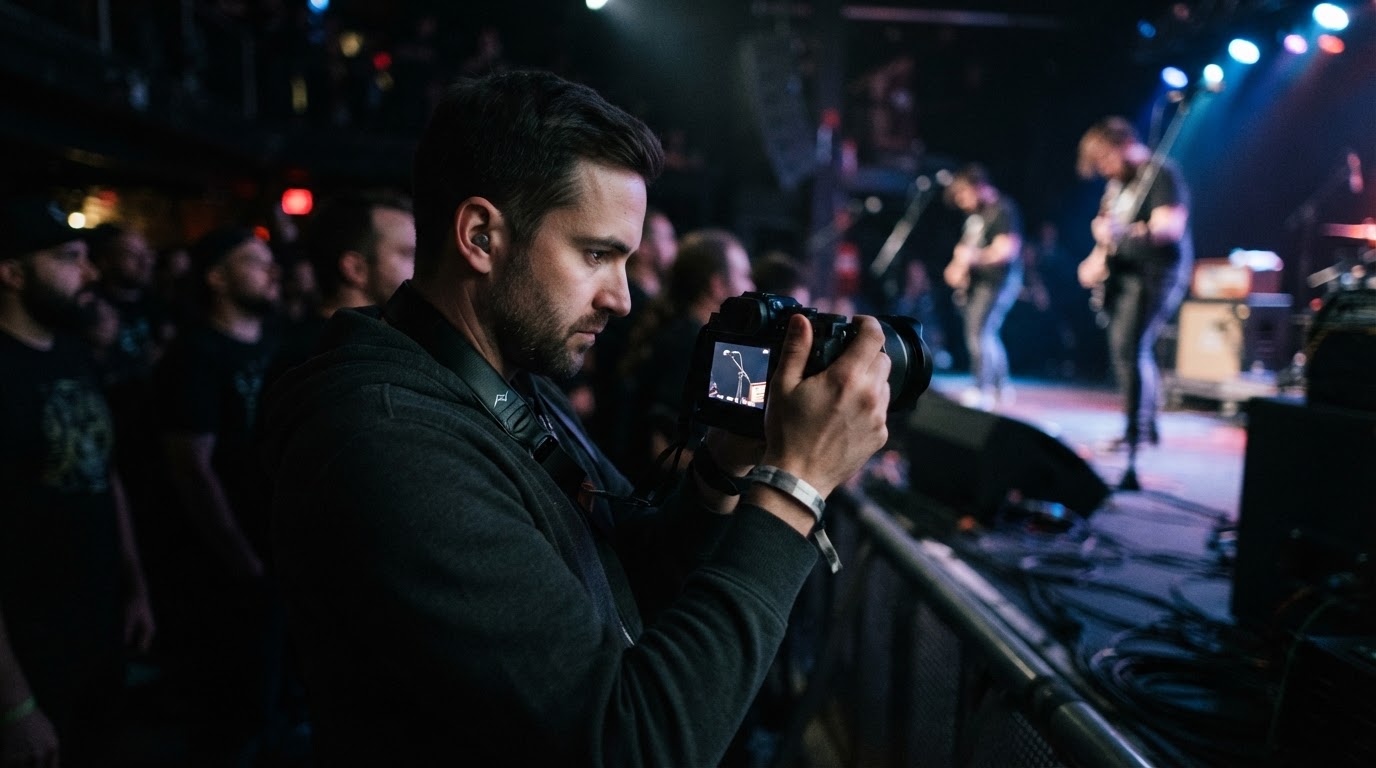
The approach is finished when fixed objects are sharp and only moving elements are soft.
Diagnostic Matrix
What you see | Most likely cause | What to change |
|---|---|---|
Whole frame soft or doubled | The camera moved | Support, trigger, or a shorter exposure |
Performer streaked, fixed objects crisp | Subject motion recorded as intended | Nothing, unless the streak is too long |
Streaks run the same way across the frame | Shake in that direction | Stabilisation and bracing |
Blown white areas around moving lights | Too much light for the exposure | Shorter exposure, not a filter |
Flash trail in front of the performer | Front-curtain sync | Rear-curtain sync |
What Long Exposure Cannot Do
- It cannot create access, fix a badly lit room, or replace a clean sharp frame.
- It cannot make camera shake acceptable; blur from the camera reads as a mistake, not a style.
- It cannot override venue rules, which decide what is possible before any setting.
- It cannot be reduced to one recipe: room size, light, lens, and the performer's speed all change the answer.
FAQs
How long should a concert long exposure be?
Begin with the shortest exposure that still shows movement, then lengthen it until the blur reads as intended. If fixed objects soften, you have gone past what your support can hold.
Can you handhold a long exposure at a concert?
Only within limits; stabilisation will not rescue a moving subject. Canon's guidance is explicit that stabilisation reduces camera shake but has no effect on blur caused by subject movement.
Should you use flash for long-exposure concert photos?
Only when the venue and tour allow it. Where it is allowed and the equipment supports it, rear-curtain sync can place light trails behind the subject. For ordinary sharp shots rather than intentional blur, see our concert photography tips.