Diagnose the limitation before you buy a body
If you cannot fit the act from your allowed position, try a wider or longer lens or a different position when your pass permits. Changing format with the same compatible lens also shifts your field of view, so it can ease a framing problem; what it cannot do is create space, lift a lens-length rule or change where you may stand. If movement is costing you sharp frames, raise the shutter and ISO to hold it. Test a full-frame body only when your widest usable aperture and slowest usable shutter still leave files too noisy at your delivery size.
What crop factor changes on the same lens
Nikon's DX and FX explainer gives DX as about 24 x 16 mm and FX as about 36 x 24 mm, with a 1.5x crop: a 24 mm lens on DX gives roughly the view a 36 mm lens would give on FX (Nikon, "The DX and FX Formats"). Focal length does not change; the sensor records a narrower or wider slice of the same image circle.
Mounting is a separate question. A lens made for a larger format does not automatically fit every smaller body across mounts and systems; the mount, adapter support and the manufacturer's compatibility list for your exact camera and lens decide that. Within one mount an FX lens may cover a crop sensor, but that is system-specific.
With the same compatible lens, a 50 mm frames like roughly 75 mm on DX and 50 mm on FX: full frame gives room when you are too tight, and takes reach when you need it. Cropping an FX file back to the DX field of view discards the extra area.
Access and reach are not sensor problems
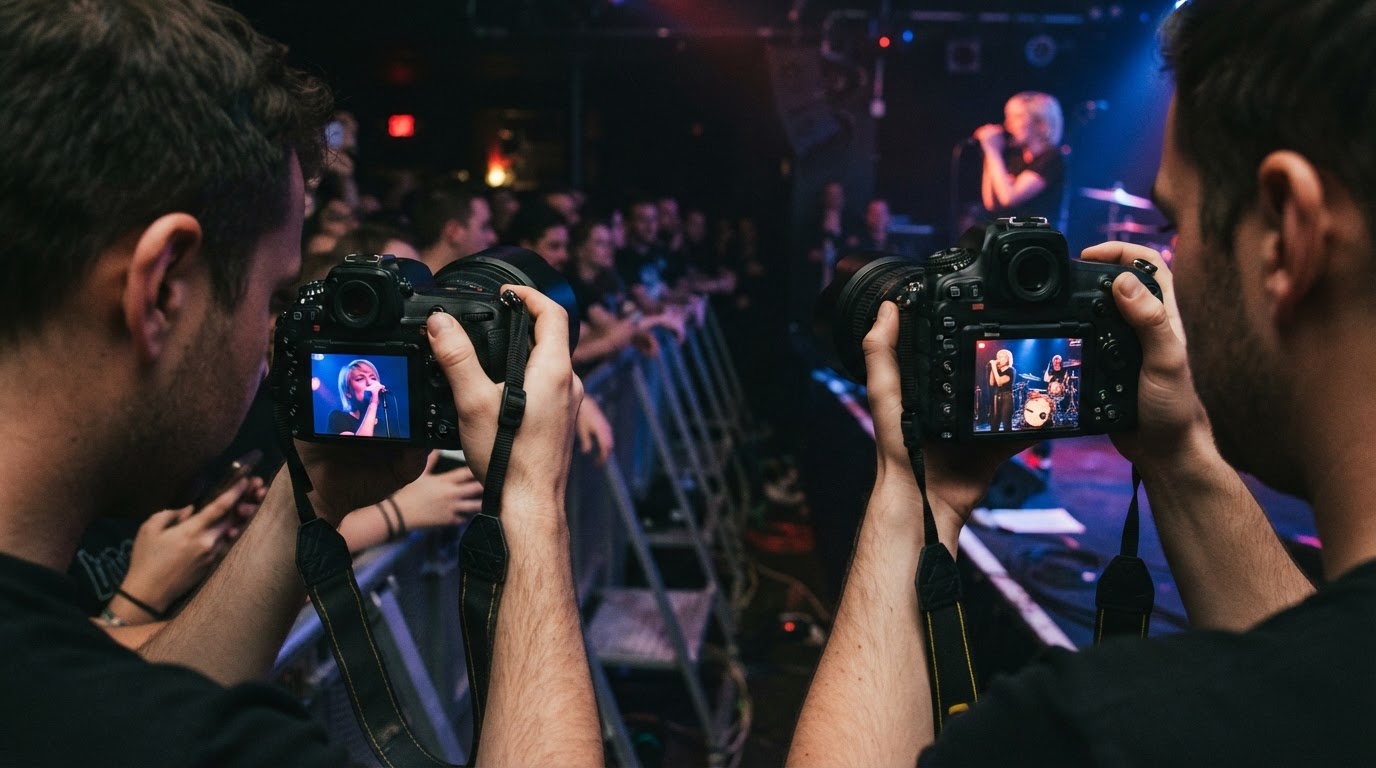
Venue rules often decide more than specifications: the site's guide to the best lens for concert photography notes that many venues and artists allow photography only for the first few songs and restrict flash and long lenses. No sensor format changes your distance, your sightline or a lens limit written into the photo pass.
The three variables that usually decide it
Aperture
Moving from a constant f/2.8 zoom to an f/1.8 prime is roughly 1.3 stops with everything else fixed — not a measured advantage over any particular sensor. Whether a faster lens wins depends on the two systems, the apertures you can afford in each and the ISO you already tolerate. If you are still on a slow kit zoom, the lens is often the larger step for the money.
Motion blur
Stabilization compensates for your hand movement, not a singer crossing the stage. Raise the shutter until the performance freezes, then raise ISO to hold it. If more frames get sharp as you shorten the shutter, motion is a likely contributor — a clue to fix shutter and ISO first, not proof that the sensor or autofocus cannot also contribute.
High-ISO noise
Nikon says the FX sensor's larger light-gathering area offers higher sensitivity and generally lower noise. "Generally" matters: the gap depends on the two specific cameras, their sensor generation and how files are processed. It is not a fixed one-stop guarantee, and it should be judged at matched output, not at a 100% crop of different magnifications.
A short check you can run at the next show
Treat these as proposed checks, not a test.
- Record your distance and focal length, and decide whether the frame is too tight or too wide.
- Keep framing and aperture fixed, then vary only shutter speed. If more frames are sharp at a shorter shutter, motion is one limit.
- At your widest usable aperture, note the ISO required for a sharp frame. If those files are still too noisy at your delivery size, you are light-limited.
Match the symptom to the first fix
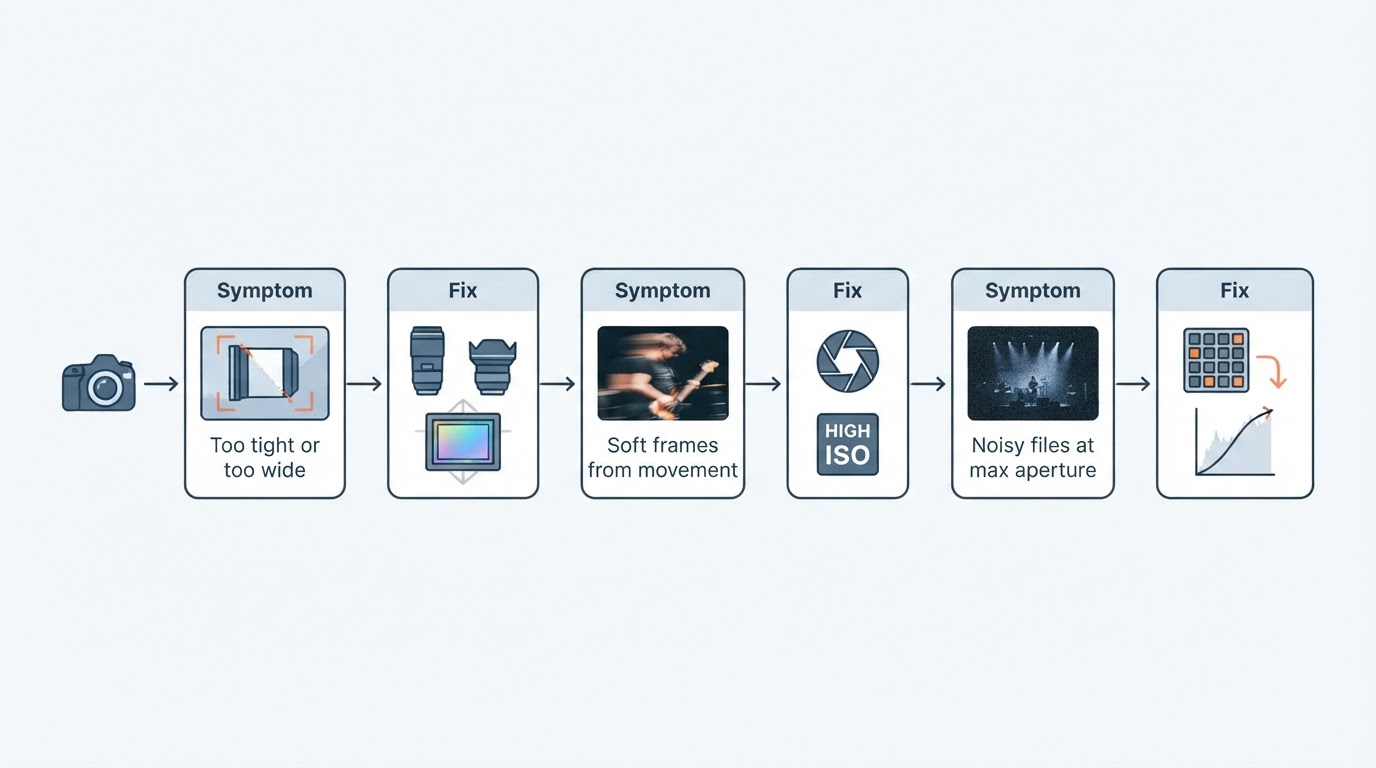
What you see | Try first | Does a format change help? |
|---|---|---|
Frame too tight or too wide | Wider or longer lens, or a new position if the pass allows | Field of view only, with the same compatible lens |
Soft frames from movement | Faster shutter, higher ISO | Not directly |
Noisy files at maximum aperture | Faster lens, then compare full frame at matched output | Possibly, per camera |
Blocked view or lens limit | Change position or ask about access | No |
Before you spend
Rent or borrow a full-frame body for one show with the lens you would actually use, and budget body and lens together. On Nikon FX bodies that offer DX crop mode, the camera may record a DX-sized area when a DX lens is attached, but behavior depends on the model and settings, so check the manual rather than assuming it applies to every mirrorless camera. Compare both at the same final size and processing. If your crop body already gets the frames, a second body may solve a different problem such as backup or avoiding lens changes, but whether that is worth more than a format change depends on your work and budget, not a general rule.