What a concert photographer actually does
A concert photographer photographs live performance while the performance carries on without interruption. The job is not staging a scene; it is reading light, position, and timing well enough to bring back frames that show what the room felt like and what the artist actually did on stage.
Most assignments mix several kinds of image. There are performance frames: the artist mid-song, hands on an instrument, a face caught in a lighting change. There are environmental frames that place the act in the room, such as the stage seen from the back of the house, the crowd's silhouettes, or the room before doors. Many shoots also add detail frames of gear, set lists, and signage, and some include short backstage or rehearsal windows arranged in advance.
It helps to separate two jobs that look similar. One is documentation for the artist, venue, or promoter: a record of the night, built to their brief. The other is editorial coverage for a publication, chosen by an editor and captioned with the writer's context. The second job answers to an outlet rather than to the artist, and both should be planned separately.
How a show is covered, from load-in to delivery
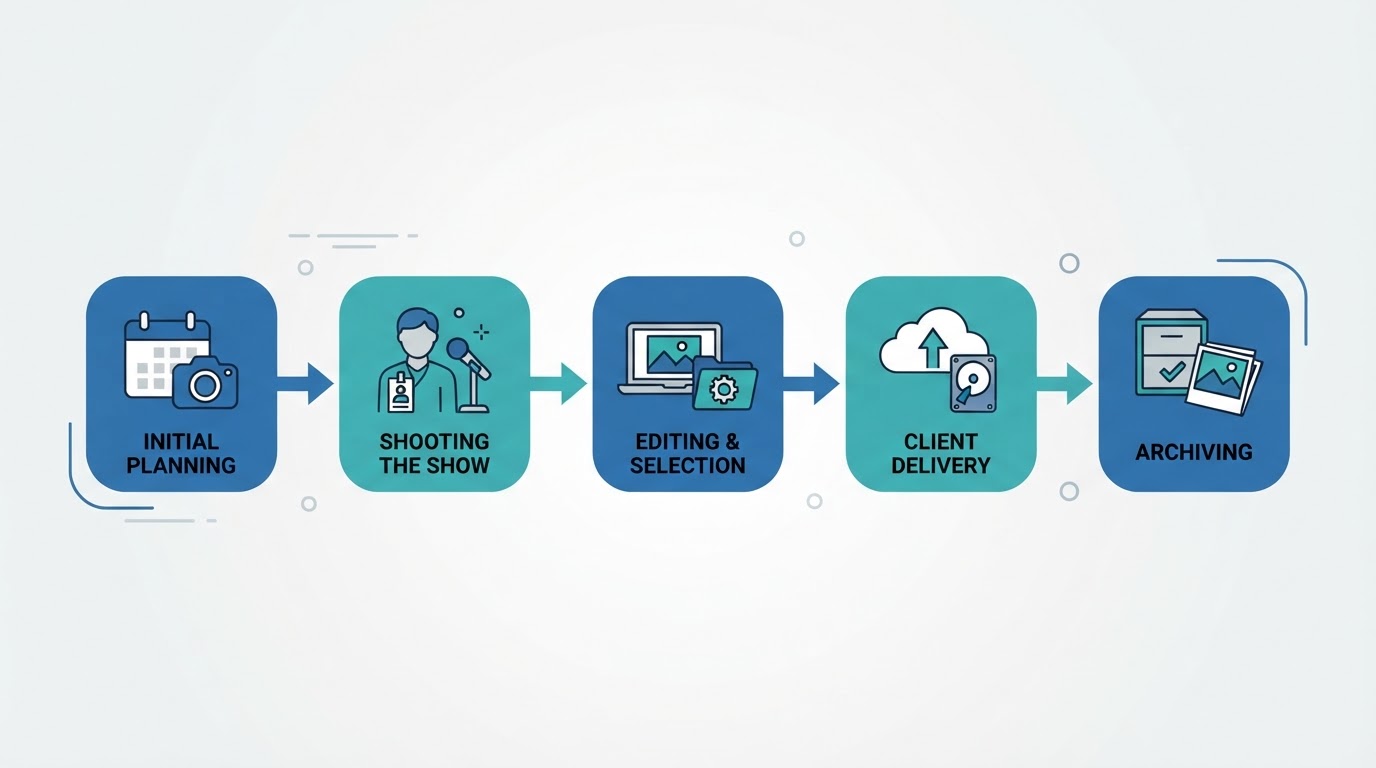
Coverage usually begins well before the first song. A photographer arrives around load-in or soundcheck, walks the room, watches how the lighting behaves during a run-through, and picks positions that will not block sightlines or put them in the crew's way. Set times and the running order get confirmed with the stage manager or the artist's tour manager, because a late change to the order can cost the frames that were specifically requested.
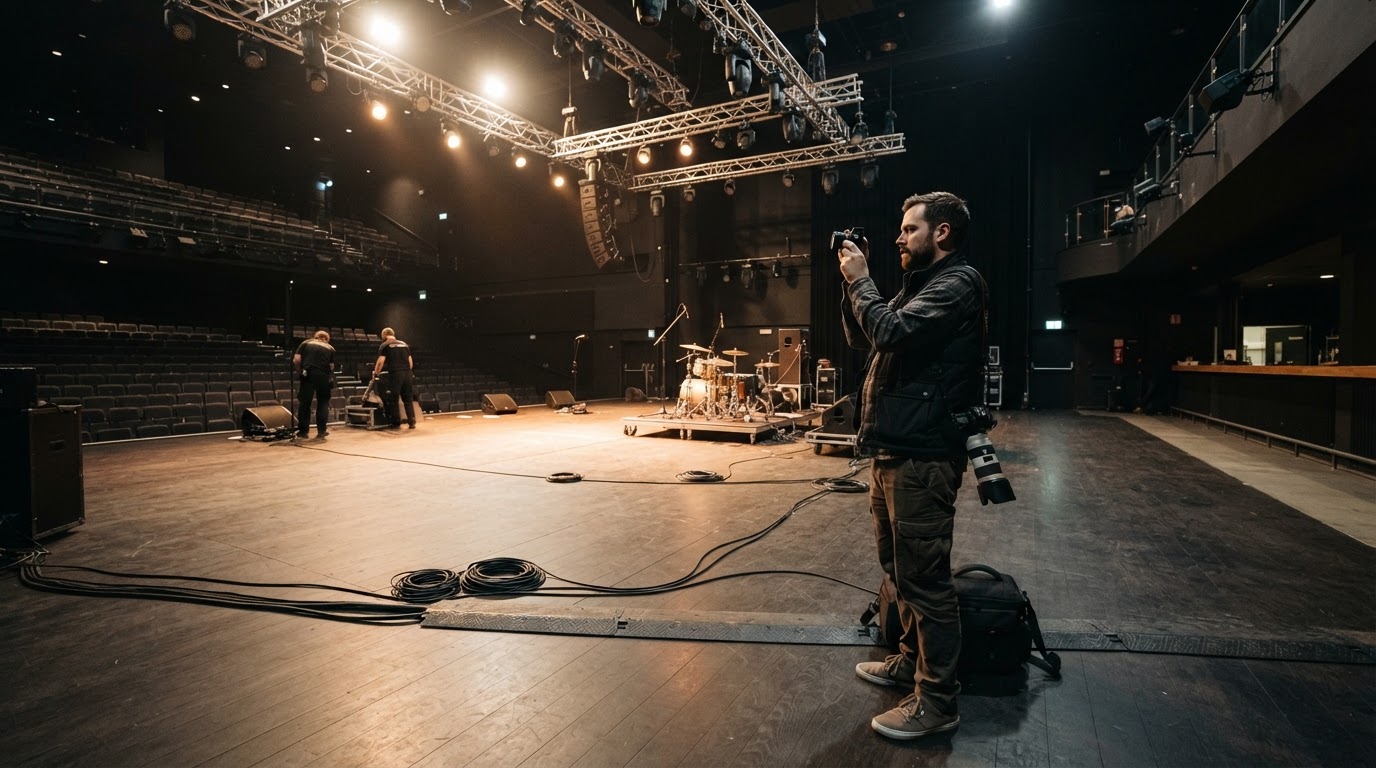
During the set the photographer works inside whatever window has been agreed, whether that is a fixed number of songs from the photo area or the full performance from permitted positions. Well-run coverage stays quiet and non-interventionist: no staged direction during a song, no flash where flash is banned, no requests to redo a moment. Between sets there is often useful material in the changeover, in the crowd, and in the venue itself.
After the show comes the part clients underestimate. Cards get backed up before anything is deleted. The photographer culls for technical quality and for the brief, edits for consistent color and exposure across the set, and exports in the formats that were agreed. Delivery is usually a review gallery plus a download link, with the selected frames named or numbered so that the recipient can refer to one specific image in a conversation. A deadline agreed in advance is what makes that handover predictable.
Access, credentials, and permissions
Access is the part of a live shoot that cannot be improvised on the night. A photo pass is issued by whoever controls the room, whether that is the venue, the promoter, the artist's management, or a festival accreditation office, and each of those can grant a different scope.
Three things are worth confirming in writing: which areas the pass covers, how long the photographer may shoot, and which house rules apply. Photo-area-only access, a ban on flash, a lens-length limit, no stage access, and a requirement to leave the pit after an agreed number of songs are all normal conditions rather than obstacles. A pass for the artist's own archive may come with different conditions than a pass for a press outlet covering the show.
There is also the matter of approval. Some artists and management teams expect to review images before they are published. That is a legitimate request when it is agreed up front; it becomes a problem when it arrives after delivery, because a published image cannot easily be unpublished.
How to brief the shoot before the night
A short, specific brief saves more time than any amount of post-shoot feedback. Describe the purpose of the images, the frames that must exist, and where the images will be used. Then attach the practical details the photographer needs: the date, call time, set time, venue, the name of whoever will meet them, and how they get in.
A useful brief also states what is out of scope. If the room is too dark for a clean wide shot, or the artist has asked for no flash, the photographer should know that before they build an approach around it. If specific people must appear in the set, name them. If the images are needed for a press release that goes out the following morning, say so at the booking stage rather than afterwards.
Licensing: promotion, press, and everything downstream
Copyright and permission are two different things. By default the photographer holds the copyright in the images they make, and a client receives a license to use them. What that license allows is negotiable, and it should be written down before the shoot rather than reconstructed afterwards.
The terms that matter are who may use the images, on which channels, in which territories, for how long, and whether the license is exclusive. Ask separately about cropping and alteration, because a tightly cropped image may no longer carry the photographer's credit line. Ask about credit requirements, and ask what happens when a promotion outgrows the original brief: a social post and a paid advertisement are usually licensed on different terms.
Press and editorial use is narrower than promotional use. An outlet publishing a review needs images that can run with the article; an artist building a press kit needs images they can send to writers and promoters. Neither of those permissions automatically covers merchandise, album art, or paid advertising, so it is worth listing the intended uses in the brief and confirming them in the license.
How to judge a portfolio before you commit
Look at complete sets from single shows rather than a grid of the best frames. A consistent set tells you how the photographer handles mixed color temperature, dark rooms, fast movement, and the ordinary stretches of a performance where nothing dramatic is happening.
Check whether the delivery matches the shoot you are planning. A portfolio full of tight stage shots may not say much about wide room shots, crowd atmosphere, or backstage portraits. Ask to see how images hold up at the crop and resolution you need, and look at whether the editing stays consistent across a set, because a gallery that shifts in color from frame to frame creates work downstream.
Then look at the unglamorous parts. Are the files delivered on time, named clearly, and accompanied by the selections that were promised? References from previous clients on comparable jobs answer that better than any caption.
What to send a photographer in advance
Send the logistics and the intent together, in one message that can be forwarded. Include the date, doors and set times, the venue and the entrance the photographer should use, the name and phone number of the day-of contact, and the photo-pass details.
Add the creative side: the artist or event name, the running order if one exists, must-have frames, any existing brand assets such as a logo or typeface, and a few references showing the look you have in mind. State the delivery needs, meaning formats, aspect ratios, resolution, number of selects, and the deadline, and say which uses the images are licensed for.
The one thing not to send is a booking with no brief attached. A message that only says to come and shoot the show leaves every decision, including access, coverage window, and usage, to be settled at the worst possible moment.
Where a live shoot runs into limits
Live coverage cannot be reshot. If a lighting cue hides the artist's face through the whole chorus, that frame does not exist, and no amount of editing will produce it. Lighting is designed for the room rather than for the camera, so a photographer is balancing exposure against color that shifts constantly, and a house rule against flash removes the usual way of filling a dark pit.
Position is the other hard limit. A single photographer cannot be in the pit, at the back of the house, and in the wings at once, so a one-person shoot is always a set of trade-offs chosen in advance. Larger rooms and festivals often solve this with more than one shooter and an agreed division of coverage, which is worth arranging when the brief includes wide shots, crowd frames, and backstage material.
Questions to ask before booking
- Which areas does the pass cover, and for how long can the photographer shoot?
- Are there house rules on flash, lens length, or stage access?
- Who issues the pass, and what do they need from us in advance?
- What is the call time, and who meets the photographer on arrival?
- Which frames must exist, and which can we live without?
- Does anyone need to review images before publication?
- Exactly which uses are permitted, such as social, press, print, or paid advertising?
- What credit line is required, and where should it appear?
- How many selects are included, in which formats, and by when?
- What happens if the set time or running order changes on the day?