What a Licensing Fee Is Actually Paying For
Most people who look for a photo licensing fee calculator are trying to answer one of two questions: what should I charge, or what should I expect to pay? Both come down to the same thing: the use, not the file.
A digital image costs almost nothing to copy, so the fee cannot be the copy. What you price is a bundle of permissions: who may use the image, where it may appear, for how long, in which markets, and whether anyone else can use it at the same time. Each permission carries its own value, which is why the same photograph can license for very different amounts in two different deals.
Factor | What you define | Why it changes the fee |
|---|---|---|
Usage and media | Where the image appears: a press kit, a merchandise print run, a paid advertisement, an editorial page, a venue poster | More commercial and more visible placements carry more value than a single editorial appearance |
Reach | How many people see the image, in which audience, and how often it runs | A campaign shown to a national audience uses more of the image's value than a local post |
Territory | The places the license covers, from one city to worldwide | Broader distribution usually justifies a higher fee than a single-market use |
Duration | The start and end of the rights, plus what happens at renewal | A three-month placement is worth less than an open-ended or multi-year license |
Exclusivity | Whether the client keeps others from using the same image for competing purposes | Exclusivity removes future earning options, so it is priced on its own line |
A licensing fee is a rights grant with boundaries. When the boundaries stay vague, the price stays vague too, and clients usually assume they bought more than the photographer intended. A written license fixes that by naming each boundary in plain language.
Why There Is No Single Number
You will not find one universal rate table that fits every photograph, market, and use. Stock platforms sell defined license types, trade bodies publish guidance for their members, and independent photographers publish their own terms. Those sources disagree because they price different things. A stock micro-license and a commissioned campaign license are not the same product.
That gap is why a photo licensing fee calculator can only ever be as good as the factors it asks about. If the tool never asks who the audience is, whether the client wants exclusivity, or how long the rights last, its output is a starting point at best. Treat any single number as one input into a conversation, not a verdict.
A Manual Method You Can Work Through Without a Tool
This is one practical way to price a license by hand. It works whether you are the photographer setting the terms or the buyer testing whether a quote matches the intended use.
Inputs you need first: the license category closest to the intended use, a one-sentence description of that use, a baseline rate you trust, and a written license template. If any of those are missing, resolve them before you quote, because the number depends on all four.
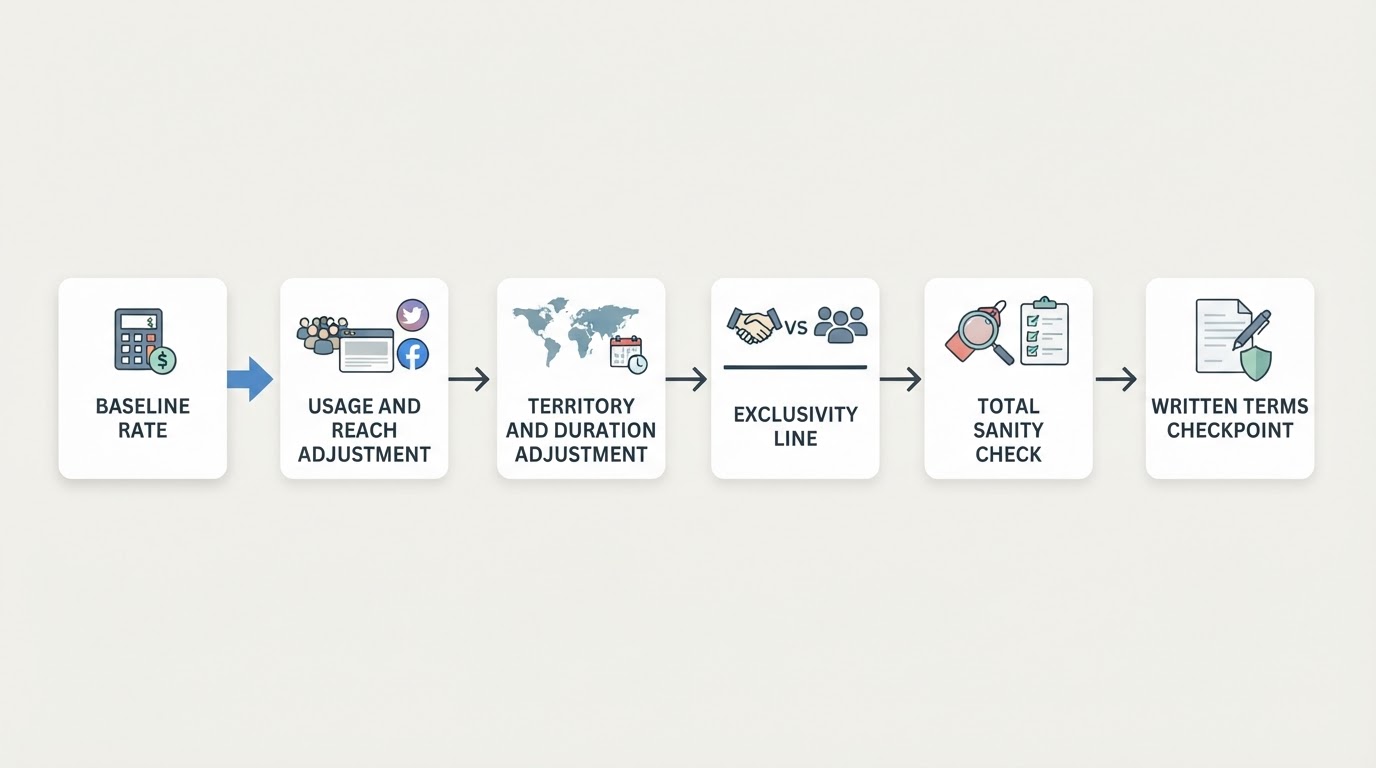
Step 1: Anchor to a Baseline Rate
Pick the published starting rate for the closest use category, or your own baseline for comparable work. The baseline does not have to be exact; it has to be the same category of use. A press-use rate is not a merchandise rate, and treating them as interchangeable is how both sides end up confused.
Output: one baseline number with the category named. Check: can you write "this baseline is for this use" without hedging?
Step 2: Describe the Use in One Sentence
Write the use as a single sentence that names the media, placement, audience, territory, term, and exclusivity. For example: one image in a one-year electronic press kit and press page, distributed in the United States, non-exclusive. If the sentence needs a second clause to cover packaging or paid advertising, that is a different deal with a different price.
Output: a use statement both sides can read the same way. Check: could two people describe the same campaign after reading it?
Step 3: Adjust for Usage and Reach
Move the baseline up or down for the media and audience the client actually named. Use ordered bands rather than false precision: narrower than the baseline, equal to it, or broader. A single newsletter is narrower than a multi-channel campaign; a product page that stays live is broader than a one-time announcement. Keep the reason for each move attached to the factor that caused it, so the client can follow the logic.
Step 4: Adjust for Territory and Duration
Add for territory that spreads beyond your normal market, and for time beyond the baseline period. A one-year license that renews quietly at the end is not the same as a three-month campaign. Decide what happens at the end date before you quote, then price the first term accordingly.
Step 5: Price Exclusivity Separately
Exclusivity is not an intensity dial on the other factors. It is a separate purchase that removes options you would otherwise keep, such as licensing the same image to a competing campaign. If the client does not ask for it, do not add it. If they do ask, quote it as its own line so they can weigh the cost against the benefit.
Step 6: Sanity-Check the Total
Compare the number with the value the image supports and the cost of making it. A fee that looks trivial next to the campaign budget usually signals an underpriced license. A fee that exceeds what the use is worth invites a narrower counteroffer. This check is a judgment call, not a fixed ratio, so write down your reasoning while it is still fresh.
Step 7: Put the Terms in Writing Before Delivery
Send the fee together with the terms, and do not release final files until both are agreed. This is the completion standard for the whole method: the money and the permissions travel together.
A Worked Example
Suppose a band wants one live photograph for a one-year electronic press kit, a press page, and its own promotional posts in the United States. No exclusivity, no merchandise, no paid advertising.
Start with the closest category. Chris Sidoruk Media publishes a starting rate for Artist / EPK / Press Use that runs for one year and begins from $300 per image, with merchandise, retroactive, and continued-use categories sitting in separate tiers. The baseline here is the press-use rate, not the merchandise rate, because the band is not printing shirts or selling products with the image.
Now test the factors. Media and reach match the baseline category, so nothing changes there. Territory covers the United States rather than a single market, so the quote moves up one band. Duration is one year, which matches the category. Exclusivity is not requested, so it never enters the quote. If the band later adds merchandise or a paid campaign, that becomes a new quote with its own terms, which is why the original license should state what it does not include.
The result is a quote that starts from a published rate and moves only for the factors the client actually needs. The client can see why the number is what it is, which shortens the back-and-forth.
What to Confirm Before You Invoice
- The rights granted, stated in plain language
- Media and placement, including whether paid promotion is covered
- Audience and reach, where the client can estimate them
- Territory and the markets covered
- Start and end dates for the term
- Whether exclusivity is included, and for which competing uses
- Credit requirements and where the credit must appear
- Payment terms, including what happens if the use expands
- Renewal terms and the handling of use that continues past the end date
- What is not granted, so the client does not assume additional rights
Run the list against the quote before you send it. A missing line here becomes a disagreement later, and it is usually the party with less leverage who pays for the ambiguity.
A Published Example Worth Comparing Against
Chris Sidoruk Media licenses its concert and landscape imagery through a written program rather than an informal agreement. The program publishes starting rates across five use categories, including artist, electronic press kit, and press use, merchandise and physical media, retroactive use, and continued past use. Commercial campaigns are quoted separately, because distribution scale and context change the value of the rights.
Two details in that structure are worth copying into your own terms. First, no rights are granted unless they are stated in writing, which keeps the default position clear. Second, the program includes a personal-sharing carve-out for artists on non-commercial accounts with full credit, while promotional uses stay in the paid categories. That kind of explicit carve-out stops a friendly post from being mistaken for a commercial license.
If you want to see how published categories map onto real use cases, Chris Sidoruk Media's licensing and image use page lists the categories and the inquiry path for a quote.

Mistakes That Undersell a License
Charging for the file instead of the use is the most common one. The file is the delivery method; the use is the product.
Leaving exclusivity implied is the second. If the contract does not say whether the client is exclusive, both sides will assume the answer that suits them, and the disagreement surfaces after the image is published.
A missing end date is the third. An open term is effectively a permanent license, whether or not that was the intention.
The fourth mistake is a vague media description such as "social media." A paid campaign and a personal post are not the same purchase. Name the platform, the placement, and whether the post is promoted.
The fifth is ignoring past use. If an image is already live in a commercial context, a retroactive license resolves it on defined terms instead of starting a takedown fight. Price that as its own category, because the work of resolving it is not the same as licensing a fresh image.